It turns out impossible to give a proper account of our two and a half weeks roaming Italy from 10 to 28 December, a repeat of the previous year's experiment which turned out equally well. What's not to love about a daily routine that embraces a leisurely breakfast, long walks, a cultural destination or two in the morning and afternoon separated by lunch, maybe a late afternoon nap, and supper? We had not a single disappointing meal, even if a dish or two were blander than expected, the sun shone for the majority of the time, accommodation was good to superlative, and the Christmas stretch chez Sophie in Siena yielded peerless Christmas (traditional) and Boxing Day (Kashmiri courtesy of guest Sanjay) lunches in perfect company.
The itinerary, in brief, included some cities and towns I've not spent much or any time in before. In full our plan was for Verona (three nights), Cremona (three), Bologna (two), Pesaro (one), Urbino (two), Città di Castello (one), Arezzo (two) and Siena (three) before returning to Verona (one, which allowed us to catch a crucial treasure we'd missed).

Every building or gallery we visited had a treasure or two (or a dozen), but I have to limit myself to the obvious standouts, beginning with the view that confronted us once inside the Romanesque beauty of San Zeno Maggiore - the exterior, pictured above, is remarkable enough, with the sculptures on the porch, the amazing bronze doors now inside the church - on the very edge of Verona.

Even though it may not look like it here, and the overall impact of seeing the presbytery above and the crypt below from the nave, the eye is drawn to Mantegna's Triptych of the Madonna with angel musicians and eight saints.

Greedy Napoleon stole the three predella panels below, now in the Louvre: these are convincing copies, but surely Italian altarpieces should have their missing bits handed back?. Anyway, the thing is the main subject, brilliantly coloured

with especially charming angel instrumentalists at the foot of the oriental-capreted chariot-throne.


How invidious to pass over the rest of San Zeno's treasurehouse, not to mention the Duomo, Sant'Anastasia (the famous Pisanello is high up, above one of the chapels) and San Fermo. Admirable that Verona has a ticket letting you into these four gems for two euros each - it helps keep them lit, for a start (remember how much one used to consume on coins for lightboxes)? But there's one more church I want to return to.
Meanwhile, on to the spectacular west front of Cremona's Duomo,

flanked there by its baptistery, and on the other side by its neighbouring Torrazzo, the highest medieval tower in Italy, and the tallest bell tower in Europe (we ascended it on our last morning, when misty cold yielded to bright sunshine). The astrological clock is a beauty.

Inside, the cathedral is rather dark, with 19th century overlay on its massive pillars not helping, but it's rich in Renaissance religious cycles devoted to Mary and Christ. The best work belongs to Pordenone, his Crucifixion at the west end above his Lamentation on the north side and a slightly later Resurrection by Bernardino Gatti on the south.

Clearly the greatest artwork in Cremona is Caravaggio's St Francis in meditation in the vast and very well laid-out Museo Civico, but the cathedral frescoes seem more tied to the place. We might have overdone three nights, but in fact it was a weekend and musical events were abundant: a carol concert with a superb trumpeter in one of the lesser churches; a half-hour recital in the state-of-the-art Museo del Violin's superb Auditorium Giovanni Arvedi (weekend lunchtimes only in the winter) by Italy-based Lena Yokoyama, a violinist I'd pay good money to see anywhere in the world, on one of the instruments in the Museo del Violino's treasure chamber, Antonio Stradivari's 'Golden Bell' violin of c. 1668, sounding different in each piece she played - Bach, Vivaldi, Massenet, Irish folk;

and a free presentation of Monteverdi's Il combattimento di Tancredi e Clorinda at the end of its 400th anniversary year in the Teatro Ponchielli (we'd skipped a Rigoletto the previous evening, having just seen such a good one in Dublin). The programme flanked it with three 2024 tributes, much the most interesting being Alessandro Solbiati's thorny but compelling O Tancredi, cosi diverso da te stesso, giving the soprano and baritone who have so little to do in the Monteverdi a rewarding dialogue. Bravi to Carlo Putelli, the tenor narrator in Il combattimento, soprano Patrizia Polia and baritone Paolo Leonardi (they/them, I'm assuming).
Bologna was our next stop, a known foodie as well as artistic hub (though we frequented three fabulous restaurants in Cremona, which furnished some of our best meals). I'd never been to the Pinacoteca, and of course there were reams of masterpieces, greatest of all perhaps Raphael's Saint Cecilia. My personal favourite was Guercino's 'Madonna and Child with Sparrow'. Good to discover that side of the city, the university zone and so very lively indeed. Graduations were taking place, students with vine leaves in their hair everywhere.

The treasure I want to focus on, though, was at the first destination. Having spent much time in San Petronio on the first full day of the 2023 trip, San Domenico beckoned. Its situation is relatively modest, but its 18th century interior allows for plenty of light. The Arca di San Domenico is, as my Blue Guide puts it, 'a masterpiece of architecture, to which many artists contributed'. Above it is San Domenico in Glory, by an artist I learned in the Pinacoteca to take a lot more seriously, Guido Reni.

St Dominic's sarcophagus was carved with high-relief scenes from his life in 1267, 46 years after his death, by pupils of the great Nicolo Pisano on his design.


The lid is decorated with statuettes and festoons mostly by Nicolo d'Arco, who took his name from the work.

Below the sarcophagus is a marvellous nativity of 1532 by Alfonso Lombardi

and one of the two angels flanking it is by the 20 year old Michelangelo, staying in Florence three years after Nicolo's death in 1492.

Also by Michelangelo are two of the statuettes on the lid. I messed up my pic of San Procolo with a cloak over his shoulder, but this is San Petronio holding a model of Bologna.

Behind, in a niche, is a reliquary of 1383 by Jacopo Roseto da Bologna containing Dominic's skull.

Among the many beautiful settings for churches - justly the most famous being the triangle in front of Santo Stefano, where folk were soaking up the bright sun where it shone - is the cloister of San Domenico. Glad I discovered this before closing time.

From Bologna to the coast, and Pesaro. I'd originally thought we only needed half a day there, for Rossini and Bellini, before getting the bus to Urbino, but I'm so glad we stayed a night - in old-fashioned luxury for 52 euros, in the Lucia Valentini Terrani Suite of the . Its previous occupant had broken the bidet, but we didn't need it... This is, of course, opera central in the summer, and the Christmas lights proclaimed all the operas of its most famous son.

The old town has an identity very distinct from the seafront, which it was good to catch at sunset

Then to the Palazzo Mosca housing the Civic Museums, staffed by delightful folk. Bellini's Coronation of the Virgin has to be THE big treasure of Pesaro, now in a room of paintings contemporary with it, and a contemporary installation in the middle.

Best of the rest is another Bellini of the Padre Omnipotente, often seen in the same pose but never more beautifully rendered.

I've seen altarpieces of Bellini's I loved more, and it's again enraging to know that the Pieta which used to be above the main picture was another Napoleonic theft, reclaimed by Canova and now hanging in the Vatican's Pinacoteca; it's been confirmed as by Mantegna (Bellini's brother in law). Why can't they be reunited?
Unlike the case of the Mantegna in Verona, at least the predella panels are here. There's a central nativity scene

with St George and the dragon to the far left.

I guess I miss winged musical angels in the main coronation scene, but it has its beauties


not least the crown and the hill town behind.

After a rich morning visiting the Rossini House Museum and a spin around a park beyond the walls, we took the bus to what might be the most beautiful hill town in Italy, one I've longed wished to visit. The dark clouds gathering over the not too pretty sea front at Pesaro

yielded a lurid sunset once we'd braved the unglamorous lift approach from Urbino's bus station.

Sure enough, the next day was one of torrential rain, our first, which hardly mattered as the hotel was opposite the Ducal Palace which houses the Galleria Nazionale delle Marche, and we spent much of the day there. Even more so than in Bologna's Pinacoteca, it was hard to pick one painting from all the glories, but there's no doubt in my mind that it was the second of the two Piero della Francescas we saw - not the famous Flagellation, which is much smaller than I expected, but the Madonna di Senigallia.

Not only is it in a better state of preservation than many Pieros, but the tender detailing of adornments, including coral around the Christ Child's neck, is enchanting.


All this, and a heated chair to view it from.
More artistic joy the next morning, a sunny one, in the beautifully situated Oratory of St John the Baptist, frescoed in uplifting colours by Giacomo and Lorenzo Salimbeni, not names with which I was familiar. But I must content myself with one shot, given self-imposed restrictions here,

and move on down the steep steps to the side of the chapel, down to famous views of the fairy-tale palace

and of where the town stops and the countryside with distant snow-capped mountains revealed itself.

In fact our bus trip from Urbino to Città di Castello was the most enchanting of our journeys, especially at the place where we changed transport and had half an hour to wander around, Piobbico. Not in the Blue Guide but has a pretty, tiny old town and nestles below the snowy mountains with a river running through it.

Piobbico also appeals by virtue of the fact that it's home to the Club dei Brutti, motto: 'la bruttezza è 'na virtù, la bellezza è schiavitù' ('Ugliness is a virtue. Beauty is slavery').
One mountain pass was traversed per bus journey. This was on the second.

We had a perfectly fine time in Città di Castello - one excellent meal, pleasant walks around town on a lively Saturday (I wonder whether the citizens are always this loud and exuberant, or was it just the weekend before Christmas?) Culturally, small beer only compared to the wonders of adjacent towns and cities. The Art Gallery is housed in the Palazzo Vitelli, with fine sgraffito on the outside walls.

The Raphael here is very damaged, but Signorelli's Martyrdom of Saint Sebastian has typically distinctive detail.


There's also a fine modern wing with an especially good de Chirico (but nothing like as impressive as the beautifully housed Luigi Carlon collection in Verona's Palazzo Maffei). One day was certainly enough here, but we'd hit a snag in the public transport - no buses at all on a Sunday. So we splashed out on a taxi to Arezzo, and found ourselves installed in the most beautifully appointed apartment of our stay. It's a shame we didn't spend more time in it, because there was a lot to see. On the first morning, we booked tickets for Piero della Francesca's fresco cycle of the Legend of the True Cross in San Francesco - no problem, even though numbers are limited. We even had half of the visit to ourselves. I came here on my first ever trip to Italy in 1983, before the restoration. It is, of course, overwhelming. But I'm going to limit coverage here to one shot only, with the 1250 Crucifix in front,

because our Piero trail led us in the afternoon to somewhere, alongside Urbino, I've longed to see for years, Sansepolcro, where the great artist was born (we saw the house, very close to the Duomo and the restaurant where we had a simple but pleasant lunch). The bus journey, which takes about an hour, is another gem, since it takes twisty byways alongside the main road and ascends to Anghiari, from which you look down on the plain where the momentous battle of 1440 was fought, in which the Florentines under Sforza defeated the Visconti of Milan. There's a straight road which plunges down, but the bus skirted the pretty hill town and then crossed the plain, snow mountain ranges visible everywhere. The Tiber which we walked along in Citta di Castello is here too. Sansepolcro seemed very sleepy; we wandered, ate and went to the Pinacoteca in the Palazzo Communale when it reopened at 2pm. The first Piero, the Madonna della Misericordia, is impressive enough, though somewhat unattractively framed

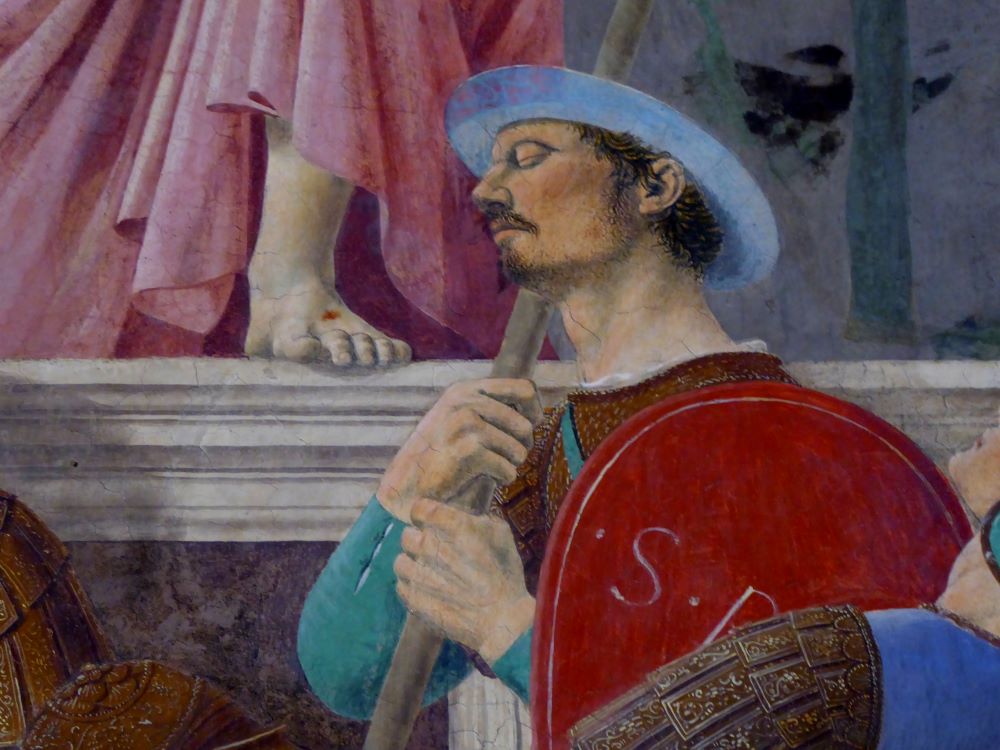
but it's the way the Resurrection leaps out at you when you enter the next room from the other end. It was originally placed in another of the palace rooms, but here is close enough. I thought I was lucky; Jill, my friend who worked on the restoration of the Piero Nativity in the National Gallery, told me how on a special visit they actually let the natural light into the room, and it looked even more extraordinary.

I've zoomed in a little on it above. The details are breathtaking, not just of the beautiful Christ

and the sleeping guards

but of the landscapes - a wintry one on the left

and trees in full leaf, the promise of Easter resurrection, on the right.

So whether you're religious or not, the fresco can serve as the most beautiful image of rebirth in man and nature. Just think, what's missing below would complete a trio of great Pieros in Sansepolcro.

It's the Baptism of Christ, now in the National Gallery, formerly hanging in Sansepolcro's Duomo. All the gaps we witnessed on this trip: these pictures need to return home! But what a can of worms that would open.
There was at least one other bonus. Last year our final destination, Volterra, proved very proud of its recently restored Rosso Fiorentino Deposition. Clearly another of his treatments of the same subject was worth seeking out in the church of San Lorenzo, at the end of a street rich in palaces and with a handsome arch to the left.

The painting was starred in the Blue Guide but described as 'dark and crowded'.

Dark it wasn't, and the mannerist riches positively glowed.

A deepening sunset accompanied our happy journey back to Arezzo, and we fell in love with the liveliness there, given a real feast of a Christmas light show, especially in the Piazza Grande.

The next morning, we ascended again and found another treasure, the Pieve di Santa Maria, though its west front sculptures were half-concealed by scaffolding and its precious Lorenzetti Polyptych had gone off on travels which will bring it to the National Gallery, much to the misgivings of art experts like Jill.
Anyway, we left lively Arezzo with some reluctance behind, and took our last bus journey, to Siena, through rolling hills, if not as dramatic as the route from Urbino to Citta di Castello. Nothing much changes about Siena, much more tourist central, but that greatest of Campos looked glorious in the clear winter light as we walked across it on the way from the bus stop to Sophie's apartment in Via di Sopra.

and the Duomo was looking equally spectacular.

I blush to say I didn't go inside this time, not even for the Xmas Day service. This was all about celebrating chez Sophie, where we had two long and excellent meals - on Xmas Day centring around a turkey that her American friend had managed to buy in town, being carved here by genial French paying guest Philippe, who was happy to mix in,

and on Boxing Day a tasty Kashmiri lunch prepared by said Sanjay, seen here at breakfast that morning with Sophie (the panettone we brought from Arezzo was possibly the best I've ever tasted).

The journey back to Verona on the 27th seemed freakishly fast - slow train to Florence, Frecciarossa from there to our destination. We even had time to catch the irregular evening opening time of San Giorgio in Braida, essential for the great Veronese of St George's Martyrdom on the High Altar. Designed to work with Sanmicheli's altar, it did not disappoint.


Goethe called this church a picture gallery, and there was so much else to see, including a Tintoretto Baptism above the west door. Most surprising to me was a Bellini-worthy Virgin Enthroned Betweem St Zeno and St Laurence by Girolamo dai Libri. Its angels at the foot of the throne bring us back almost full circle to the Mantegna altarpiece over the river with which I began.

Our last day in Verona before catching the flight to Dublin in the evening brought the warmest sun, but everything was different: what pre-Xmas was relatively quiet now seemed overwhelmed by tourists, and we turned away from the museum in the Castelvecchio, the last port of call. Nevertheless walks along the river were as lovely as before. Here's a last shot of the Ponte Nuovo with the Duomo tower on the left and the dome of San Giorgio in Braida behind.

And so, another December, another rich excursion around Northern Italy. So much more still to explore.


 Posts