Friday, 11 May 2012

Three Wiltshire churches


Flanked here by the pinnacled fantasia of St Mary the Virgin Steeple Ashton - a 'silvery battleship' as Betjeman described it - and the massy grandeur of the collegiate church at Edington on the edge of Salisbury plain is the spired bellcote of a small gem in an equally prosperous context, All Saints Great Chalfield. We started our Bank Holiday Sunday excursion there, skimming a lively plant fair our Lacock hosts were keen to catch and heading straight for the garden of the amiably proportioned manor at opening time. The church, which feels more like a cosy private chapel appended by Thomas Trop(e)nell to the late 15th century house - he added the bellcote to the 13th century building at the same time - is echoed by two topiaried pavilions or tree 'houses' of hollowed-out yews, part of Alfred Parsons' splendid garden design in 1910.


Tropnell further enhanced the little church with a family chapel, approached through an elegant screen with his coat of arms - gryphons, not cockatoos - in the centre.


Mutilated but still striking wall-paintings of the life of St Catherine within are surprisingly well complemented by Andrew Taylor's 1999 windows taking St Luke's Parable of the Sower as pretext for a detailed representation of British nature. I've chosen just a couple of details.


The good folk of Steeple Ashton lavished the profits of their cloth-weaving on what for me is one of the most magical flourishes of Perpendicular Gothic.


The steeple which gives the place its name was several times toppled in the 17th century and is no more, but the height of the tower which once supported it remains impressive. Beneath the pinnacles is a gallimaufry of gargoyles.


The porch gives promise of stonework within: its vaulting, which contains at its centre the Assumption of the Virgin,


continues in aisles and chapels, though the original intention to have stone vaults throughout apparently halted when it came to the nave. This roof of oak and plaster with pendants and bosses gives the well-lit interior further airy grace.


Fragments of medieval glass help to date the greater part of the church: the white rose and the sun-on-shield of Richard III mean the structure must have been completed before his death in 1485.


Just as Steeple Ashton is a great flowering of late medieval art, so the church of the Blessed Virgin Mary, St Katherine and All Saints at Edington, just below the north slope of Salisbury Plain, ranks as a handsome specimen of the previous century's transition from Decorated to Perpendicular. Its richness is due to its foundation, between 1352 and 1361, by William of Edington, Bishop of Winchester, who set up the neighbouring priory for the Augustinian Order of Bonhommes. Among whose number this monk may or may not be counted (the inappropriate blue of his vestment is due to a later recolouring, though some of the original has survived).


Again, he may or may not be a Baynton, as suggested by the visual representation of a bay in a barrel (tun) of wine.


Even more splendid is the monument dedicated to Sir Edward Lewys by his wife Anne Beauchamp, who followed her husband to eternal rest in 1664. It quite seduced me away from the other glories of the 14th century chancel. The angel or putto poised with crown above the couple is of wood rather than marble, which accounts for his elegant suspension.


The children pray for their parents below


and are imitated - with a presumably unintended sense of humour - by the early 19th century monument to the Tayler family in the north aisle. These equally pious offspring are children no longer.


Very nearly contemporary with the Lewys monument are the plaster vaults of nave, transepts and tower.


And so, our church homages done, we journeyed south for a circular walk around woods and downs. In a couple of weeks the bluebells may be over


but the beeches will be in full leaf and parts of the woodland will be covered in the orchids of several species we found emerging on the slopes.

Friday, 4 May 2012

Cymbeline of South Sudan


Of all the Globe to Globe ventures, the visit of the South Sudan Theatre Company seemed the most likely to be overwhelmed by its background story: theatre folk and poets coming together in a country less than a year old, still torn by strife when it should be building its new peace, to tackle an unfamiliar text. Not that Cymbeline is among the Bard’s most studied plays anywhere – I discovered a special fondness for it at university -  but the circumstances here seem especially fraught. For two decades no English books were permitted by the Sudanese government in the north, so having the text translated into Juba Arabic, a language subject to an oral rather than a written tradition and one formerly suppressed under British colonial rule, was a double victory. This excellent little film draws you in to the newly-formed company's preparations.


How was it, in practice? Very rough and ready: some tentative entrances, plenty of stand and deliver, actors talking over each other rather more often than was in the interests of lively drama. But there was no mistaking these Africans’ enthusiasm and instinct for storytelling, the way they slipped so easily between punctuating drumbeats into the Globe’s best house style of engaging the audience and resonantly addressing invisible gods (I hear the six Italians’ crazy version of Julius Caesar later on Wednesday needed miking: che disgrazia!) The tradition of strolling players was alive and well here; you could well imagine this team putting across the essence of the play vividly to assembled village people al fresco. We don’t find the raising of a sleeping maiden’s nightdress cause for a good laugh, but cultures can’t always be expected to agree.


How much does the story reflect South Sudan’s struggle for liberation, as has been claimed? Not a great deal: though peace and reconciliation must resonate in spite of very recent Sudanese evidence to the contrary, the conflict between Cymbeline of the woaded Britons and ancient Rome is, at least until the very late stages of the play, mere background for the wanderings and trials of the king’s daughter.

‘Heavenly Imogen’ I’ve always thought of as a kind of Alice cast adrift in a grotesque wonderland when separated from her beloved Posthumus. She fends off the advances of his scurvy friend Iachimo, who wrests love-tokens from her unknown by sneaking into her bedchamber concealed in a trunk (here he snakes out of a trap door). She wakes from the effects of a death-simulating potion alongside the headless body of her wicked stepmother’s silly son Cloten, killed by a young man under provocation who will turn out to be her brother, and takes the torso to be Posthumus. The lengthy reconciliation scene is full of what a friend of mine calls ‘I was that toothbrush’ moments.


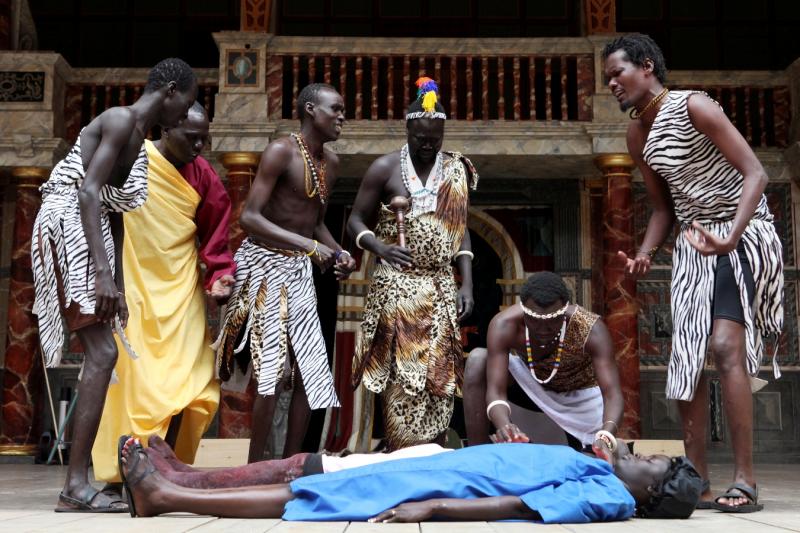
All this was strongly evoked by the South Sudanese actors, with (I fancy) very few cuts and minimal help from the scene summaries in the LED paratitles. It was impossible not to warm to the indignation and passion of Margaret Kowarto’s Imogen (prone in the above photo) or the dignity of Francis Paulino Lugali’s Posthumus. But the festival’s ongoing problem, which can occasionally be a virtue, of not having the text translated back into the Shakespeare original to help the punters made me realize more than ever that the contrived situations of Cymbeline seem merely daft in themselves; it's the poetry they conjure up in the unlikeliest circumstances which gives them sense and wonder.

Here it’s not quite enough to claim that one vaguely feels the force of that poetry in another language without understanding it. The audiences for these shows are incredibly resilient and patient, but they have to be grateful for resourceful mime, jolly dances to clap along to and choice morsels dropped in (non-Shakespearean) English, in which the South Sudanese were as well versed as the Indian actors in the much slicker Twelfth Night. Which of course is far from the whole story, however well that story's told. Shakespeare the poet is largely absent unless you happen to speak the language; Shakespeare the dramatist usually emerges triumphant. Which is enough to keep me going, I hope, to more offerings in this extraordinary world festival.

Production images by Ellie Kurttz for Shakespeare's Globe

Monday, 30 April 2012

Cherokees see Shakespeare slain


Here's a picture which is less remarkable for its execution than for capturing a slice of history not entirely unrelated to the worldwide Shakespeare carnival parading within the Globe. We arrived at the Victoria & Albert Museum the Sunday before last at 2pm, just too late to catch any of the art-college Shakespearean design ‘happenings’ which had by all accounts enlivened so many of the museum’s rooms and galleries. But I and Neapolitan visitor Clara were regaled with fabulously entertaining anecdotes about objects in the theatre collection by curator Geoff Marsh, who’d already given such good value at the time of the Diaghilev exhibition back in 2010.

He gave us the lively circumstantial history of this sub-Hogarthian artwork by William Dawes, The Downfall of Shakespeare Represented on a Modern Stage (click on the image for more detail). The darker-skinned spectators in the audience to the far right are two Cherokee Indians, part of a delegation visiting London in 1762. Chief Ostenaco, diplomatic in his relations with colonial big-wigs, met George III and sat for Sir Joshua Reynolds.


What they're watching is an allegorical murder: the triumph of Italian opera in the London of the mid 18th century  as represented, it’s thought, by Artaxerxes, over far superior native art (though if we're talking the Artaxerxes of Arne, he of Rule, Britannia! fame, both the libretto and the composer were English, so I'm a bit confused). Which is why Shakespeare lies dead while the operatic hero tramples pages of his plays. The V&A’s website page explains further: ‘In the 18th century Drury Lane and Covent Garden were the only theatres licensed to stage 'legitimate' drama. The popular Italian opera was the province of the King's Theatre in the Haymarket. Things changed in 1761 when the great English tenor, John Beard, took over the management of Covent Garden. He increased the number of opera performances and those of Shakespeare fell.’ More background here.


 Needless to say, rumours of our Will’s sudden death were greatly exaggerated, and now visitors once perceived as exotic are more likely to be playing Shakespeare from their own special perspectives rather than missing the chance to see his works on the London stage. I’ve now seen two more offerings in the great Bardic world meeting of Globe to Globe to follow the first play to be performed, Troilus and Cressida in Maori, and I’d be hard pressed to say which of the three was the best. No need to reiterate eulogies on The Arts Desk – on the Swahili Merry Wives of Windsor here and the Hindi Twelfth Night here – but let’s see a couple more images. First, Mrisho Mpoto’s Falstaff nimbly tumbling, if such a thing’s possible, into the buck-basket supplied by Mistresses Page (Chichi Seii) and Ford (Lydiah Gitachu; photo for Shakespeare’s Globe by Marc Brennan).


Now Geetanjali Kulkarni as a feisty Viola in The Theatre Company of Mumbai's earthy - but musically very sophisticated - Twelfth Night. Photo by Simon Annand.


For proof that at least half the audience understood the Hindi, see below. I should hasten to add this was taken before the performance, not during it. And yes, I abandoned my usual groundling place and opted for a seat, since heavy downpours threatened; in the event there was only one.


This week’s Globe to Globe  includes a handful of Italian actors taking on all parts in Julius Caesar; the appearance of the youngest nation, South Sudan, in Cymbeline; and Richard II from Ashtar Theatre, Ramallah, a staging which goes some way to meeting the objection of those (including Mark Rylance) who think Israel’s Habima National Theatre shouldn’t be allowed to appear with its Merchant of Venice.

Thursday, 26 April 2012

Shakespeare's Maori warriors


With 38 theatre companies and as many languages descending on the Wooden O across the next six weeks, the least I thought I could do was to make a long-overdue theatrical outing and honour the Globe to Globe Shakespeare marathon at the earliest opportunity. I missed the opening, an evidently enchanting dramatization of Venus and Adonis by South Africa’s Isango Ensemble, but I hied me thither to catch the next event, an extraordinary Troilus and Cressida from the Maori company Ngakau Toa directed by Rachel House (production photo above by Simon Annand for Shakespeare’s Globe; shot below featuring Kimo Houltham’s Troilus/Toroihi and Awhina Rose Henare-Ashby’s Cressida/Kahira from the team’s admirable website). For a more detailed appraisal of the individual performances than I’m about to give, read my colleague Matt Wolf’s eulogy on The Arts Desk.

The overall look and sound of it will never be forgotten. Here were warriors to the life, acting out Shakespeare’s singular and troubling interpretation of episodes from the later stages of the Trojan war with incredible vigour, all feathers, bare chests and tattooed buttocks and thighs. They started with a traditional Maori Haka or war cry to the Prologue’s ‘In Troy [for which read Aeotearoa], there lies the scene’ - a ritual now on YouTube courtesy of a little Telegraph film -


 and there was an impromptu response at the end, too, as our neighbour-groundlings responded with their own earth-shaking tribute. At last we understood just how many audience members had been getting the verbal as well as the physical jokes; the Maori community in London must have joined the actors’ devoted fans from New Zealand.

All this was visceral, goosebump-raising and subtly complemented throughout the play itself by the refined, often spooky taonga puoro musicmaking of participant James Webster. Maybe the action itself came across as a bit too robust to suggest a war that’s been dragging on for years; there was little sense of the ‘botchy core’ eating away at notions of valour and love, though I liked the changes rung by an impish female Thersites (the chameleonic Juanita Hepi). But one big plus was that the fight scenes, which are usually the point at which even the best of British productions buckle a bit, provided a fitting climax, even if the horror of Hector’s ignoble death at the hands of Achilles’s Myrmidons went for little. 


One crucial accompanying element came as a bit of a shock. The digital panels either side of the stage gave us not a line of Shakespeare in the original, only the baldest of scene-summaries. So the Bard’s flights of fancy and disgust had to be semaphored at best, the war-council speeches – and I was alarmed to find how much of them I’d forgotten since a time when I knew the play well – passed us largely by, and identification of the warriors on both sides was even harder than usual (an opportunity missed by the supertitling in the early parade of Trojans, duly compared to big up Troilus in Cressida’s eyes by Rawiri Paratene’s authoritatively seedy Pandarus). Certainly words to the effect ‘Pandarus brings Troilus and Cressida  together’ were no substitute for the poetry in that initially tentative love-scene. So the language, except for those who understood the impressive Maori translation, was the biggest casualty. I wonder if the same opacity is to dog, say, the Serbian/Albanian/Macedonian Henry VI three parter?


Yet it has to be said that the audience went with the general sense of it all; the groundling zone remained as busy after the interval as it had been during the first half. As far as I could judge, this was the most compellingly-realised Troilus of the ones I’ve seen since Howard Davies’s Crimean War version many years ago, with Juliet Stevenson as an against-the-grain Cressida so shockingly bartered and traduced. The unique atmosphere of the whole will resonate in the memory long beyond any of those quibbles.

Full details of the Globe to Globe extravaganza here

Thursday, 19 April 2012

Chopin list


On the stage of Paris’s Théâtre du Châtelet in June 1909 were Vaslav Nijinsky in a rather unbecoming orangey-blond wig and attendant ethereal creatures including Tamara Karsavina and Alicia Pavlova. Down in the pit the orchestra played the joint creative input of six musical minds, colliding in a pretty mélange of sorts. Since three of them – Chopin, Stravinsky and Glazunov – are to meet in the Royal Ballet’s triple bill of A Month in the Country, A Birthday Offering and Les noces next month, and I needed to knit them together somehow in a programme article, the premiere of Les sylphides seemed like a very good place to start.

Digging out the whys and wherefores made me realize what a complex musical history this more or less plotless ballet, with its romantic poet flanked by long-tutued sylphs, has had. Not only does it tend to be most often performed, when it is performed at all, in Roy Douglas’s arrangement, but since the Russians other orchestrators have included Maurice Ravel in 1914* and Benjamin Britten, in a 1940 effort for an American ballet company sadly lost (and the editors of Britten’s letters must be believed on this, rather than Richard Taruskin, who claims the orchestration to be ‘in current use’. I wish it were).

So I thought as a kind of fridge-magnet memo to self I would attempt as un-drily as I could to list the path to the 1909 Les sylphides. Volume One of Taruskin’s Stravinsky and the Russian Traditions was a huge help, with detail from Lynn Garafola’s Diaghilev’s Ballets Russes.


Glazunov kicked off in 1892 with his orchestral suite Chopiniana, presumably inspired by what Tchaikovsky had done with Mozart piano pieces + the motet ‘Ave verum corpus’ Lisztified in his Suite No. 4. The four pieces in Chopiniana – none of them, note, used in Les sylphides – were the 'Military' Polonaise, Op. 40 No. 1; the Nocturne in F, Op. 15 No. 1; the Mazurka in C sharp minor, Op. 50 No. 3;  and the Tarantelle, Op. 43.


In 1907 Mikhail Fokine – pictured above two years earlier in costume for Paquita – choreographed Chopiniana for the Mariinsky. He asked Glazunov to make an additional orchestration of the C sharp minor Waltz, Op. 64 No. 2 with a bit of the Op. 25 No. 7 Etude to preface it. The waltz did of course survive into the Diaghilev-managed Les sylphides.

Chopiniana the ballet showcased national as well as classical dances – Warsaw ballroom style for the Polonaise, Capri-based folk dance for the Tarantella. That had little in common with Les sylphides. But the music and choreography for Fokine’s second Chopiniana ballet, entitled Grand Pas to Music by Chopin, certainly did. This retained only the C sharp minor Waltz and placed it alongside the six other numbers we know from Les sylphides (I'm getting opus fatigue now, and I'm sure you are, so we'll leave it at that until Stravinsky's contribution pops up).


 When Diaghilev turned to ‘the second Chopiniana’ for his Ballets Russes’ first appearance in the Parisian ‘Saison Russe’ of 1909, he clearly didn’t think much of its arrangements other than Glazunov’s; the rest had been hastily done by a répétiteur at the Mariinsky, Maurice Keller. So Diaghilev turned to Lyadov, Taneyev, Nikolay Tcherepnin and...the 26 year old Igor Stravinsky, who at the beginning of 1909 impressed him with his orchestral showpiece the Scherzo fantastique. I’ve not been able to trace the other arrangements, but Stravinsky’s not especially flavoursome yet historically fascinating versions of the Nocturne in A flat, Op. 32. No. 2 and the Grande Valse brillante, Op. 28 appear in rather poor sound – and with visuals you fortunately don't need to watch – via a performance from Sakari Oramo and the City of Birmingham Symphony Orchestra. Don't ask me why there's a snippet of Beethoven's Fourth Piano Concerto at the start, but don't readjust your sets - it quickly vanishes.


Which provides an excuse very belatedly to congratulate Oramo on his appointment as principal conductor of the BBC Symphony Orchestra, taking up the baton in September. That fabulous Bax/Saariaho/Sibelius concert which was definitely one of the highs of 2011 clearly had its impact - and looking back at the associated blog post, I see there was speculation in the comments about who would take over the reins at the BBCSO. One thing I didn't know at the time was that it was the first occasion on which Oramo had conducted a London orchestra.

And while sounding the BBC note, fullish details of the works at the 2012 Proms (though minus artists) are here on the Arts Desk and here on the BBC Proms website, less easy to take in at once. All I’ll say is that there must be something there to satisfy everyone, and that if another Beethoven symphonies cycle would usually send me diving for cover, the fact that it comes from Barenboim and his West-Eastern Divan Orchestra is a real coup for the world's biggest music festival.

*this added in the light of Shin-ichi Numabe's comment below.

Saturday, 14 April 2012

In search of a shadow


The first time I saw Strauss and Hofmannsthal’s ‘massive and artificial’ (Strauss’s words) operatic fairy tale Die Frau ohne Schatten performed by Welsh National Opera, programme and posters were garlanded with images by the Belgian symbolist painter Fernand Khnopff, whose enigmatically titled ‘I Lock My Door Against Myself’ is pictured up top, his ‘Sleeping Medusa’ below. The opera’s unsettling, decadent atmosphere, its clash of spirit and human worlds, was not exactly Khnopffed but well served all the same by the spare yet effective and magically lit touring production (and great Norman Bailey sang the role of Barak the Dyer – I’m pleased still to have his singing in Act 1 on an old cassette).


Yet it’s worth remembering that, begun as it was before the First World War, this optimistic fantasy finally premiered in a Vienna stricken by post war austerity. The mood had changed – as had Strauss’s, who, as he waited for Hofmannsthal to get the last bits of text to him in 1916, decided that such monuments were now out of joint with the troubled times and felt ‘downright called upon to become the Offenbach of the 20th century’ instead.

Quite apart from its dodgy moral-majority message that you’re incomplete without children – which can be sidestepped by special pleading that the subjects are really creativity and compassion - Frau is, no doubt, problematic in that it starts out taking the magic seriously in an astonishingly scored first act and finishes by not believing enough in its happy end. But does this justify wrenching it to another time and place still reeling from calamities, a chilly 1950s Vienna of underheated recording-studio halls and drab winter clothing, where a stiff Christmas concert performance deputises for the portentous finale?

That’s director Christof Loy’s solution, and I’m still in two minds about his 2011 Salzburg Festival production, now preserved on an Opus Arte DVD. It does humanise all five principal characters – on one side the Emperor and the Empress who has not yet born him a child, on the other the dissatisfied wife who may or may not give up the shadow the other woman needs and her placid husband, with the Mephistophelean Nurse as conniving go-between. There is, though, one huge problem. I genuinely believe that, for all the mumbo-jumbo, the essence of Hofmannsthal’s plot is rather simple as it follows the Empress’s path to enlightened rejection of the shadow, the realization that she cannot buy her own happiness at the cost of others. Loy replaces, rather than parallels, it with a recording-studio ‘storyline’ that’s so oblique it doesn’t begin to make sense. His exhortation of Strindberg’s preface to A Dream Play suggests that he never intended it to. 


Anyway, it’s not my place here to discuss the DVD as a whole, which I’ve done within the constraints of a BBC Music Magazine review yet to be published. I will say that I was alternately fascinated and baffled, never repelled, by the production, but always in thrall to Thielemann’s magisterially beautiful conducting of the Vienna Philharmonic and to the Empress of my Straussian idol Anne Schwanewilms (pictured up top by Monika Rittershaus for the Salzburg Festival).

It’s not a flawless performance, but so expressively right for the translucent not-quite-earthly girl who becomes a deeply feeling human being. Prior to the DVD release with English subtitles, chunks of the telly screening went up on YouTube, so watch and hear, if you will, the Empress’s awakening scene in Act One – that’s a keenly-inflecting Michaela Schuster as the Nurse at the start, and you can decide whether you want to go on to their scene together, a bit of a trial without translation -


and the culminating ‘judgment of Solomon’ scene of Act Three in which the Empress has to decide whether to take the shadow or not. Maddeningly, there’s no dramatic substitute for the usual suspense as to whether the elusive shadow will appear on cue or not, or for the chilling sight of the Emperor petrified except for his eyes; but I reckon Schwanewilms holds the intensity of the drama with her vocal and physical expressiveness. Again, you can probably forego the barky aftermath of heldentenor Stephen Gould’s contribution.


Tuesday, 10 April 2012

Easter Day at Ozleworth


Our Gloucestershire Sunday walk took us down through the woods of the Newark Park estate and up along the back lane to this isolated but spruced-up* gathering of barns, grand house and Norman church in a circular churchyard which I like to think reflects an original pagan site (the rest of the way back to our hosts' farm at Uley was cut short because we'd come out with the wrong Ordnance Survey map, and sniffing our route on and off piste was only partially successful).

The name is singular: the option I prefer interprets 'Ozle' as 'Osle' or blackbird - think of Shakespeare's Bottom and his 'ousel-cock so black of hue, with orange-tawny bill'. The site is the side of one of those valleys in which Gloucestershire abounds, less dramatic than the hilltop setting for the house at Newark; the ensemble here does not open itself up to vistas. But St Nicholas of Myra is quietly remarkable.


Its irregular hexagonal tower, dating from 1110-20, was probably built above the Norman nave of a small oratory. Enlargements were made in the early 13th and 14th centuries, and again in the 19th by clergyman architect William Henry Lowder. But the 'improvement' of the Victorian restoration is pleasantly offset by the building's current status under the Churches Conservation Trust, which always means clean-cut simplicity.


There are two fine arches, one chevroned in the west tower wall, the other more unusual around the south doorway (pictured above), which the detailed guide describes as boasting 'a finely carved exuberant decoration of stiff-leaf sprays set in six large lobes around the arch and supported by circular shafts with stiff-leaf decoration around the capital'. The font is 13th century, with dog-tooth and nail-head decoration


and, apart from the Flemish windows in the south-west tower, the only old glass is a medieval fragment of a saint at the top of the otherwise Victorian east window.


Prettily lichened cherubs grace a Warlock family tomb in the uncluttered churchyard (hard to fill given such a small parish).


Later we processed to a homespun Evensong in the local church at Owlpen, gaudy with Victorian and Edwardian mosaics which you'll admire if you like that sort of thing or find contributing to a 'special ugliness' if you share the sentiments of the Shell Guide's author. Anyway, the 1913 angel is at least bright and topical.


Our Easter fare was a last year's lamb from the neighbouring field, and the kitchen table was bright with eggs, including a few real ones from the bantams outside, and flowers from the garden, most intriguing of seasonal visitors, I reckon, being the snakeshead fritillary.


On a personal note, I count it as a big achievement to have ventured thus far, a small enough distance under usual circumstances but a major effort in the light of the past few months; the path to recovery surely (surely!) begins here.


*friend Cal says it was much more atmospheric when overgrown, and before socially competitive folk laid renovating hands on the site. But it's all lovingly done, I guess.