Showing posts with label Stravinsky. Show all posts

Friday, 16 October 2020

From Firebird to Revolution, 1910-17


First term of my Russian music course on Zoom went well, by which I mean there were lots of happy students and I enjoyed every minute of it, firming up allegiances and discovering more (especially in the sphere of chamber music). In the end we covered ground from Glinka to early Rachmaninov, stopping at 1900, with a few glimpses into the future. My original idea, to devote the 10th class to Stravinsky's The Firebird as a last great synthesis of the fantasy tradition, was postponed simply because the one class I'd intended on Musorgsky's and Tchaikovsky's piano music turned into two. 

That was because Samson Tsoy had so much to say about Pictures at an Exhibition and his partner Pavel Kolesnikov, who popped up briefly at the end of that class, was happy to return a couple of weeks later. When great musicians are willing to come along, as they did for every class of my course on the symphony, you have to be flexible (pictured below by Eva Vermandel, Samson and Pavel during their phenomenal Ragged Music Festival, from which I'm still recovering: read what one of my students described as a 'palpitating' review - that's got to be better than 'gushing').


I'd also intended to go straight on from the first term to Soviet music. But it occurred to me that those seven amazing years from 1910 to 1917 could take a term of their own, albeit one of seven classes (taking a break and mapping out the possible up to Christmas meant I ended up with that number). Here's the plan. We start on Thursday 29 October and each class runs from 2.30pm-4.30pm (longer under certain circumstances). £10 a class so £70 for the term. Special guests TBC, though two top pianists have already shown willingness. UPDATE (19/11) Seven classes have evolved into eight, due to an enrichment not unlike the one we had in the first term.

 1: The Firebird and the end of a tradition  29 October

Stravinsky's first ballet for Diaghilev - the exotic exported to Paris - reflected the fairy-tale compendium of its scenario with homages to the fantasies of his teacher Rimsky-Korsakov and others, but also nodded to the harmonic experiments of Scriabin and looked forward to the rhythmic revolution of The Rite of Spring. I'll be placing it in the context of the 19th century tradition as well as the early years of the 20th century. Pictured above: Mikhail Fokine and Tamara Karsavina in the 1910 Ballets Russes premiere.

2: Petrushka and Russian popular song  5 November

Stocked high with highly original treatments of familiar folk/urban song, Stravinsky's fairground ballet of 1911 features a radical use of orchestration which owes its originality to Tchaikovsky's example. But it is also startlingly modern in the scenes featuring the pathetic Russian Pierrot come to life. Hungarian-born conductor Gergely Madaras is our special guest.

3: The Rite of Spring I: mostly melodic and traditional  12 November

Often overshadowed in the stress on rhythmic iconoclasm is Stravinsky's use of singing themes - only three of them this time taken from folk sources. Again, the mix of modernism and tradition is startling. Pictured above: maidens in Nicolas Roerich's designs for the Ballets Russes premiere of 1913. Andrew Litton, whose BIS recordings of Petrushka and The Rite of Spring are such a revelation, joined us for this class, and going with the flow meant we were only halfway through what needed to be said and demonstrated about the work. A second hour was intended the following week, which stretched to two - hence the offer I've just made of a free eighth class.

4: The Rite of Spring 2: polyrhythms and unfathomable accents  19 November

Andrew's return yielded more fascinating chapter and verse, and the return of Catherine Larsen-Maguire gave us insights into the writing for bassoon - her instrument before she changed to conducting. Leonard Bernstein in his Norton lecture 'The Poetry of Earth', Pina Bausch's choreography and Stravinsky speaking again on the aftermath also joined the party.

5: ''Footballish' pianism and audacious orchestral tricks: the young Prokofiev  26 November
 
 
First appearing on the scene in the same St Petersburg Evenings of Contemporary Music where Stravinsky made his debut, a young Conservatoire student quickly created a sensation. With special focus on Prokofiev's first two piano concertos, early piano pieces and the Scythian Suite derived from his first ballet music for Diaghilev, Ala and Lolly.

6: Rachmaninov's The Bells and his Vespers as part of the revived Russian Orthodox tradition  3 December
 
The rediscovery of ancient church traditions only really took off in the early 1900s, and was flourishing when the revolution put a stop to so many schools of choral music. Before that happened, though, it produced its greatest synthesis-masterpiece, Rachmaninov's numbers for the All-Night Easter Vigil known as the Vespers, in total contrast to his choral symphony inspired by Edgar Allen Poe The Bells.

7: Scriabin: mystic chords and apocalyptic visions  10 December
 
 
Boris Pasternak thought him 'warped, posed and opinionated' but also as bright as the sun in his music; Prokofiev found his harmonic discoveries a millstone weighing down his options. But there's no doubt that Alexander Scriabin was a true original
 
8: On the eve of an earthquake  17 December
 
What kind of music were the Russian composers creating as the February and then the October revolutions broke? Prokofiev's diary gives a special insight into where he was and what he was doing at these times, with cinematic descriptions of being caught up in the chaos of Petrograd early in the year. We also look at Rachmaninov's last great compositional flowering before exile and the need to tour as pianist slowed down his creativity.
 
Do join us - and if you can't do so on the afternoon, I send out recordings (video if film is used, audio otherwise). You don't need to have attended the previous course. If you're interested, just send me a message with your email: I won't publish it, but I promise to respond.

Monday, 5 November 2018

Rake afternoon reminder


Click on the above for better detail and come along if you can. What would normally be the last class of my Opera in Depth term has turned into a little gala with excerpts from Stravinsky's The Rake's Progress to raise funds for British Youth Opera. I'm confident that Spence, Nicky will match Spence, Toby, who gave a total performance on Saturday night as Vladimir Jurowski's Tom Rakewell. Our Rake people span productions from 1977 (Dame Felicity Lott, who will speak but not sing, at least live) to this year (Samantha Clarke, a stupendous Anne Trulove in British Youth Opera's fine production). It's been a joy dealing with the folk at St James's Sussex Gardens - total pros.


Meanwhile the last two of four classes on Tchaikovsky's The Queen of Spades will be, very appropriately, at Pushkin House, since the Frontline, 'gone corporate' as founder member Ed Vulliamy puts it, decided that they needed to have the room available to make more dosh - and I pay them quite a sum already - in 'the run-up to Christmas', which they regard as the whole of November. Well, the bonus is that the students also get to see a fine exhibition of Laura Footes's imaginative artwork inspired by Bulgakov's The Master and Margarita. I was at Pushkin House last Tuesday for a talk by my New Best Friend from a Bromsgrove Shostakovich Quartets weekend, Elizabeth Wilson, on the extraordinary pianist Maria Yudina. Which has led to a whole investigation of great playing. But more on that anon.

Wednesday, 12 September 2018

Rake and Spades at the Frontline: do join us


Yes, that's the great Dame Felicity Lott as our Opera in Depth end-of-term lunch guest last term, before she went on to talk with her usual natural charm, wit and insight on Britten (we were covering A Midsummer Night's Dream over five Monday afternoons, using the Peter Hall Glyndebourne DVD in which she plays an appropriately tall Helena. Yesterday she was a very impressed onlooker at the celebrations of the great director's life). There are, incidentally, many more of us than you see in the Frontline club room shot above.


For the coming term, which starts next Monday, I'll be covering Stravinsky's The Rake's Progress and Tchaikovsky's The Queen of Spades, two operas which climax in a crucial game of cards. Pikovaya Dama, to give it the proper Russian name (Pique Dame, incidentally, is nonsensical) will be staged at the Royal Opera in Stefan Herheim's Tchaikovskycentric production; having reviewed the DVD of its Dutch incarnation for the BBC Music Magazine, I can say you're in for a treat, a concept that's actually followed through, so let's forget that dramatically abysmal Pelléas et Mélisande at Glyndebourne.

Vladimir Jurowski will conduct The Rake's Progress at the Royal Festival Hall (no idea yet how semi-staged it's going to be). He made such poignant and light-of-touch work of it at ENO years back, in a quirky production by Annabel Arden with a profoundly moving Bedlam scene. Back to the Garden of Eden below in the recent British Youth Orchestra production I found so effective: Pedro Ometto as Trulove, Samantha Clarke as Anne and Frederick Jones as Tom Rakewell (image by Bill Knight).


Meanwhile, a Rake extravaganza linked to the above has already taken some shape for our last class on 17 November. As the Frontline Club flummoxed me a couple of months ago by telling me that they regard the 'run-up to Christmas' as including the whole of November, when they hope to make more than the substantial amount I pay them for my weekly two hours, I've had to find other homes for the last three Mondays. Which, it now seems, will be St James's Church Sussex Gardens, with its avowedly fine audio-visual set-up - I'm going to check it out on Monday - and its new Steinway Boston Concert Grand.


The idea for the proposed event took shape quickly after I'd been to see the BYO Rake. FLott, as Madame la Patronne of BYO (as she is of the Poulenc Society), had recommended I go, and I'm glad I did. So she has agreed to preside, a lovely connection back to the famous Hockney-designed Glyndebourne Rake in which she sang the role of Anne Trulove, happily preserved on DVD (the Bedlam scene above with Leo Goerke). Samantha Clarke, already a world-class Anne, will, we hope, reprise the aria.


Nicky Spence - who sang Tom Rakewell for BYO a decade ago, pictured above - will join with his pianist partner Dylan Perez, and Susie Self, a hairy-chested Baba the Turk for Opera Factory back in the 1990s, has agreed to come along too.

Students for the term will have this as part of their package, but we hope others will come along too, to help us raise money for BYO. A unique event - put it in your diaries, and leave a message here with your contact details (I won't publish it) if you want to join us either for that or for the entire term.

Thursday, 24 December 2015

Seasonal notes


That's notes in both senses - purely musical ones, and writing about the music, which I was honoured to do for two releases of the highest quality. Actually both came out last year, but top Norwegian ensemble Music for a while's Canticles of Winter didn't get pushed/distributed here until recently (they came close to a deal with Deutsche Grammophon). My excellent friend and colleague on The Arts Desk, Graham Rickson, echoes most of my thoughts in the first of his Christmas CD roundups here

As for what I felt on listening to the white-label copy, that's in the liner notes, and if they smack to you of gush, they're certainly not insincere. I really was bowled over by that chance encounter with Tora Augestad and her phenomenal players at a late-night cabaret in Stavanger, bought their Weill CD - one of the best, if not the best, I know - and got sent the selection of Dowland and other classics transformed. It's high time the group made their UK debut, preferably at the Sam Wanamaker Playhouse. This is an ensemble of equals, and if there's a better, cooler jazz trumpeter than Mathias Eick I don't know him. Stian Carstensen's accordion also adds sharp icicles, and not just to the group's second version of 'Der Leiermann' at the end of Schubert's Winterreise (very different from the first). Canticles of Winter tends to the dark, chilly side, but it's none the worse for that.


All brisk brightness, on the other hand, is the third and last of Neeme Järvi's complete Tchaikovsky ballet recordings with the Bergen Philharmonic for Chandos. I'm not so much proud of these notes as grateful to Chandos for letting me do what I'd always wanted - a number by number synopsis pointing out the specific nature of the musical genius in each. Good news, too, is that the equally idiomatic and characterful concert performance of The Sleeping Beauty Act Three from Vasily Petrenko and the Royal Liverpool Philharmonic Orchestra has been recorded for release on the RLPO's own label.


Finally, if you want a big aural binge in the lazy days between Christmas and New Year, let me reinforce what I had to say about two big Stravinsky boxes on BBC Radio 3's CD Review (four days left to listen on the iPlayer). Several friends have already bought the DG box on the strength of what they heard, and while Stravinsky's own performances are of infinite fascination on Sony, and the presentation much more sexy/nostalgic,


the variety of interpretations here is no doubt richer, and gives an interesting perspective on the range of approaches to Stravinsky over 80 years. Excellent value for money, too, I'm told. And it should be pointed out that neither edition is 'complete' - several key arrangements of other composers are missing though not, on DG, the essential, telling transcriptions of two Wolf songs right at the end of Stravinsky's life. I was pleased with the radio segue into the chromatic first of them from the dodecaphonic In Memoriam Dylan Thomas.

Happy listening, and season's greetings, with a second plea for charitable giving to Migrant Offshore Aid Station (MOAS). Circa 3,500 would-be migrants lost their lives at sea this year, another 30 hitting the news today. Even one would be too many.

Wednesday, 25 November 2015

Once a Bishop


From his birth in 1940 until 1975, he was plain Stephen Bishop, named after his stepfather (typically, he plunged in at the deep end in his recording career with Philips, recording Beethoven's Diabelli Variations in 1968, sleeve pictured above). Then he added his Croatian father's name and became Stephen Bishop-Kovacevich. For many years now, he's been not-so-plain Kovacevich, and as such he celebrated his 75th birthday in high style with former other half Martha Argerich at the Wigmore Hall. Here they are playing Debussy's En blanc et noir - roles were swapped for a stupendous performance of Rachmaninov's Symphonic Dances -  with thanks to Clive Barda.


I reviewed the curate's-egg programme - still can't quite decide what I thought about the very speedy Schubert D960 Sonata, so very different from his Hyperion version - on The Arts Desk, preceding it with a long, long interview. Which was a privilege and an honour, but how much more I could have got out of it had the Universal box of all his Philips recordings made a timely arrival.


It was, at any rate, a pleasure to dive in and dig out the performances he specially rated: Brahms One and Schumann Concerto with Colin Davis, Bartók's Sonata for Two Pianos and Percussion with Argerich, and of his many recordings of the Brahms solo piano works, he singled out the Capriccio, No. 8 of Op. 76 as something very special and oh, so hard to play well. The set also plays to my being suckered-in by original sleeve artworks, sadly not of course reproduced at the size of the original LPs, but some are so very 1970s.


I've spent much time with the rest of the 25 CDs - amazed by his Chopin, a composer with whom we tend not to have associated him, and returning most often to the sets of late Brahms piano pieces (Opp. 116-119). He switched me on to some of these elusive, often very interior masterpieces in a 1981 Edinburgh Queen's Hall recital during my first year as a student (it may just have been Op. 117, and certainly a Beethoven sonata was also on the programme - though whether 'Tempest' or 'Waldstein', I can't remember - one of those because I made an only partially successful attempt to learn both in the early 1980s).

These are certainly top of the heap - in the interim, I've also played Nicolas Angelich's interpretations - and no-one captures better or more supernaturally the weird introspection of, say, Op. 116's No. 5 in E minor or the first two of Op. 119. The titanic and the intimate side by side which mean Kovacevich IS Brahms for me are most extreme in the first of the Op. 79 Rhapsodies.


Kovacevich's delicious solo rendition of Brahms's Op. 39 Waltzes provides an appropriate link to a more consistently miraculous birthday celebration more recently at the Wigmore - divine Elisabeth Leonskaja's 70th, surrounded by friends both young and (relatively) old. Again, I've written a review, this time a total paean, over on The Arts Desk, and I was thrilled to hear Jörg Widmann live as clarinettist for the first time - what a complete performer - but the four-handed Waltzes were a special delight.

Fireworks came from Samson Tsoy and Pavel Kolesnikov; taking over for some of the more inward numbers were 'Lisa' and acolyte Alexandra Silocea - whom I've known since writing the notes for her Prokofiev debut CD and like a lot, ditto her delightful husband Sébastien Chonion, who's been garnering awards for his production work at Glyndebourne. I'm assuming he took this picture of the happy Brahms foursome (update: he tells me he didn't, and only Alexandra, giving a Manchester Bridgewater Hall lunchtime recital even as I write, can identify the photographer). Kolesnikov is on the right.


Another good pic of the evening - which wasn't officially snapped - came from Tweeter Odetta. I hope she won't mind my reproducing this one, an alternative to Sebastien's group shot which I used on TAD. Sorry you can't see more at this size.


As for bumper boxes, I finally got to the end of 86 CDs - 50 in a Sony box, 36 from Universal - of Stravinsky, and talked about the experience with Andrew McGregor for about an hour on Saturday's CD Review, with some choice excerpts. I can honestly say it's been a constant enlightenment, and probably no composer weathers such consecutive listening better. Listen to a fraction of the thoughts I had about the two sets for the next 28 days on the BBC iPlayer. The chunk starts at about the 1hr48m mark.

Sunday, 10 November 2013

Two Norwegian moods


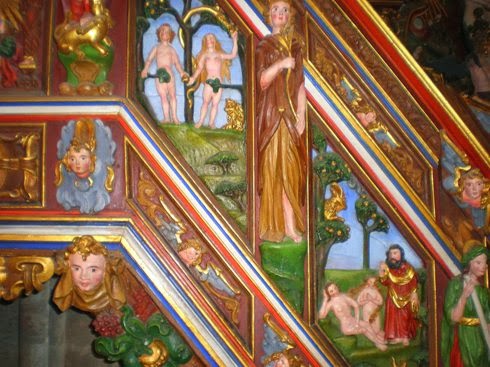
The one in St Swithun's Cathedral Stavanger was essentially as celebratory as its gaudy pulpit, completed in 1658 by Scot Andrew Lawrenceson (aka Anders Lauritzen after he settled in Bergen and married a Norwegian) Smith and running the Bible story from Adam and Eve to Christ in triumph: this was the first home for the great events of the fabulous Stavanger International Chamber Music Festival, my invitation to which kicked off an unforgettable Scandinavian holiday.


No doubt there would have been a party mood out on the island of Mosterøy when the festival celebrates the end of a busy week with a picnic and a concert at Utstein Abbey. Alas, we were only around for the first three days. Since an expedition to the famous Pulpit Rock up the fjord would have taken too long between the festival events, I pleaded with our obliging hostess to take a trip out to Utstein on a brilliant sunny summer morning. Bathing in the inlet was also an attraction (though only for me, as it turned out).


Of course there was no-one there except the girl in the ticket office, so we probably got a better sense of why the monastic community which existed there until the Reformation loved it so. Records for the Abbey actually go back to the 9th century when its site seems to have been some sort of royal farm or fortress for Harald Fairhair. The Augustinian monks settled there, and the Abbey was built, around 1260. Now it's almost concealed by the beeches and other trees which have grown up around it.


Post-Reformation it became the parish church, which accounts for the handsome early 17th century fittings by Gottfried Hentschel and the Lauritz Workshop (online information is very hard to come by; I should have bought the guide book at the time). In the Gothic east end, this includes the altar surmounted by trumpeting angels and the pulpit.


The font, modern as it looks, is Romanesque


as is the nave, separated from the chancel by the bell tower. Here the Stavanger Chamber Festival concerts take place.


 Attractive whitewash in the cloister occasionally lets the original details shine through


while the rooms occupied by Christopher Garmann in the 18th century are handsomely if simply furnished and on a sunny morning the windows frame trees and water in a halo of light.


Everyone loves a bit of the supernatural to be appended to a sober monastery. The story goes that Garmann's first wife made him swear on her deathbed that he wouldn't marry again. 20 years later he did; his death followed in a matter of weeks. Copies of the first Garmann couple's portraits - pretty terrible, it has to be said - hang in their dining room.


After that air was needed, so the others sat on the jetty while I swam around - the only holiday bathe in salt rather than fresh water, though it still felt like a lake.


Back in Stavanger, the cathedral was always evocatively lit for the concerts, the purple of which I'm so fond bathing another Gothic chancel behind the players and Victor Sparre's rather attractive 1957 east window glowing until nightfall.  First of two images by the excellent official festival photographer Nikolaj Lund.


St Swithun's has an older history than the monastery. The bishopric was established around the time of Stavanger's founding in 1125, its first encumbent none other than Reinald of Winchester, who arrived one of Swithun's arms (!) and other relics - removed after the Reformation, when the building became Lutheran, to Denmark. Norman nave, second of Lund's photos during a festival event.


All the pulpits we saw in Norway and Sweden were handsome in either simple painted or extravagantly carved ways (or both), but Andrew Smith's was the garish jewel.


Braco-born Smith also designed some equally handsome memorials in the north and south aisles.


Externally, the cathedral was stripped back in the 1960s to something of its original look after a heavy handed Victorian restoration. Festival crowds outside the west end.


Some of the 19th century work, chiefly on the east end exterior, isn't bad at all.

And the setting is lovely, sloping down to Stavanger's central park and lake.


Fond memories from the perspective of rainy, strife torn November. Barbican protest report next. I wanted to finish by redeeming the half-promise of the title with Stravinsky's very pretty Four Norwegian Moods, salvaged from his unused film score to Columbia's 1941 The Commandos Strike at Dawn. The only full version available on YouTube, an excellent performance conducted by Chailly, isn't for some reason postable here, so just click on this link and enjoy.