Two are the semi-comic ones of Captain Grimes and Paul Pennyfeather, or so Evelyn Waugh similarly titles them as chapter-headings in Decline and Fall. To describe the form they take would spoil the pleasure of the absurd plot, if you haven't read the book or watched the new BBC three-parter. I do remember at university wondering why on earth we were studying such pieces of fluff as this and Vile Bodies, but the serialisation reinforced that the dialogue is so crisp, sharp and laugh-out-loud funny.
All credit to the director and cast for making it consistently so on the screen. I think lad-comedian Jack Whitehall surprised everyone with his pitch-perfect Paul, and though I saw other performances traduced for being too broad-brushstroke, that's surely how Waugh paints them. The main thing, again, is that I laughed a lot at Douglas Hodge's unsquashable Grimes, David Suchet's Dr Fagan ('it do, it do' being one of the funniest rejoinders in the whole thing - you need the context), Stephen Graham's Philbrick and sundry minor caricatures. I warmly agree with every word of Mark Sanderson's review on The Arts Desk. I could ask no more of it than the fact that I've gone back to my old Penguin copy (pictured up top), and who knows, I might continue with a Waugh binge.
'The' resurrection, about which I feel a little like Philip Pullman in The Good Man Jesus and the Scoundrel Christ, is a bit of a sticking point. Can we just take it as a metaphor or a parable, as Rupert Shortt suggests in his otherwise unproblematic (for me) God is No Thing? Perhaps, at least on Easter Day, when we need a 'triumphant' shout after the suffering of the Passion. Anyway, it allows me to put up one more detail from the glorious Vyšší Brod Brod altarpiece, and this superb minimalistic finale of Rachmaninov's Suite No. 1 for two pianos, eventually matching the bellsong of the happy morn with the same 'Christ is Risen' chant Rimsky-Korsakov uses in his Russian Easter Festival Orchestra. Forgive the poor picture, but the sound and performance of Lilya Zilberstein and Martha Argerich are terrific here.
In the meantime, I leave you with a somewhat sacrilegious Easter greeting - either message may be adopted - which has been widely circulated by us from home today.
Duncombe, Cranford and Hanbury are all one, at least for the purposes of the Best Classic Television Serial Ever, the BBC's Cranford. In its wake, the three Elizabeth Gaskell novellas its clever adapters fused together with a fair amount of dramatic licence - followed by even more in the dodgier Return to Cranford Christmas specials - tend to appear together.
I'd read the lynchpin classic before, but this week I got round to Mr Harrison's Confessions and My Lady Ludlow. The doctor's story is more or less candyfloss, stiffened with some acute satire on the ladies of Duncombe/Cranford and featuring a much plainer hero than the pretty sandy gentleman in the TV series. As in the dramatisation, though, it does suddenly shock us when Little Walter dies in three pages flat halfway through the story.
That permits me a digression of the kind Mrs Gaskell so encouraged. People die frequently and suddenly before their time in her novels: that's just the way it was (and in some cases, of course, if less frequently, still is). We learn, for instance, in the last paragraph of My Lady Ludlow that young, delicate Mr Gray shuffled off his mortal coil far too soon. Which helps me find a home at last for a small gem that's haunted me over the last year - a self portrait by George Manson displayed at the National Trust property of Polesden Lacey.
Manson was 19 when he painted that little watercolour in 1869, and only 25 when his promising career was cut short by the end of a long illness. I didn't know the facts when I saw it, but I surmised with an unexpected quiver of emotion that here was a young man not long for this world. I think Mrs Gaskell would have liked the tenacious young Scot, apprenticed as a woodcutter and a fervent speaker against slavery.
But back to our novels. The tales and behaviour of Lady Ludlow are altogether richer than those of Mr Harrison, and some opportunities had to be missed in the translation to TV. It's in the book, but not in the series, that we meet Mr Gray, the stumbling, fragile progressive clergyman. His scenes with the maddeningly obdurate, reactionary Lady provide real edge-of-seat dialogue. And the wonderful thing about Gaskell's writing is that we sympathise with the convention-corseted Lady Ludlow and get to see that she's essentially a good person who may change her views over time if she comes into contact with the harbingers of change as real human beings.
Equally resistant to progress, Miss Galindo is quite a different and more entertaining person than the sober common-sense character played so beautifully by Emma Fielding. She, Imelda Staunton, Julia McKenzie and Dame Judi all touched me by their restraint when we finally caught up with the outrageous and exploitative Return. Very well, so I went with the railway story-line of the first episode, but the second was so indigestibly chocolate-boxy. And after all the attention to detail for which these BBC series are famous, why on earth did they shoot the October to December outdoor scenes with the trees still in full leaf and such very unautumnal or wintry skies?
Anyway, Gaskell's prose is a different matter altogether, and she tells such a good, clear story. I even enjoyed the huge digression of Lady Ludlow's narrative about the aristocratic lovers caught up in the French Revolution. While obviously not quite on the Hilary Mantel level, it stuck me as a good deal more truthful about those best and worst of times than the overstuffed operatic farrago of Corigliano's The Ghosts of Versailles, which I'm having to watch as part of a mostly pleasurable reviewing trawl through the James Levine 40 Years at the Met boxes. Was having such fun with Figaro and Puccini's Trittico - and then this. Ah well, it can't all be nectar-quaffing. Now I must go off and sit through what I'm hoping against hope will be the final scene.
Forgive the note of unusual negativity in a blog which is
mostly about sounding enthusiasms: this is a post about why I’m not going to
the movies to see Keira Knightley as Anna Karenina, and why I’ve not returned to
Keith Warner’s Royal Opera production of Wagner's Ring after an underwhelmed first visit. The
positives are rather retrospective, but ideals are difficult to shift once
you’ve witnessed them. There can only be new experiences of visions which work very differently but on the same level or else disappointments in store.
As for Anna Karenina, first of course you should read (or
re-read: note to self) Tolstoy’s novel, andthen head not to the cinema but to DVD to see the old BBC serialization
with an unforgettable central performance by Nicola Pagett (pictured above).
Why? Most obviously because the leisure of a multi-parter is
always going to be more apposite to Tolstoy’s panorama than a film, even one
that’s more than the standard 90 minutes long (a notable exception is Sergei Bondarchuk’s epic,
still selective take on War and Peace). The Garbo version, by the way, is beyond bad. But above all I think the BBC casting of
Tolstoy's protagonist was so right, possibly because for me as a teenager Pagett WAS Anna before
I came to read the book, and even the reading didn't change that. A revisit suggests she’s still apt in so many ways – not least for the
nervous intensity, the hectic flushes, which we now know were part of this
talented, bipolar actress’s burden in real life. Pagett’s is a vulnerable heroine for whom
you want the best, even when you know she’s doomed not to realize it.
The BBC series also gave proper weight to the parallel,
equally significant strand of Tolstoy’s self-portrait – following bits of
himself projected into both Prince Andrey and Pierre in War and Peace – as
Levin. When I heard that the new film doesn’t bring Levin and Anna together, as
they must be brought in any adaptation, that was another nail in the coffin of
its reputation.
Of course the 1970s television production values were not as
high as they’ve become in recent classic serials: Bleak House and Little Dorrit
being atmospheric good examples, the recent Great Expectations a misapplication
of misty gloom (and vanity casting) over the vitality of Dickens’s novel.
But when the performances are as good as they were in the BBC Anna – and that includes Stuart Wilson,
Eric Porter and Robert Swann – they overcome the creaky sets and garish studio lighting. A return to the BBC War and Peace, on the other hand, proved
disillusioning: though Anthony Hopkins plays Pierre with extraordinary nuance, Morag Hood’s
Natasha is too old for the impetuous teenager and lacks charm throughout. The
70s hairstyles, too, are more than a circumstantial liability.
Reports from trusted sources have suggested that many of the
major drawbacks in the Royal Opera’s Ring revival still loom large. Not that I
probably could have got a ticket even if I wanted to: the house was not giving any to The Arts Desk or any online reviews site, and getting a paid seat was going to be
next to impossible. But on my previous visit I hadn't taken away any favourable impressions of the way Keith Warner swilled around a lot of half-cooked ideas, not at least beyond Rheingold, which is in any case
a rather theoretical box of tricks and in this case promised more than the rest delivered. And Warner’s real weakness was to pay too
little attention to the chemistry of all the crucial one-to-ones; this is where
any great Ring production, whatever you think of its mises-en-scene, makes its
mark.
I’m glad if Pappano has more grasp of the oceanic tides than back in 2006-7, and if great Bryn now has the strength to make it as Wotan and
Wanderer (he was tired out by the end of Walküre when I saw it, but still a major reason for going). Yet while
Covent Garden has done right by Sue Bullock, as it should have in the
first place when the house cast Lisa Gasteen, she of the shot top, as
Brünnhilde, the
Siegfried problem continues: Stefan Vinke makes a horrid noise, or did when I
heard him labour his way through Proms performances of Mahler’s Eighth and
Janáček’s Glagolitic Mass. I wouldn’t hold out much for his skill as an actor,
either. (UPDATE - 11/2/2019 - how wrong I was on that count, seeing him as the Siegfried Siegfried this season. Fabulous forging scene too)
The point is, if you're keen to experience the whole marathon for its own sake, your money will at least have been decently spent. It might be worth while tuning in to Radio 3, currently halfway through its broadcasts from the Royal Opera. But the Ring remains, for me, the sum of the great cycles I’ve seen which worked: Chéreau’s incendiary Bayreuth Centenary staging
– my way in as watched, one act per week, on TV during my student years;
Kupfer’s first take, which I was lucky enough to see at Wagner’s home shrine,
and if I never get there again, I’ll at least have had my vision; and the
Richard Jones production at Covent Garden. Not all of it worked, but there Jones's radical ideas resonated throughout the four operas as Warner's much less rigorous rattlebag did not (and Jones's Siegfried was sheer genius). Even the Phyllida Lloyd staging for ENO had
unforgettable hits among the misses – I nearly left her Valkyrie after Act One, but Lloyd
upped its game from Brünnhilde’s annunciation of death to Siegmund onwards, and
the Twilight was inspired as a production from start to finish.
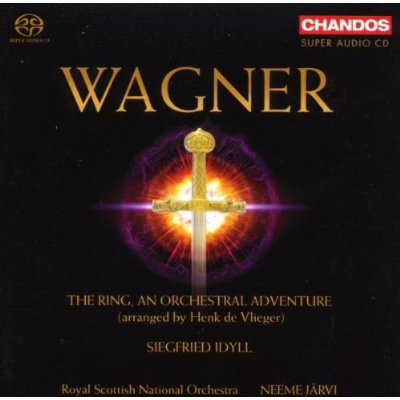
Anyway, talking of potted adaptations, I wonder what we
shall make of Henk de Vlieger’s 60-plus minute symphonic tour of Ring
orchestral highlights, due from the BBC Symphony Orchestra under the excellent
Mark Wigglesworth tomorrow night (and already espoused by Neeme Järvi and the
Royal Scottish National Orchestra on Chandos, a recording I have yet to hear).
On Tuesday with the BBCSO course students, I had one hour on Tippett’s Triple
Concerto, the first work in the concert – triggering a heated debate of pros
versus cons, with me somewhere in the middle – and one on the essence of the
Ring, with glimpses of the beginning and the end and in between, a couple of
selections from the momentous later stages of Rheingold and Walküre to deal with transformation/dramatic introduction
of the leifmotifs, and a gallery of nature pictures – water, air, fire and
earth.
Those should all be there tomorrow, but will the experience add up? Sometimes charisma can make it work - I love mad Stokowski's 'symphonic syntheses' from the Ring, Tristan and Parsifal, especially in his portamenti-laden Philadelphia recordings from the 1930s. Here's his take sans voices on Act Three of Parsifal.
As for Wigglesworth's Wagner (and Tippett), if you can't be there at the Barbican, the concert is broadcast live on Radio 3. STOP PRESS (20/10): It worked, it truly did (and the Tippett was compelling, too). Listen to the concert for the next seven days here and read the Arts Desk review here.
All observations, questions and challenges are welcome: resistant to tweeting and Facebook (though long converted to LinkedIn), I still like to exchange ideas. You don't have to be signed up, and you can be anonymous, but comments are moderated.
Copyright
If you wish to use any of my own photographs featured in the blog, or any of the text, just let me know in the comments. Acknowledgment and a link are all it takes.




 Posts
Posts



