Showing posts with label Tolstoy. Show all posts

Wednesday, 21 April 2021

Vasily Grossman: a Mensch at the front line

First, as far as those reading in translation were concerned, came Life and Fate, a masterpiece on a Tolstoyan scale and with that genius's nuance in characterisation, about the end of the Stalingrad conflict and what came afterwards. I found it frustrating to begin with: who were all these people who kept popping up without immediate explanation, their back-histories revealed across the course of the novel, if at all? Reading the small print, as it were, one found out that this wasn't a self-contained epic at all, but the second instalment of what one might call a 'dilogy'; the first, For a Just Cause, hadn't then been translated since its Soviet publication in 1952. I wrote a bit about this in a blog entry partly on Life and Fate back in 2018. In brief, there was much dismissal of For a Just Cause's quality; since Grossman had written it while Stalin was still alive, it was deemed to be seriously compromised by censorship and the need to give a postive picture.

When, at last, Stalingrad, as Grossman had wanted to call For a Just Cause, appeared in a translation by Robert and Elizabeth Chandler in 2019, so many myths about it were dispelled; it's only now that I've been able to read it. Yes, the post-Stalin Grossman would have been harsher on the leader's 'not one step back' policy which resulted in thousands of soldiers being executed by their own; he might have exposed the extermination of the kulaks and the truth behind the forced collectivization of previous years; he might have been harsher on the bickering generals. But the characters we mostly meet again in Life and Fate are so finely drawn, the sense of shame in the retreat and the awareness that Stalingrad was the last of Russia, and soldiers might choose being there over the quieter life on the steppe across the Volga, the general heroic assertion of defending it 'for a just cause', to a death which might seem pointless in the smaller scheme of things, all justifiably strong and vivid.

The choices the Chandlers made over co-ordinating no less than five versions seem entirely admirable. Their decisions strike me as analogous with what any opera company decides to do with Prokofiev's most wide-ranging masterpiece, War and Peace, which preoccupied him from 1941 up to his death. In both cases revisions made the most of apparent compromise: Grossman was 'advised' not to make one of his leading figures, the physicist Viktor Shtrum, top of his league - he was Jewish, like Grossman, and that wouldn't do in the still virulently anti-Semitic atmosphere of Stalin's last years - but in creating a purely Russian figure to whom Shtrum is subordinate, Chepyzhin, he merely added another rich creation. 

Asked to give some sense of the coal production which helped power reinforcements, Grossman also added a dozen chapters focusing on the work of Colonel Novikov's brother Ivan in the Donbass. And these are fascinatingly well observed - one would no longer wish them away than one would Prokofiev's 13th scene, his last addition to War and Peace, sketching the council at Fili and giving Kutuzov a crucial and deeply moving aria. One of Stalingrad's most vivd and shocking chapters, in which we see Tolya Shaposhnikov so full of hope and budding heroism, was added to the fifth version; once read, never forgotten. Picking up Stalingrad after reading Victor Serge's The Case of Comrade Tulayev made me realise what these two authors, who knew each other (somewhat to Grossman's cost), have in common and where they differ. Both are lyrical about nature, and especially about the night sky, but while the terror of Serge's novel is limited to earth, Grossman's sky is ruined by hurtling death stars - the bombers - and constant noise.

Perhaps the most remarkable thing of all about Stalingrad is that it's not only a great feat of the imagination in the case of the various characters, but carries over experiences Grossman himself had undergone as a reporter constantly heading out to various front lines, and to Stalingrad itself in its darkerst hours, only a few years earlier. How different from Tolstoy's War and Peace, created entirely from a phenomenal effort to recreate events at the other end of the 19th century. 


Which of course doesn't make Grossman's work better, only more authentic (not always a commendation in similar cases). That's why it was so enriching to read alongside the novel Anthony Beevor and Luba Vinogradova's A Writer at War: Vasily Grossman with the Red Army 1941-1945. While this was published before either had read Stalingrad/For a Just Cause - which they serve poorly by referring only to Life and Fate - the selected notebook entries show us how much Grossman carried over, often transferring his own thoughts and witnessing to characters in the novel. It also gives us much more about the early days of the war, on the Eastern Front, recreated in the backstory of Colonel Novikov in the novel. Grossman actually arrived in Stalingrad after the attack had begun, but in this entry, perhaps, lie the seeds of a novel about it:

Stalingrad is burned down. I would have to write too much if I wanted to describe it. Stalingrad is burned down. Stalingrad is in ashes. It is dead.  People are in basements. Everything is burned out. The hot walls of the buildings are like the bodies of people who have died in the terrible heat and haven't gone cold yet.

Both in the journals and the novel, too, he describes the buildings without windows as 'blind'. He would eventually see how the city still lived through its defence. And what he hadn't experienced for himself he would get his interviewees to describe. His fellow correspondents were amazed, for instance, according to his boss General David Ortenburg, 'how Grossman had made the divisional commander , General Gurtiev, a silent and reserved Siberian, talk to him for six hours without a break, telling him all that he wanted to know, at one of the hardest moments [of the battle]'.

Movingly, too, A Writer at War it takes us beyond to Grossman's journey back east with the Red Army, the appalling revelations of what had happened to his mother and other Jews in his birth town of Berdichev, the horrors of Treblinka, the depredations of the Soviet army once it left home soil and moved in on Berlin (pictured below, Grossman on the left at the Brandenburg Gate). 

One of the most striking things about Stalingrad is that Shtrum opens the last letter from his mother but we learn nothing of the contents. The complete letter forms a full chapter only in Life and Fate. I wept again when I read that Grossman wrote two more letters to his mother in 1950 and 1961, the 20th anniversary of her death; they are translated in full on pages 259-61 of A Writer at War, a vital epilogue to the fates of both the fictional and the real mothers.

His essay on Treblinka is shattering, ruthless in its detail and its furious turns of the screw, and he acknowledges its awfulness:

It is infinitely hard even to read this. The reader must believe me, it is hard to write it. Someone might ask: 'Why write about all this, why remember that?' It is the writer's duty to tell this terrible truth, and it is the civilian duty of the reader to learn it. Everyone who would turn away, who would shut his eyes and walk past would insult the memory of the dead. Everyone who does not know the truth about this would never be able to understand with what sort of enemy, with what sort of monster, our Red Army started on its own mortal combat.

Next task: to get hold of a translation of The Black Book in which this essay features, thorough documentation of the fate of Russian and other Jews in the Holocaust, which he co-authored with Ilya Ehrenburg (it should be available to all for a more affordable price). The story of its suppression in the Soviet Union and of the hostility towards the Jewish Anti-Fascist Committee makes for a further chilling chaper. Even if Grossman were a lesser writer - and all this makes clear he is one of the very greatest - the record and reportage alone should be essential reading for everyone.

Wednesday, 31 December 2014

War, peace and love


This last post of the year looks forward to 10 hours of War and Peace on Radio 4 tomorrow, but mainly back to the last great treat of 2014. Love is the only way to describe what so many of us feel about Tolstoy's complicated creatures, and how we respond, too, to Prokofiev's gift for homing in on scenes and lines to bring them fully to life in operatic terms. Tough love is how I might define Graham Vick's second interpretation of the opera 23 years on from the groundbreaking 1991 Mariinsky production; as he told us when he came to talk to my Opera in Depth students at the Frontline Club, he'd been romantic and relatively young when he first tacked the epic then, and now he saw both Natasha's near-breaking on the corrupt society wheel as well as Andrey's endless sufferings in a much harsher light. Production shots here of the 2014 Mariinsky War and Peace, starting with Aida Garifullina's Natasha and Andrei Bondarenko's Andrei falling in love at the ball, by Natasha Razina and Valentin Baranovsky.

We got to see this endlessly resourceful and perfectly realised take on Tolstoy and Prokofiev as an extra to my ten classes, making extra space from 12.30 to 4.30pm on a mid-December Monday. It was the final highlight of a year which I and my Arts Desk colleagues have chronicled, live-wise, in as much detail as we could: concerts round-up here, opera top 11 here.


All bar one of the students were knocked for six by Vick's special putting-it-together, even without subtitles (those will, of course, appear, when the DVDs are released some time next year, as they must be). It was going to take a superlative portrayal of Natasha to budge my allegiance to one of the greatest singing actresses of the last three decades, Yelena Prokina, but the less tutored and polished Aida Garifullina's performance is just that, in a slightly different way. Graham had spoken of her being, well, just a natural: even if she doesn't always know what to do with her body and hands, the face speaks every emotion - and her beauty even surpasses Netrebko's back in 2000; we had better beware that an oligarch doesn't lock her up in an ivory tower. Which would be a loss as the voice, too, is a beauty, warm and vibrant, as telling as Prokina's of what she's singing about.

The first part, which Prokofiev was at one point urged to call Natasha Rostova, charts her enchanted falling in love with Andrey followed by the unnatural pressures under which she's put in their year-long separation. Vick gives us the moonshine as wonderfully as Konchalovsky did in 2000, all the more heart-flipping since we first see Andrei Bondarenko's Prince contemplating suicide before the voice in the night air turns his thoughts to spring again. 'One must believe with all one's soul in the possibility of happiness' runs the Tolstoyan line on the blackboard.


In the next scene he's lost years, smiling, rapt in love as who wouldn't be with this Natasha at the ball?

Then the fall. Graham was right: in a contemporary setting, it's all the more disturbing. In today's society, the feckless set led by Helene and Anatol would be off of their faces on cocaine, as we see the lady of the beautiful shoulders in the washroom of Scene Four and the lads in the planned abduction scene.


For Vick, it's all about consumerism, the mores of the I Want It Now generation; fur coats suggested by gypsy Matryosha's sacrifice of hers dangle spookily from the heights, to be predictably replaced by hanging corpses once war begins, a billboard offsets the tank that's mostly present, while Anatol's limo provides a useful prop for Pierre to bang his head against and slam the door into him. It's good to see the rake as a feckless young man: Ilya Selivanov is a superb actor and has a golden tenor voice of the kind the Russians produce in droves.

'War' is harder to pull together, especially if you insist, as Gergiev still does, on the complete score (for me, Tim Albery's ENO production provided the best solution to judicious cuts, shedding most of the later Soviet ballast). Vick's fluent parade wings us brilliantly from suggestions of the Ukrainian conflict - it remains a miracle how in today's Russia he got away with a socialist realist poster of happy peasants in yellow, white and blue, later bespattered  -


- to the canonization of Kutuzov (veteran Gennady Bezzubenkov), unpacked from a museum crate


and holding the council of war at Fili with other Russian commanders in 1812 costume ( '450,000 dead' is chalked up on the blackboard). Compare Vick's tableau with a late 19th century painting.


Natasha's scene with the dying Andrey is fascinating to compare with the 1991 version, which was a proper deathbed scene. One of my students didn't get the Carousel idea of Andrey as spirit trying to communicate with a bewildered Natasha in worker's gear; I thought it was shatteringly moving and gravely beautiful, since both protagonsts are remarkable singer-actors ('I will no longer exist' is the Tolstoy phrase he's chalked up here).


The open door to death is all the more striking now that (2/1) I've heard the radio dramatization, which reminds us that Andrei talks of it in his last days, and how a spiritually exhausted Natasha longs to go through it later in the novel. Here she remains onstage through the final fallout, a further demand successfully carried by Garifullina the actress, to end up sitting opposite Pierre at a bare table in the final moments.

No superlatives are too much for what's been achieved here, least of all in 2014 St Petersburg. In short, Vick's panorama eludes being tied to any one war, any particular era, just as in his Birmingham Khovanskygate (it even has elements of the audience integration so crucial to that once-in-a-lifetime experience). Some see this as faulty vagueness, but it's a lot harder to bring off than one dogged centripetal idea.

I didn't watch the livescreening in the summer simply because I was sure it had to become some sort of nationalistic pageant. But that was to reckon without the trust placed in Vick by Gergiev, who goes a small way towards redeeming his rant against the Ukraine and his unapologetic, unthinking equation of homosexuals with paedophiles (for which, come the end of 2014, he's clearly never going to apologise). Clearly a divided soul who's signed a Faustian pact, but when he conducts well, as he does here, there's still a touch of genius.


At the same time as the first term's classes came to a close, I got to the end of reading my first book of military history, Dominic Lieven's Russia Against Napoleon. The reality probably lies somewhere between Tolstoy's view of history as chaotic flux and Lieven's chessboard, but the facts as Lieven arranges them are an interesting counterbalance.


The biggest importance of the history is that it restores an overview based on research in Russian as well as French archives, one in which the French retreat from Moscow in 1812 is only the first stage in a strategy to push them back as far, as it turned out, to Paris in the campaigns of 1813-14. And the movers behind all this are seen to be Alexander I, whom Tolstoy gave scant credit for planning ahead, and Barclay de Tolly (striking how many non-Russian names figure in the high command of the Russian army - how confusing when they have French names like De Langeron).


Even so, old Kutuzov remains a hero of sorts for his very restraint: a seasoned fighter knew better than to waste soldiers in unnecessary battles and skirmishes. His response was partly pragmatic - without an army, there would be no Russian nation - but it also stands in opposition to the younger hotheads who thought they'd be hailed as heroes for sacrificing whole divisions in impulsive onslaughts. But how like a nursery-room battlefield with toy soldiers Lieven makes so much of it sound: thousands are lost in this or that fight, and if that also means wounded and deserters, it's still shocking in its casualness and frequency.


Ultimately, the real truth lies with the human perspectives of Pierre or Nikolai Rostov on the battlefield: what on earth is all this for? By the way, in looking for images I was surprised to find so many 're-enactments' by Vereshchagin, one of the great war artists, probably most famous for his pyramid of skulls.


This is such a good cue for the Napoleon-at-Borodino scenes in the novel and opera, where by the way the sole survivor of the 1991 cast, Vasily Gerello, was still in splendid voice in 2014 and even more magnetic.

I'll be curious  to hear what remains tomorrow in Timberlake Wertenbaker's 10-hour adaptation on BBC Radio 4*. I slightly baulk at 'dramatisation, since I don't see how you can dispense with Tolstoy's authorial voice. They did that the last time, and I gave up sharpish. I may do so again in the morning, but I've cleared a space and taken a long walk this afternoon in anticipation of being glued to the 'wireless' all New Year's Day. The cast is extraordinary and I'm delighted to note a happy reconciliation. Harriet Walter recommended Joel MacCormack fresh out of RADA for my German Romantic Opera Discovery Day in Birmingham, and wonderful he was too:  they're re-united as Drubetskoy mother and son.

That was a highlight of my year, my first ever 'curatorship', and another was Harriet saying yes to recording chapters of War and Peace for my class, not to mention doing so with such spellbinding sensitivity. On which note I can't resist reproducing the alternative shot (with rather than without flash) of a serendipitous meeting just after one such session: another heroine of mine, Birgitte Hjørt Sorensen 'as seen in' Borgen, had dropped in to see Henry IV and they were as happy to meet each other as I was to snap them both.


Happy 2015/ s novim godom/bonne année a tous

*Review now up on The Arts  Desk here .

Friday, 5 December 2014

Great guests


'Great' is a term I hope I don't splash about too much, but it's always good to know who or what truly stands out, especially in the musical and operatic world where standards are generally so high already (one can't make the same generalisation about theatre).  I stick by the publicity blurb I wrote for the flyer to advertise Sioned Williams's lecture-recital at St Andrew's Fulham Fields: she IS one of the world's great harpists. And Graham Vick enters the pantheon of top directors - not that it's overstocked, in my opinion - above all for his pioneering work on opera involving the community in Birmingham. As chronicled here and on a BBC Radio 3 chat with Tom Service, I went for the first time this year, to see the Big Top Khovanskygate, and it was certainly up there with the most extraordinary operatic experiences of my life. A total immersive experience, on our feet for three hours plus and no compromises - full CBSO, no miking, quality singers, chorus bolstered by professionals.

Actually I also owe Graham a debt for introducing me to Britten's Billy Budd and tackling the crucial gay issues in it back in the 1980s. When we talked together at the Opera in Depth class the other week, I said it had such an impact because it was the first time I saw it. 'And do you not think that might have been because my production was actually rather good?', he said, not boastfully but with a secure sense of his own worth (it was; only Tim Albery's since has come close).


Sioned first, anyway. She came with harp to St Andrew's Fulham Fields, where I'm running monthly classes linked to the BBC Symphony Orchestra courses as before, chiefly because after the City Lit debacle I still very much wanted to cover the Nielsen symphonies Sakari Oramo is conducting this season. Some of the players also volunteered to make appearances as before: cellist Michael Atkinson is getting the Merchant Quartet back together to work on Sibelius's great Voces Intimae Quartet, possibly a Nielsen too. And Sioned wanted both to make up for the fact that when she'd last come to the City Lit, it was at the end of a serious illness and she hadn't the strength to bring the harp too, and to reflect on her brilliant Purcell Room concert of six new works for harp commissioned by herself (read the Arts Desk rave - which is absolutely not because I know and like her).

So this time we brave few got the benefit of her insights into the differing virtues of the commissions. The harp is perhaps the trickiest of all instruments for a composer to know the strengths and limitations thereof; Paul Patterson, who came along as stalwart supporter again, and perfectionist Michael Finnissy are masters of the art, where one of the other works had asked the impossible and impractical and a great deal of collaboration was necessary.


We heard movements and selections again, often with an illuminating running commentary on what was going on pedal and string-wise; and the biggest triumph was to get screen and sound working - if only you knew how brinksmanlike that was - for Dominic Murcott's Domestica. I found it even richer second time around, knowing now that the domestic sights and sounds were filmed, oh so artistically, by Magali Charier in Sioned's and Ali's home, and that the ticking clock slows down (you don't sense this, or at least I didn't, at the premiere, though you do feel that the harp contributions become more introspective and poetic).And, small in number though the audience was this time, St Andrew's turns out to be a wonderful venue for subtlety and magic.

Graham's visit to my Opera in Depth course at the Frontline Club has trailed a host of wondering messages from the students which have left me in no doubt of his special connection. He spoke very movingly on the sense of change since he first directed Prokofiev's War and Peace at the Kirov, as it then was, when he was still a relative youngster full of romantic idealism back in 1991 (thanks to Peter Maniura, that first visit when Leningrad was turning back into Petersburg proved a bridge for me to devoting middle life to great Sergey Sergeyevich).

Now he wonders at how modern the music is, and was keen to redress weaknesses he'd felt in the characterisation of Prince Andrey (this time played by Ukrainian Andrey Bondarenko, his Glyndebourne Onegin and the one singer on whom he actually insisted). He wanted to refer back to Austerlitz and to keep the war in the peace sequence, and the private scenes more prominent in the war half.

The second collaboration with Gergiev originated in a mad idea to do the opera on the Edinburgh Tattoo parade ground during the Festival. 'And just as when you have to think a low note when you sing a high one, or sit if necessary on stage as if you were rising up, I wanted to make it about three people.' The project failed for lack of money, but Gergiev was insistent on Vick coming back to the Mariinsky for his roughly ten-year reassessment of Prokofiev's opera (with Andrey Konchalovsky's beautifully realised but heavily cut version in between). Graham says he was surprised at Gergiev's request for an openly gay director with a track record of controversial productions.


And yet Gergiev gave him total carte blanche. Going for the contemporary meant endless meetings with lawyers about what could and couldn't be represented on the Russian stage, but Vick says he fought tooth and claw, and succeeded in nearly everything. Even, note, in the slipped-in yellow, white and blue of the screens above, played out to the choral ode in the New Year's Eve ball scene, and returning in the 'war' sequence spattered with blood.

Anyway, it all happened; he hadn't heard from Gergiev what he thought - according to Caroline of the Mariinsky Friends, he was delighted - because the conductor only appeared for the final rehearsal. Even so, Vick thinks that things have now gone so far in Russia that he would have to think twice about returning. I can't wait to see the whole thing at the Frontline on Monday week.


The other great personage who's been keeping us company through the ten two-hour classes on War and Peace - for we've been following Graham's 1991 production on DVD alongside Francesca Zambello's Paris Opera show - has been Dame Harriet Walter (seen above in the first of Helen Maybanks' photos for the Donmar Henry IV). As you'll have read if you've been following the blog, she consented to my amazement to read those chapters or sequences of Tolstoy's novel which parallel Prokofiev's more or less faithful setting of them, and she's done it beautifully. I was especially moved the other week, recording Pierre's confrontation with Natasha after the failed elopement and Natasha's encounter with the dying Andrey, to find her stopping, going back and finding a depth in the speeches that was moving to tears. We reach the last two scenes on Monday so I'm looking forward to editing her last contribution for that.


Since we would meet in the break between Saturday matinees and evening performances of Henry IV at the Donmar, I was very conscious of that background. Not that I'd have missed Phyllida Lloyd's production for the world, but I pushed that little bit harder to get tickets and finally saw it the other Saturday. Folk have been split down the middle about it, but I found it electrifying - perhaps all the more so since I hadn't seen, more fool me, the Julius Caesar also set in a women's prison; but the use of simple props and the evocation of the background seemed to me utterly fresh and always pertinent.

This was true ensemble work, rather unconventionally so since there were beautiful verse-speakers like Harriet's King, Jackie Clunes's Owen Glendower and the fabulous Ann Ogbomo as Worcester, seen here in confab with the 'enemy'


alongside new talent, in one way less experienced but in another thrillingly immediate. I couldn't get it out of my head that  Jade Anouka's Hotspur - even with an arm in plaster - wasn't some hyperactive, gifted but undirected black teenager from South London.


She was heartbreaking, especially so in the scenes with Sharon Rooney's Lady Percy, That's not a role that usually makes a huge impact, but as young, stressed, poor mother, the characterisation went straight to the heart- with an astonishing touch of physical knockabout added to the mix.


For me, there were no false notes. Falstaff, maybe, should be posh, but since he was being played by a prison inmate the take still worked in conjuring him as a sarf London wideboy; I laughed a lot not only at the fear of a burst balloon in the Gadshill episode, but the muttered remembrance of it as nightmare when Falstaff dozes behind the arras. The music was superbly placed and apt, the company routines brilliant, the whole thing pacy and vibrant. And the inclusion of two key scenes from Part Two added on to a fairly complete Part One was a fair compromise, short of having both in two performances - which I'll be seeing when the RSC production arrives at the Barbican, though I don't expect it to communicate quite as well as this.


A guest who will certainly be great has been staying with us in two spells. Eszter Bránya from Kecskemet, Hungary, Kitty Lambton's former classmate when the family spent a year out there, celebrated her 19th birthday here with a delicious cardamomy cake from the Swedish bakery Bagariet complete with a Carluccio's firework candle. Our young violinist came first for consultation lessons and then for auditions at the Guildhall and the Royal College of Music - successful in the first, waiting to hear about the second, though she went straight through to the scholarship second round - and all I'll say for now is that her tone is dark and powerful, from hearing her practise, her attitude incredibly quick and responsive, her dedication that of a serious artist. She'll go far, no doubt about that.


Tonight I have a great guest for 10 minutes of my 6pm talk before the BBC Symphony Orchestra concert conducted by one of the best, Jukka-Pekka Saraste, at the Barbican. He'll be presenting together the revolutionary Part Two of Berlioz's Romeo et Juliette,  Prokofiev's shattering Third Symphony and Dramatis personae by the BBCSO's Artist in Residence Brett Dean (pictured above). Brett will be joining me hot off the plane from Australia; I look forward hugely to meeting him. 

Thursday, 18 October 2012

Other Annas, other Rings


Forgive the note of unusual negativity in a blog which is mostly about sounding enthusiasms: this is a post about why I’m not going to the movies to see Keira Knightley as Anna Karenina, and why I’ve not returned to Keith Warner’s Royal Opera production of Wagner's Ring after an underwhelmed first visit. The positives are rather retrospective, but ideals are difficult to shift once you’ve witnessed them. There can only be new experiences of visions which work very differently but on the same level or else disappointments in store.

As for Anna Karenina, first of course you should read (or re-read: note to self) Tolstoy’s novel, and  then head not to the cinema but to DVD to see the old BBC serialization with an unforgettable central performance by Nicola Pagett (pictured above).

Why? Most obviously because the leisure of a multi-parter is always going to be more apposite to Tolstoy’s panorama than a film, even one that’s more than the standard 90 minutes long (a notable exception is Sergei Bondarchuk’s epic, still selective take on War and Peace). The Garbo version, by the way, is beyond bad. But above all I think the BBC casting of Tolstoy's protagonist was so right, possibly because for me as a teenager Pagett WAS Anna before I came to read the book, and even the reading didn't change that. A revisit suggests she’s still apt in so many ways – not least for the nervous intensity, the hectic flushes, which we now know were part of this talented, bipolar actress’s burden in real life. Pagett’s is a vulnerable heroine for whom you want the best, even when you know she’s doomed not to realize it.


The BBC series also gave proper weight to the parallel, equally significant strand of Tolstoy’s self-portrait – following bits of himself projected into both Prince Andrey and Pierre in War and Peace – as Levin. When I heard that the new film doesn’t bring Levin and Anna together, as they must be brought in any adaptation, that was another nail in the coffin of its reputation.

Of course the 1970s television production values were not as high as they’ve become in recent classic serials: Bleak House and Little Dorrit being atmospheric good examples, the recent Great Expectations a misapplication of misty gloom (and vanity casting) over the vitality of Dickens’s novel. But when the performances are as good as they were in the BBC Anna – and that includes Stuart Wilson, Eric Porter and Robert Swann – they overcome the creaky sets and garish studio lighting. A return to the BBC War and Peace, on the other hand, proved disillusioning: though Anthony Hopkins plays Pierre with extraordinary nuance, Morag Hood’s Natasha is too old for the impetuous teenager and lacks charm throughout. The 70s hairstyles, too, are more than a circumstantial liability.


Reports from trusted sources have suggested that many of the major drawbacks in the Royal Opera’s Ring revival still loom large. Not that I probably could have got a ticket even if I wanted to: the house was not giving any to The Arts Desk or any online reviews site, and getting a paid seat was going to be next to impossible. But on my previous visit I hadn't taken away any favourable impressions of the way Keith Warner swilled around a lot of half-cooked ideas, not at least beyond Rheingold, which is in any case a rather theoretical box of tricks and in this case promised more than the rest delivered. And Warner’s real weakness was to pay too little attention to the chemistry of all the crucial one-to-ones; this is where any great Ring production, whatever you think of its mises-en-scene, makes its mark.

I’m glad if Pappano has more grasp of the oceanic tides than back in 2006-7, and if great Bryn now has the strength to make it as Wotan and Wanderer (he was tired out by the end of Walküre when I saw it, but still a major reason for going). Yet while Covent Garden has done right by Sue Bullock, as it should have in the first place when the house cast Lisa Gasteen, she of the shot top, as Brünnhilde, the Siegfried problem continues: Stefan Vinke makes a horrid noise, or did when I heard him labour his way through Proms performances of Mahler’s Eighth and Janáček’s Glagolitic Mass. I wouldn’t hold out much for his skill as an actor, either. (UPDATE - 11/2/2019 - how wrong I was on that count, seeing him as the Siegfried Siegfried this season. Fabulous forging scene too)

The point is, if you're keen to experience the whole marathon for its own sake, your money will at least have been decently spent. It might be worth while tuning in to Radio 3, currently halfway through its broadcasts from the Royal Opera. But the Ring remains, for me, the sum of the great cycles I’ve seen which worked: Chéreau’s incendiary Bayreuth Centenary staging – my way in as watched, one act per week, on TV during my student years; Kupfer’s first take, which I was lucky enough to see at Wagner’s home shrine, and if I never get there again, I’ll at least have had my vision; and the Richard Jones production at Covent Garden. Not all of it worked, but there Jones's radical ideas resonated throughout the four operas as Warner's much less rigorous rattlebag did not (and Jones's Siegfried was sheer genius). Even the Phyllida Lloyd staging for ENO had unforgettable hits among the misses – I nearly left her Valkyrie after Act One, but Lloyd upped its game from Brünnhilde’s annunciation of death to Siegmund onwards, and the Twilight was inspired as a production from start to finish.


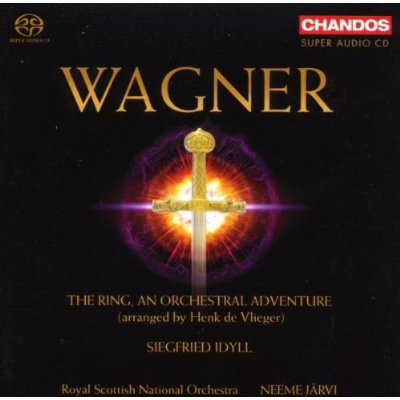
Anyway, talking of potted adaptations, I wonder what we shall make of Henk de Vlieger’s 60-plus minute symphonic tour of Ring orchestral highlights, due from the BBC Symphony Orchestra under the excellent Mark Wigglesworth tomorrow night (and already espoused by Neeme Järvi and the Royal Scottish National Orchestra on Chandos, a recording I have yet to hear). On Tuesday with the BBCSO course students, I had one hour on Tippett’s Triple Concerto, the first work in the concert – triggering a heated debate of pros versus cons, with me somewhere in the middle – and one on the essence of the Ring, with glimpses of the beginning and the end and in between, a couple of selections from the momentous later stages of Rheingold and Walküre to deal with transformation/dramatic introduction of the leifmotifs, and a gallery of nature pictures – water, air, fire and earth.

Those should all be there tomorrow, but will the experience add up? Sometimes charisma can make it work - I love mad Stokowski's 'symphonic syntheses' from the Ring, Tristan and Parsifal, especially in his portamenti-laden Philadelphia recordings from the 1930s. Here's his take sans voices on Act Three of Parsifal.


As for Wigglesworth's Wagner (and Tippett), if you can't be there at the Barbican, the concert is broadcast live on Radio 3. STOP PRESS (20/10): It worked, it truly did (and the Tippett was compelling, too). Listen to the concert for the next seven days here and read the Arts Desk review here.

Monday, 24 October 2011

The little things


I've never read a more entertaining, laugh-out-loud 'history' book than Simon Winder's Germania. Who could not but agree with him that most of the potentates who've called the shots throughout the centuries are nothing more than a bunch of demented sociopaths (he is generous with the exceptions)? It could all have been a bit brittle and wearing, this stance, were it not for the author's likeable personality and his willingness to stick his neck out for what he loves and cares about.


Which amounts to the civic by-products of all this instability: the handsome works of art commissioned by the worst people, the way that anything lovable has a way of squeezing itself in between the lines of horrible history. To sum up 'the pleasure and vigour of the pre-1914 world', Winder chooses his favourite painting, August Macke's Walterchens Spielsachen (Little Walter's Playthings) in Frankfurt's Städel Museum. I hadn't seen it, so I had to look it up and illustrate above. Having described it well in words, Winder sums up:

There are thousands of grander, more brilliant pictures in the world, but I'd settle for Little Walter's Playthings, not least for its revolutionary role in making guinea pigs an acceptable subject for portraiture. Macke spent his entire, short life creating paintings of happiness - shops, souks, parks, parrots, beautiful hats, all in the most surprising and lovely colours. He was killed in Champagne a few weeks into the war, which of course is where the problem begins.


Not that it hadn't begun again and again before in what we now call German history. As for after, when it comes to 1933, Winder declares that 'anecdotal facetiousness has to get out of the way and simply stop'. So he does, justifying as his cut-off point the fact that all the people who made Germany such a rich and rare place to be either emigrated or were murdered. Yet I wish he'd write another book on the continuing paradoxes of post-1945 'Germania', which of course he includes tangentially via his own multiple visits.

Those are what make such seemingly unbearable earlier grimnesses such as the Thirty Years War so bracing to read about. Winder meditates on the stuffed horse of Sweden's Gustavus Adolphus he's seen in Ingolstadt's city museum. Via an hilarious meditation on the usual experience of such civic institutions, he gives us the background and tells us how Gustavus narrowly escaped death in Ingolstadt when his horse was shot from under him before finally meeting it at Lützen. Here's the aside which especially flavours the anecdote: 'This sort of lucky escape is such a common cliché of history books that it is tempting to think of a parallel version which would privilege the horse: so that later, at the Battle of Lützen, "the horse's rider was shot from over him" would be a happy and much-whinnied at outcome'.

The first of Winder's three little chapters on the Thirty Years War made me look at images of more pictures, this time by an artist I'd never heard of steeped in the horrors of that time, Sebastian Vrancx. Alas, his execution is generally less accomplished and creepy than Winder's narrative of these 'highly disturbing images of powerlessness'. But I did find one which seemed sufficiently strange and right, of monkeys and cats in military uniform.


I could go on citing the pleasures of Germania, the many books I have to read and places I need to see which Winder has so enthusiastically recommended. But I'll stop by giving his final inimitable turns of phrase to a theory which Tolstoy put more cumbersomely in his diaries. The context is praise of the Biedermeier generation, 'the first timid attempt at bourgeois civil society, a sort of limbering up for us all now just sitting in a happy pile watching television', and praise for the 'time of quiet consolidation':

Just as most Europeans after the Second World War were, if given the chance, just sitting around in family groups and buying consumer goods, so the new rulers were able to preside over a generally rather dozy population. Indeed, a parallel history of Europe could be written which viewed family life and regular work as the essential Continental motor of civilization. Then war and revolution would need to be seen by historians as startling, sick departures from that norm of a kind that require serious explanation, rather than viewing periods of gentle introversy as mere tiresome interludes before the next thrill-packed bloodbath.


Worth applying, perhaps, to film and TV. I always remember Emma Thompson asking whether that splendid Ang Lee movie Sense and Sensibility wasn't closer to life as most of us experience it than the latest thriller or gangster movie. By the same token - bearing in mind that the only TV we watch is a string of catch-up episodes on J's iPad - isn't Come Dine With Me a bit more of the essence than generic, if well acted thrillers like Spooks and Hidden, which seems to me from a non-TVcentric perspective ridiculously overpraised? At any rate, it's always pleasantly surprising to be charmed on CDWM by the likes of Bobby Davro, a character one had written off (with little knowledge or interest, it has to be said) as a complete numpty.

Saturday, 27 August 2011

Monody


Tolstoy may have had some crazy ideas about art and the battle of the sexes, as I found in that hard-going but revelatory trawl through the diaries, but in the former case, at least, there's sometimes a grain of truth. This is the man who thought Dante and Shakespeare had only acquired their great reputations 'by chance', who told Tchaikovsky Beethoven 'lacked talent', yet who could weep over Tchaikovsky's Andante Cantabile and Goldenweiser's Chopin.

As often, his theories did not always run parallel with his feelings. He tried to talk himself out of western conservatoire-trained music, claiming that the history-books only told 'the history of artificial music, ie of how real, melodious music was deformed'. I'd qualify but not entirely disagree with his comment that if you say you don't yet understand a work of art yet, 'it means the work of art is not good, because its task is to make understandable what was not understandable before'. And if I give even lip-service to his abhorrence of contrapuntal music - 'the destruction of music, a means of perverting it' - it's only because much the best thing I've heard at the Proms this year, where for various reasons I've been to less than usual and shall be attending fewer still, has been June Tabor with her two unaccompanied folk solos, captivating a late-night Albert Hall audience. Hurrah that both are now up on YouTube. Here's the first


and the second, purging the rather overblown Percy Grainger arrangement that came before it, which was done with suitable fulsomeness (you see, Ismene, I use the word correctly here) by the BBC Singers and Northern Sinfonia.


Since that revelation, I've been ordering up June Tabor CDs - I actually found I had one track, about a dying miner, on the CDs accompanying Tim Winton's stunning novel Dirt Music - and while the smoky tones of later years may not have developed on one of her seminal albums, Airs and Graces, back in 1976, the solo tracks here are just as moving, not least her highly-acclaimed treatment of Eric Bogle's Gallipoli threnody The Band Played Waltzing Matilda.

Tuesday, 2 August 2011

Diaries of one who would be good


I've been leading a melancholy reading existence in the shadow of that great but troubled man Lev Tolstoy, namely working my way through the two volumes of his diaries as selected, edited and translated by R. F. Christian. He's such a beast to his clearly not very easy wife throughout their long and all too often Strindbergian marriage - though you end up trying not to hate her for harrying him to a death away from Yasnaya Polyana which the 82-year-old actually seems to have peacefully embraced - and comes to some outrageous conclusions about women so obviously based on that relationship. You keep wanting to kick him into giving away his estate instead of feeling masochistically bad about it, too, just as you want to shout out 'not good enough' when he beats himself up about his 'churlish and egotistical attitude' to Sonya*.


But on the other hand the observations on non violence and human love versus the harm of organised religion, state education and governmental murder seem so timeless that it's not hard to see why he was so idolised in later years (and he hated that too, being seen as the celebrity rather than the man). Why the rule making? Is it pat psychology to trace it all back to the 'sacred ideal' of the mother as well as the father he lost in his childhood? He does seem like a lost young man, though there's something comical about the determined listmaking (18 April 1847: 'the first rule which I prescribe is as follows: No. 1. Carry out everything you have resolved must be carried out. I haven't carried out this rule'). And so it goes on: he blames himself for his 'gambling, sensuality and vanity', but only kicks the first two over the years, and the latter probably never.

But isn't this the point: that we (or I, at any rate) love Prince Andrey and Pierre Bezukhov for trying to reach out for the meaning of life, thinking they've found it and then losing it again. Isn't the search what matters?


I copied out huge chunks of his wiser entries into my little black book: marvellous stuff on the insanity of believing that the only correct view of life comes from a council of bishops convened 1500 years ago, the 'terrible' reading of official (ie royal) history ('murder, torture, deceit, robbery, adultery and nothing more...') and the intense observation of the natural order of things, especially well expressed in a passage written months before he died. But increasingly I found the pith of the odd line more interesting (or maybe my writing hand just got tired). Hence a few I note down as much for myself as anyone else. The punctuating portraits, by the way, are all by the superlative Ilya Repin - I had no idea he painted Tolstoy so often - and as a result tend to show us the older writer.

3 February 1870: Truth repels, because it is fragmented and incomprehensible, while delusion is coherent and logical.

3 November 1889: 'It's a great mistake to think that the kingdom of God is out there beyond the grave, and just as great a mistake to think it's here. It's within one, and when it's within one then here and there are inseparable.

15 May 1894: Material good is only acquired at the expense of other people. Spiritual good - always through the good of other people.

28 May 1896: What we call evil is the good the effect of which we can't yet see. (Hmmm. Discuss.)

28 September 1896: The only instance when a person can and should be preoccupied with himself is when he feels unhappy. Unhappiness is the best condition for improving oneself, for rising to a higher level.' Viz Dorothy Rowe, whose wisdoms on this subject felt horribly sanctimonious and weren't much good when I was mired in unhappiness some years back.


19 December 1900: An artist, in order to produce an effect on other people, must be a seeker; his work must be a search. If he has found everything and knows everything and teaches or deliberately amuses, he produces no effect.

23 June 1903: I'm a person with very bad qualities, very slow to understand good...and so I'm not a bad teacher, in fact I'm a good teacher.

18 December 1905: To be good only means wanting to be good more often than bad. And this is something I desire.


17 April 1906: 'Contemplation of nature' is 'the awareness of our unity with everything, an awareness concealed from us by time.

21 March 1909: There can be no heroic feats, no heroism, nothing "great". There is only doing one's duty and not doing it.

You can see where Gandhi and Krishnamurti came from, though Tolstoy himself took as much wisdom from Indian schools of thought as he gave. And his insistence on the perennial philosophy, the insignificance of work produced with a desire to be 'contemporary', is one of the aspects of his flawed and partial view that I find most attractive. One final picture, this time a photograph of Repin reading the news of Tolstoy's death. The one major portrait I couldn't track down - a double one of Lev Nikolayevich and Sofiya Andreyevna - stands just behind him.


*One of the most extraordinary passages in the two volumes is the 'dialogue' appended to the entries for 1898, starting on p. 464 in the second volume. He reproduces, as close to the event as possible, a late-night scene between himself and Sonya in which we clearly see him hounding her, irrationally and relentlessly, about her obviously platonic relationship with Taneyev. It's painful reading, and you want to scream along with Sonya long before it's concluded. I wonder that someone hasn't dramatised this as a twenty-minute play as much 'from life' as it's possible to get.