Showing posts with label Germany. Show all posts

Monday, 29 May 2017

The frogs of Göttingen - and Seeburger See


Anyone who's hung around this blog for a long time may remember my account of first acquaintance with the more unexpected choruses of the Göttingen International Handel Festival, when I fell in love with the symphony of brekekekexes in the University of Göttingen's magical Botanical Gardens. On two subsequent visits, their stridency was rather muted - last year's epiphany with a mallard and his drake made amends - but not this past week. It meant a fair bit of hanging around, though, until I finally saw the above fella on one of the lilypads and, in following his progress, got the full sonic works. There's a lot of jumping, but blink and you'll miss the bubble-gum inflating to make the noise early on.


As I explained in last year's blog, the time of the Festival depends on where in the calendar the Germans' Ascension Day holiday falls. This time we were back to the end of May, when the aquilegias are flourishing


and providing a major source of nectar for the bees.


I actually got a double dose of ranine activity on the first full day of my visit to the Festival this year. Not ideal, sleepwise, since I'd got up at 5.30am on Wednesday morning for an early flight and had to do so at 3.30am on Thursday for the GIHF's second 'sunrise concert'. Still, it had to be done: my all-day Messiaenic birdsong experience at Aldeburgh last year taught me that. So after a stunning performance of  a work which came as a revelation to me, Handel's early (and pre-Bach St Matthew and John) Brockes-Passion on Wednesday evening, I decided it made sense to skip Continuum's late-night event and get something approaching four hours' sleep (by the way, all the events I did attend I'll be writing up on The Arts Desk next weekend).

As at Aldeburgh, the dawn chorus was one attraction. It seemed to be starting up in the tree-lined streets of Göttingen as I walked through the near-darkness at 4am to get the coach to our destination. But on arrival at the Seeburger See 45 minutes later, with the red glow of pre-sunrise across the lake,


the full thing was definitely in full spate. You may not see much of what I could, as  I walked through the woods near the lakeside in this short film, but you'll hear what you need to. Of course, our ranine friends soon come into earshot by a small pond.


Then I joined the few other concertgoers who hadn't gone straight into the warm on arrival


seeing this to the left
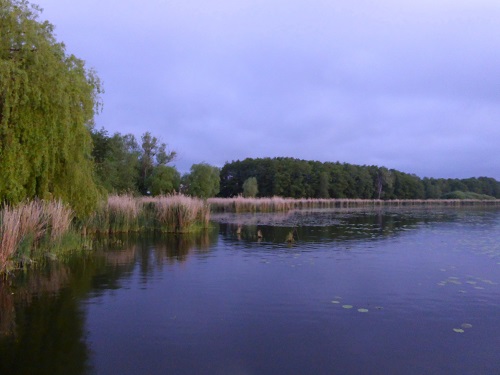

and some old boathouses to the right.


The one-hour concert began at 5am on the first floor of the Restaurant Graf Isang (est. 1925), with candles lighting our way upstairs and strategically placed in front of the surprise instrument - a clavichord, no less, the first time I've ever heard one live in concert.


Although the actual programme is the territory of my Arts Desk piece, we must just see young Avinoam Shalev, one of the already more than promising prizewinners in which the GIHF has placed justified faith. Israeli by birth, Hanover trained and now living in The Hague, he led us into a mesmerising meditation on the sounds and colours possible within the quieter end of the dynamic range the instrument inhabits. The sun actually rose behind the willows to our left at about 5.25am, as he was in to the first movement of Haydn's G minor Sonata Hob. XVI: 44. I took this picture, of course, in a break between movements, not during, as no official photographer was present.


A bow to a wildly enthusiastic if necessarily small and select audience: note the bird of prey in the first complete window pane on the left behind our clavichordist.
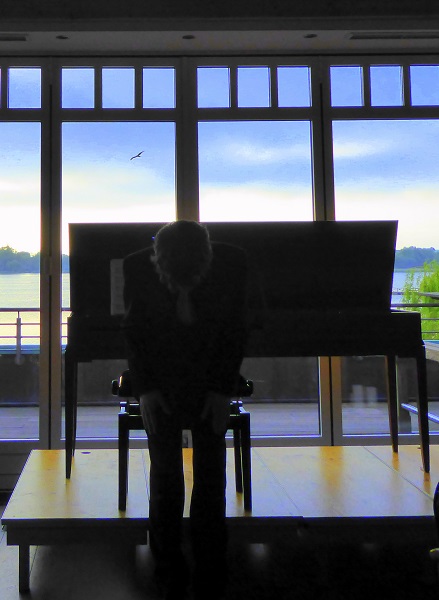

The sun went behind early morning clouds - by 9am a clear blue sky would emerge - but that didn't deter me from taking my breakfast out on to the terrace.


This turned out to be a good idea, or maybe it was just a case of attracting kindred spirits, because first our coach driver, a very interesting and friendly guy called Jan who'd stood for the whole recital, asked if he could join me. Then Avinoam appeared (pictured left), followed by our chaperone Enno (who said he had to stay out of this picture so as not to block the lake view) and Lisa Kraemer from the GIHF Artists' Office.


So we had a happy time - and there was plenty of it, the coach not due to leave until an hour and a half after the concert - mainly fulminating about Brexit and Trump (the legs you may see in the background belong to a bizarre dummy who had an unfortunate resemblance to the latter). This wasn't the only occasion at Göttingen this year where I have cause to invoke the suitable observation of Kurt Vonnegut's uncle on blessed gatherings in lovely places, 'if this isn't nice, what is?'

In fact that was also true of a last meeting yesterday (Sunday) morning at our favourite haunt in Göttingen, the Cafe Botanik. Pictured here, our wonderful co-ordinator, now a friend, Victoria Viebahn, critic Luca and his friend Christian.


You may also have read on this blog before about the Botanik, still run by an Iranian whose menu is small but perfect. On a hot afternoon I had a refreshing glass of sharbat as well as a hummus plate, and yesterday saffron cake was the only option in the absence of croissants - but delicious.


Inevitably, with less than an hour to go before my train back to Hanover Airport, I had to make a last homage to the frogs, taking Victoria with me, and the inhabitants of the noisiest pond were still to be found.


Their neighbours several blocks to the south set up quite a racket, too, and this time the birds were obliging, both aurally and visually.


So I said this farewell to another inhabitant,


found another bee nectar-sipping, this time in a peony


and noted various positive signs of Germany today - funny, isn't it, how its chancellor is now officially the Leader of the Free World - including this sign in the rather deracinated part of the garden (it's now in need of more finances, and too dependent on volunteers)


and these papers and magazines on a rack inside the Cafe Botanik, snapshotting Obama's meeting with Merkel in Berlin as well as Macron, 'dear friend'*,


 and made my way back to the station via the lovely town museum, currently housing a neat little exhibition on Lutheranism arriving in Göttingen (relatively late, in 1529, with predictably disastrous consequences). Maybe more on that in a future entry, but the ensemble is irresistible.


*It actually turns out to need taking in its other meaning of 'expensive', as two folk have pointed out to me; the subheading is how Macron will cost Germany. But the leader actually ends with the conclusion that togetherness for European countries is the only way ahead.

Monday, 24 October 2011

The little things


I've never read a more entertaining, laugh-out-loud 'history' book than Simon Winder's Germania. Who could not but agree with him that most of the potentates who've called the shots throughout the centuries are nothing more than a bunch of demented sociopaths (he is generous with the exceptions)? It could all have been a bit brittle and wearing, this stance, were it not for the author's likeable personality and his willingness to stick his neck out for what he loves and cares about.


Which amounts to the civic by-products of all this instability: the handsome works of art commissioned by the worst people, the way that anything lovable has a way of squeezing itself in between the lines of horrible history. To sum up 'the pleasure and vigour of the pre-1914 world', Winder chooses his favourite painting, August Macke's Walterchens Spielsachen (Little Walter's Playthings) in Frankfurt's Städel Museum. I hadn't seen it, so I had to look it up and illustrate above. Having described it well in words, Winder sums up:

There are thousands of grander, more brilliant pictures in the world, but I'd settle for Little Walter's Playthings, not least for its revolutionary role in making guinea pigs an acceptable subject for portraiture. Macke spent his entire, short life creating paintings of happiness - shops, souks, parks, parrots, beautiful hats, all in the most surprising and lovely colours. He was killed in Champagne a few weeks into the war, which of course is where the problem begins.


Not that it hadn't begun again and again before in what we now call German history. As for after, when it comes to 1933, Winder declares that 'anecdotal facetiousness has to get out of the way and simply stop'. So he does, justifying as his cut-off point the fact that all the people who made Germany such a rich and rare place to be either emigrated or were murdered. Yet I wish he'd write another book on the continuing paradoxes of post-1945 'Germania', which of course he includes tangentially via his own multiple visits.

Those are what make such seemingly unbearable earlier grimnesses such as the Thirty Years War so bracing to read about. Winder meditates on the stuffed horse of Sweden's Gustavus Adolphus he's seen in Ingolstadt's city museum. Via an hilarious meditation on the usual experience of such civic institutions, he gives us the background and tells us how Gustavus narrowly escaped death in Ingolstadt when his horse was shot from under him before finally meeting it at Lützen. Here's the aside which especially flavours the anecdote: 'This sort of lucky escape is such a common cliché of history books that it is tempting to think of a parallel version which would privilege the horse: so that later, at the Battle of Lützen, "the horse's rider was shot from over him" would be a happy and much-whinnied at outcome'.

The first of Winder's three little chapters on the Thirty Years War made me look at images of more pictures, this time by an artist I'd never heard of steeped in the horrors of that time, Sebastian Vrancx. Alas, his execution is generally less accomplished and creepy than Winder's narrative of these 'highly disturbing images of powerlessness'. But I did find one which seemed sufficiently strange and right, of monkeys and cats in military uniform.


I could go on citing the pleasures of Germania, the many books I have to read and places I need to see which Winder has so enthusiastically recommended. But I'll stop by giving his final inimitable turns of phrase to a theory which Tolstoy put more cumbersomely in his diaries. The context is praise of the Biedermeier generation, 'the first timid attempt at bourgeois civil society, a sort of limbering up for us all now just sitting in a happy pile watching television', and praise for the 'time of quiet consolidation':

Just as most Europeans after the Second World War were, if given the chance, just sitting around in family groups and buying consumer goods, so the new rulers were able to preside over a generally rather dozy population. Indeed, a parallel history of Europe could be written which viewed family life and regular work as the essential Continental motor of civilization. Then war and revolution would need to be seen by historians as startling, sick departures from that norm of a kind that require serious explanation, rather than viewing periods of gentle introversy as mere tiresome interludes before the next thrill-packed bloodbath.


Worth applying, perhaps, to film and TV. I always remember Emma Thompson asking whether that splendid Ang Lee movie Sense and Sensibility wasn't closer to life as most of us experience it than the latest thriller or gangster movie. By the same token - bearing in mind that the only TV we watch is a string of catch-up episodes on J's iPad - isn't Come Dine With Me a bit more of the essence than generic, if well acted thrillers like Spooks and Hidden, which seems to me from a non-TVcentric perspective ridiculously overpraised? At any rate, it's always pleasantly surprising to be charmed on CDWM by the likes of Bobby Davro, a character one had written off (with little knowledge or interest, it has to be said) as a complete numpty.

Wednesday, 28 September 2011

11,002 virgins


Cologne has quite a monopoly there, at least on St Ursula, supposedly a Romano-British princess who arrived by boat along the Rhine in 383 (some say) with her maidenly cohorts on the return from a pilgrimage to Rome (research suggests there may have been a bit of a misreading of the number 11,000 - could be 11, could just be a virgin called Undecimilia), only to be massacred by the Huns. As for the BMV who makes up the total, there are hundreds of medieval statues of her scattered throughout the 12 romanesque churches within the city walls.

Not that you'd really think of going inside did you not know that each is a treasurehouse, for the post-war rebuilding renders most of the exteriors unprepossessing. I took the hint, while in Cologne at the weekend for an ultimately stunning Mahler 8 celebrating the Philharmonie's 25th birthday, while browsing a book on the city's many Virgin statues in the Wallraf-Richartz Museum's shop. I was also delighted to find a serendipitous link with Mahler beyond the obvious one (that he was here in 1904 to conduct the Gürzenich-Orchestra in the first performance of his Fifth Symphony; players from the same orchestra had also participated in the Krefeld premiere of the Third).

For didn't Mahler tell his pre-Alma confidante Nathalie Bauer-Lechner that the Fourth Symphony's slow-movement theme is 'the smile of St Ursula', laughing through tears? This is what he means, ineffably done by the best orchestra in the world at Lucerne and the greatest living conductor (only half the movement, unless you decide to pick up the next instalment, but the plus is that you don't have to watch Magdalena Kozena gurning her way through the song-finale; go back to von Stade on Abbado's first recording for a much better characterised mezzo version of that). Double-click on moving image as usual for the whole screen.


And don't Ursula's elftausend Jungfrauen dance to the unearthly music in the child's heaven of the Fourth's finale? That Cologne owns her is due to an early inscription at the church on the Ursulaplatz. It claims that the basilica was raised on the site where huge numbers of holy virgins had been killed, their bones discovered therein and installed in the Golden Chamber. Which, alas, was closed for restoration up to the saint's day on 21 October.


I didn't even get a proper look at the church, which was closing an hour earlier than the rest just as I got there; the warden was adamant, so I just peered up towards the east end before being shooed out. There's still a 'Bruderschaft' of St Ursula, and the place is in very good nick, so the Catholic money must be pouring in. As it is in several other well-maintained establishments. I saw out a 5pm service at St Kunibert, restoration complete as late as 1985, gazing at the reliquaries behind glass


before briefly speeding round the church prior to lock-up. There are two striking virgin shrines - a Pieta with a typically bloodied and wound-scarred Christ


and our Lady with lilies


as well as fine glass from the mid-13th century (not my photo, this one, as I was operating without flash as I always do in churches, and the camera didn't like the low light-levels).


The next lunchtime, after a wonderfully engaging interview with Markus Stenz, the delightful Bettina Schimmer indulged me in a second church trek (she's no more religious in an official sense than I, incidentally, and told me of the strange anomaly whereby her unbaptised six-year-old daughter wasn't permitted to attend religious instruction classes at school, diverse though they were). We struck out southwards to St. Maria im Kapitol, the biggest of the Romanesque 12.


It was built on a Roman temple to the Capitoline deities at the command of Plectrudis, wife of Pippin II - don't you just love those early Franconian names? - with the huge ambition of emulating the Church of the Nativity in Bethlehem. Again, the post-war rebuild is fairly apparent, but the scale remains impressive, especially in the ambulatory around the trefoiled choir. And there are big treasures here, chiefly the wooden doors of 1065


with scenes from the life and passion of Christ, many with the paint still on them.


Modern though she looks, this Madonna of Herman-Joseph with her apple offerings dates from about 1180


and another expressive Pieta has a fine old window behind it.


Older is this (unlisted) monument on the south wall of the nave.


There's little of the Marian about St. Georg, a more intimate church further south, but like St. Maria im Kapitol it has an extraordinary crucifix at the west end


and what I presume to be a copy - because my postcard claimed that the original is in the Schnütgen Museum, which we didn't have time to see - of an even more amazing early wooden (1067) Christ on the cross above the high altar. St. Georg also has a fine Adam and Eve pillar in the porch.


As for St. Ursula, other reminders are scattered about town. St. Andreas, which I also revisited after a service, has the 15th century 'reservoir' over the sides of which, the inscription tells us, her blood is supposed to have flowed


and there's a fine statue in the cathedral, donated by a Frankfurt pastor.


That brings us back, as every walk in Cologne must, to the mighty Dom and its great west front shining in Saturday's hot late afternoon sun. How different to my first acquaintance when we stepped off an early morning train from Milan on a rainy January morning with only about £5 to last us six hours in Cologne and sat, or so I was convinced, behind Arvo Pärt in the first Sunday service of the day. I love the fact that the cathedral is open to all from 6am to 19.30 every day of the week, the true heart of the city.


Can't forget the lion on the door


nor a parting shot of that incredible situation alongside the Hauptbahnhof. A great city, which will repay many more visits; this was my third, and I've still no more than scratched the surface.


Looking for a decent city guide in Stanfords on Monday evening, I stumbled across Simon Winder's idiosyncratic meditation on Teutonic history, Germania, and found myself both laughing out loud and agreeing with what I read in the introduction. He doesn't shun the shameful era which he says is responsible for making Germany - probably Berlin excepted, now - 'a sort of Dead Zone' for all visitors other than 'those with professional reasons for being there' (like me, in this instance).

Yet Winder also reminds us that Germany is 'in many ways Britain's weird twin', 'a place without which European culture makes no sense, and for over sixty years Germans have been working strenuously to rebuild that culture in a way that, while admitting the legacy of the Third Reich, allows that earlier past to shine again.' As it does in Cologne, though again the nature of the rebuilding means that we never forget the more recent circumstances either.
