Showing posts with label Hindemith. Show all posts

Tuesday, 18 January 2011

Lisztomania


Or rather, mania with Liszt attached. I wasn't expecting to be quite so stunned by the new DVD of Kenneth MacMillan's Mayerling; having seen Edward Watson as a rather pallid Romeo, I'd never imagined he'd be up to the mark of syphilitic, gun-toting, sado-masochistic Crown Prince Rudolf of Austria (not telling you the true-to-life plot if you don't already know it). But that's the intriguing thing about dancers, as with singers, that some roles just fit them like a glove. I wish I'd understood this earlier in life.

Clearly 35 words on it in a BBC Music Magazine ballet round-up wasn't going to be enough, so I was lucky to have a chance, simultaneously, to write about Liszt and the use of his music in the ballet by John Lanchbery for the Royal Opera and Ballet website, readable here. I think the site looks good now as well as, let's hope, reading informatively and being well cross-referenced).

That fellow Jack, as Lanchbery's pals knew him, really was more of a great man than most people seem to have recognised. I adore his work on Tales of Beatrix Potter - which he came to the flat to talk about shortly before he died, tinkling away on the ivories of our on-loan Steinway Boudoir Grand to demonstrate - and La fille mal gardee. The Liszt potpourri is perhaps even more sensitive a selection. There are works already scored by Liszt, who God knows was not on the whole the greatest orchestrator, including the opening of A Faust Symphony which serves as brooding deathmotif throughout; but Lanchbery also does a pointedly weird job himself on some of the quirkier piano miniatures. Anyway, read all about it over there.


As for the latest cast to take up MacMillan's grim gauntlet, what an ensemble it is. All the ladies create a real sense of character - not just the scary-ambitious Mary Vetsera of Mara Galeazzi (pictured with Watson above in the first of two Royal Ballet production photos by Johan Persson, in a Pas so physical you fear her body might snap) and Sarah Lamb's calculating Marie Larisch but also the poignant ones, Iohna Loots as poor Princess Stephanie (dancing another weird Pas de deux with Watson's Rudolf below) and Cindy Jourdain's hot-and-cold Empress Mother. There's a dazzling, sexy cameo from Steven McRae, too, as royal cabbie Bratfisch. Otherwise the whole thing works against what I always thought the principle of ballet was, to froth up, instead stripping down to the skull beneath the skin. Very scary. I can't wait for it to come back into the Royal Ballet rep.


And of course it's the Liszt bicentenary, as if you could possibly have missed that already, as well as Hungary's controversial six-month EU presidency (it looks as if Sarkozy and Merkel may already have plied a restraining effect upon Hungary's truly awful new government). I have no regrets about missing the wonderful Budapest Festival Orchestra under Ivan Fischer on Sunday, simply because while no doubt that was a five-star occasion - my pal Ed Seckerson certainly loved it, and so did the diplo-mate - the duo of towering violinist Leonidas Kavakos and revelatory pianist Enrico Pace over at the Wigmore would have to merit five and a half. More anxious to hear a masterpiece not often played live, Prokofiev's First Violin Sonata, in such hands rather than the relatively known quantities on the BFO programme, I chose to write about the recital for The Arts Desk; I'm still reeling from it and thinking over especially the plains of heaven Kavakos and Pace trod in Schubert's C major Fantasy.

Anyway, there's plenty more Liszt on the horizon (all they had on offer at the Southbank was the First Piano Concerto, another dubious choice for Stephen Hough, but Fischer had already done several of the not-great tone poems as well as anyone could expect at the Barbican several years back). Mayerling has sent me back to some of the sources, not least the Harmonies du soir of the transcendental etudes which serves as a climactic Act 3 Pas de Deux. Bertrand in Paris was going through a Cziffra craze, some of which rubbed off on me, so here's the phenomenal Hungarian master surmounting a peak of pianistic art:


Before we go on to more Cziffra, a less overheated interlude - one of the many great works which wouldn't have fitted into the decadent, hothouse environment of Mayerling, Les jeux d'eaux a la Villa d'Este. This performance was recorded in 1928 by my personal favourite among Liszt interpreters, Claudio Arrau.


Cziffra leads me on to the opera we're spending seven or so weeks on at the City Lit, Wagner's Tannhauser. We're already having an intriguing time in the two Venusbergs of 1845 and 1861, so here's the Liszt transcription of the Overture from Tannhauser's second hymn of praise to Venus to the end:


And just as an ironic encore, since there's been so much talk of this since we discussed it at Susie and Michael's on 2 January, another overture transcription with a difference: Hindemith's Overture to The Flying Dutchman as Played at Sight by a Second-Rate Spa Orchestra at the Village Well at 7 O'Clock in the Morning.
A little of it goes a long way until it breaks out in a Strauss waltz, but what effects from a mere string quartet.

Thursday, 4 November 2010

Let's hear it for Hindemith


Took the BBCSO students through this coming Friday's programme to be conducted by the often electrifying Yan Pascal Tortelier. I always have so much to say about Musorgsky's Pictures at an Exhibition both in its piano original and its thousandfold arrangements that I knew I wouldn't have much time to talk about Hindemith's Concert Music for Brass and Strings. Yet it fascinated me all the same. We've got it all wrong about the mighty and humane German composer, labelled by his notorious claim for Gebrauchsmusik, 'utility music'.

Yes, he was prolific and yes, he saw it as his obligation to compose for the less familiar instruments, in which respect I suppose he was very much like his near-contemporary over the border, great Bohuslav Martinu (both, of course, ended up in America, where PH is pictured above in 1945). But even Martinu didn't write a chamber piece to showcase the heckelphone, that lowest member of the oboe family analogous to the bass oboe. Of course I would be fascinated by that as oboist manque, wouldn't I? It plays quite a part in the creepiness of Strauss's Salome, but Hindemith was surely the first major composer to bring it to the forefront. Here's the second movement of his quirkiest trio.


It was the opera Mathis der Maler which first hit me with an emotional force I hadn't expected (a brief firework in the Royal Opera's more adventurous programming some years back, directed by Sellars and conducted by Salonen). But I find plenty of melodic heart, too, among the counterpoint of Hindemith's Kammer- and Konzertmusiks. The students were hugely entertained both by the one that's popping up in tomorrow's programme and by Walton's jolly, unashamed ripoff in the finale of his First Symphony. I still treasure that fabulous Storgards programme in Helsinki twinning the two composers, and a couple of conductors I've spoken to think it would be a fascinating idea. So come on, Vladimir, stick your neck out and do it, please.

In the meantime, there's a film of Hindemith conducting on YouTube, but it can't be embedded. So here's the first movement of the Konzermusik in question from his 1950 Philharmonia recording. You can always go on to the second if you're hooked.


On a not unconnected brass note, I was sorry to hear that the doyen of orchestral trumpeters, Maurice Murphy, had died. I'll remember for ever the way he played the sassy blues solo of An American in Paris during Tilson Thomas's LSO series The Gershwin Years. I loved a comment referred to on one message board about Gabriel now being out of a job up there.

And news of distinguished musicians' deaths does seem to be coming thick and fast this year. Radio 3's In Tune just rang to tell me that the admirable Rudolf Barshai - viola-player (like Hindemith), arranger and conductor - has died at the age of 86. I'll be popping into the studio later*, and though I'm much taken up with Raskatov's opera A Dog's Heart at the moment, will squeeze in a hour to reflect on Barshai's Greatest Hits. Which will include his performances in the early Borodin Quartet, his string-orchestra transcriptions of Prokofiev's Visions fugitives and Shostakovich's Eighth String Quartet, and his Shostakovich symphonies cycle on Brilliant Classics (outstanding Fourth and Thirteenth). Is there no end to the wonders of YouTube? Someone's even put up the Prokofiev recording, which I have only in mono. This may not be the most soulful of the tracks, but it does highlight what the intended antiphons sound like in stereo:


*You can hear the chat with Sean Rafferty - before he and other presenters went on strike over the BBC pensions debacle - for the next six days on the BBC iPlayer. It's about 41 minutes into the programme.

Tuesday, 6 April 2010

Sibelius at home IV: portraits


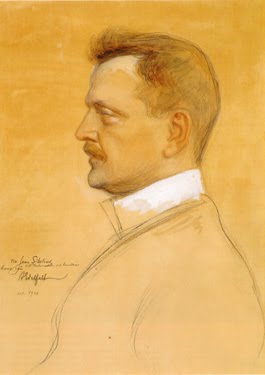
In addition to John Munsterhjelm's 1909 bronze of the composer - into which Sibelius inserted a lucky horseshoe - two of the most important portraits are to be found at Ainola. One faces you on the other side of the window to the bust as you enter the drawing room.


This is Albert Edelfeldt's study, made in 1904 as a preparatory sketch for his three-part mural in the University of Helsinki's main auditorium. I had a feeling I might get to see it on my much-anticipated visit to hear the Helsinki Philharmonic that evening. The deplorable situation with the main Finlandia Concert Hall means that either of the city's two main orchestras can be ousted if a more lucrative conference booking so decrees, and that's what happened on Thursday evening - with the result that, owing to the subscription sales outstripping the seating facilities at the university, I was told a ticket at the smaller venue would be very hard to come by. And this for a programme of Walton and Hindemith you'd be lucky to get half an audience for in London.

Anyway, I did get in, and as it turned out there were plenty of empty seats owing to the subscribers' prerogative of turning up or not (the still very large audience, though, proved a healthy mix, attentive and enthusiastic). I had the huge pleasure of top Finnish designer (and very modest gentleman) Markku Piri's company, and he took me down from our balcony seats to look at the main hall in the interval. I think that, for all his knowledge, he was rather surprised to find that Sibelius did indeed feature in the mural. There he is in the procession of figures in 17th century dress leading the Turku University inauguration, just behind Governor Per Brahe.


Forgive the pointillist overlay, but I couldn't find any better image than my own on the web. Here's a more professional shot of the handsome neoclassical hall.


It's a rather small venue for a large symphony orchestra, and there was nowhere for the Helsinki Phil players to hide from the audience. Not that they needed to: John Storgards did a splendid job with a brilliant programme, three-quarters of which I've never heard in a UK concert. First half started with Walton's Spitfire Prelude and Fugue, followed by the Hindemith Cello Concerto, its cheeky march-finale anticipating the pleasures of the more familiar Weber Metamorphoses. Spot-on Torlef Thedeen formed a true concerto partnership with this lively team (characterful principal clarinet, later first flautist and oboist, had a very individual sound). After the interval, the orchestration of Walton's Hindemith Variations, its theme derived from the slow movement of the Concerto, was pure sleek pleasure, an altogether trickier fugue to cap it all followed by a decadent slow fade. I told Markku he was in for a treat with the Turandot March of the Hindemith Variations; sure enough, he smiled and even laughed at the jazzy bit. Lots to think about, he said at the end, and so there was.

One notorious artistic glimpse of Sibelius at large in Helsinki I didn't get to see: while I've already noted the surprise of Gallen-Kallela's triptych, his celebrated take on a drinking 'symposium' at the happening Kamp Hotel was, we were told by the hotel's reception, locked in a safe. Yet there seems to be a version at the Gosta Serlachius Foundation.


No prizes for guessing why the depiction of Sibelius on the right gave him a bad name, and almost led the Jarvenpaa worthies to refuse him the land at Ainola (the other reprobates, left to right, are the artist, Merikanto and Kajanus). Another drinking bout may be the reason why Aino looks so weary in this marvellous portrait by her brother Eero Jarnefelt, hanging to the left of the Ainola dining-room entrance.


Only someone close, I reckon, could have caught that look - it reminded me of something similar in Thomas Eakins's study of his embittered wife. But I don't think Aino was embittered long-term. She looks rather jolly in some later photographs; Sibelius rarely, but there is just one equivalent to 'Garbo laughs', which seems like a good way to end this penultimate instalment about the house.