Showing posts with label Peter Forbes. Show all posts

Tuesday, 25 March 2025

Cabaret at the Kit Kat Club - Wilkommen einmal


Privileged to have been there on press night three years four months ago - rave review here - and equally so to be invited back, albeit following an initial request, to see the great Billy Porter (centre above in the first of Marc Brenner's production photos) as the new Emcee. 

This is still the most perfect show that I know on the London stage - it was the best thing I saw in 2021, operas and plays included. The backstage/outside auditorium entertainment has been augmented - if I remember right about the first time - to include a small space where one of the dancers worked miracles around a violinist and pianist. If the first half seems even more extreme now - OTT is part of it - that only makes the darkening shadows of the second all the more sinister. The audience laughed bitterly when Cliff asks Sally to follow him to 'safe' America. And director Rebecca Frecknell's minimising the swastikas and enveloping the cast in anonymous suits insists on how totalitarianism can take hold anywhere, any time (Porter 'conducting' the final scene below).

A condition of my visit was that I wasn't going to write a review as such. My emphasis is on the continuity of this extraordinary show, how it continues to sell out, be revitalised by all the cast changes since Eddie Redmayne and Jessie Buckley wowed us. What I will say is that Sally full of inner rage is also what we get from Marisha Wallace, giving another consummate artistic spin on 'Maybe this time' and storming in 'Life is a Cabaret'. As with Buckley, I'm left wondering how such an intense performance can happen night after night (though Wallace isn't singing in all performances).

Both Fraulein Schneiders and Herr Schultzes have been very fine, but I'll repeat - none will surpass the pair we had in our Edinburgh University Theatre Company production, which I've written about twice before. 

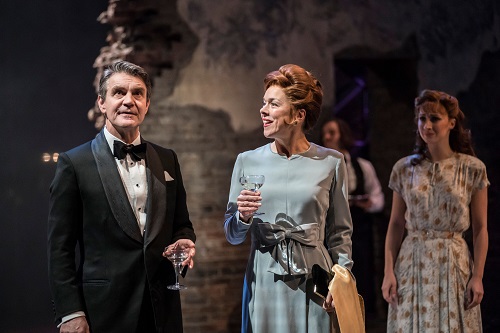
Kerry Richardson, the Schneider, who made me weep every night in 'What Would You Do?', went with me the other week to the Orange Tree Theatre in Richmond to see Peter Forbes, the Schultz, as Stalin, no less, in Howard Brenton's outstanding new play Churchill in Moscow. Here they both are after the show. 

We all knew Peter would be the one to succeed, and now he's come into his own as, among many other things, the best Buddy Plummer I've seen, in the National Theatre production of Follies. The Stalin role, probably the first time the character has had an inner monologue (springing from a Pushkin poem), is just as important as that of Churchill - the nominal star (because he's a name) Roger Allam. Production photos here by Tristram Kenton.

The unpredictable turns in their relationship, with both actors playing off each other to perfection, is mirrored by their interpreters, fictional creations but delicious ones: RAF Lieutenant Sally Powell (Jo Herbert) and Red Army Lieutenant Olga Dovzhenko (Elisabeth Snegir). It turns out, of course, that MI5 meets NKVD here. The two pairs waver between a move towards what they have in common and a deeper knowledge that more separates them than can ever connect them

In the games of the couples, we also see Molotov pitted against UK Ambassador Archie Clark Kerr. The solitary individual is Svetlana, Stalin's teenage daughter. I can see why she ends the play looking towards her breaking-free of the allotted role, but there was a sense of 'oh, is that it?' Otherwise, a wonderful piece of theatrical twists and turns. No-one was sure when we went whether there would be a West End transfer, but we hope and pray there is. 

As for awards, how would you privilege Allam over Forbes any more than you could choose between Ben Whishaw and Lucien Msamati in Waiting for Godot? Peter, of course, the most genuinely modest and thoughtful of people, doesn't seem that bothered. In the last two weeks he was also going in to rehearsal as Leonato in the RSC's forthcoming Much Ado About Nothing. He's already a stage legend to those of us who've been following his career since that Edinburgh Cabaret.

Sunday, 3 March 2019

Follies of 2019


To declare the National Theatre's revival the best ever production, with the best ever cast, of Sondheim and Goldman's layered masterpiece, you'd have to go back as far as the 1971 premiere. My theatre editor on The Arts Desk, Matt Wolf, was sitting next to a man who'd been there, and he declared this was tops. What I do know is that I laughed, cried and cheered my way through the 2017 press night of Dominic Cooke's subtle staging, already the stuff of five-star raves like mine, and that it just got even better (Marianka Swain seems to me to hit the nail on the head, and eloquently so, for TAD this time). Production photos throughout by Johan Persson.


It sounds curmudgeonly to say so, but while Imelda Staunton brought her usual perceptiveness and truth to the role of Sally Durant Plummer, the former Weismann Girl who's been eating her heart out over decades for the man she should have married while wed to the one she doesn't really love, it didn't fit her like a glove in the way that her definitive Mamma Rose in Gypsy absolutely did. The lines lie quite high, really needing an accomplished singer - some numbers were transposed for IS, I'm told - and one hears Barbara Cook sometimes in the true show voice of Joanna Riding.


But oh, we get so much more. It's interesting that, as before, the production images don't give away what happens in the climactic 'Loveland' Follies of the four main characters, working all the better for not coming after an interval. So you see the sweet facade of Sally above, not the raging monster that breaks out of 'Losing My Mind'. The image - slight spoiler notice - of her ripping off her wig and staring terrifyingly with her clown-face at the audience is up there with the great moment of her Julie Jordan bursting out of the house in Act Two of Carousel and crying 'where is he?' (of the 'ghost' Billy Bigelow). I remember how our row rocked with tearful heavings at that point.


The way that key song is played underlines what Cooke does with so many numbers - has them start naturalistically and quietly, at a mirror ('Broadway Baby' and, more stylised, this one) or conversationally to friends, admirers or husband (Tracie Bennett's ever-stupendous 'I'm Still Here' - pictured above, given in full in the YouTube film at the end of this piece - and Janie Dee's cool-beginning 'Could I Leave You?' - Dee pictured below with Alexander Hanson and Christine Tucker) and then rise to heights either of theatrical defiance, on with the motley, or sheer fury. The stage persona can be as 'real' as the inner turmoil revealed.


I was struck this time by how much the young 'ghosts' were interacting with their older selves, more palpably aghast at the way they'd turned out. Having a drink after the show with our former Edinburgh University Theatre Company buddy, and the best Buddy you'll ever see, Peter Forbes (pictured below), he confirmed that Cooke, even in absentia for part of the rehearsal period as he was finishing off a film, had wanted more of this. The excellent junior show singers, therefore (Christine Tucker, Gemma Sutton, Harry Hepple and Ian McIntosh) had to be 'present', emotionally speaking, the whole time. So you looked at them much more often. In any case, 'Waiting for the Girls Upstairs' is as perfect an ensemble (an octet, in fact) as Sondheim ever devised.


Alexander Hanson gave us a different Ben from Philip Quast, the cracks showing from the start, some very sensitive singing going on. Perhaps that meant that the ultimate breakdown felt inevitable rather than surprising, but none the worse for that. I assumed we were seeing the same Hattie 'Broadway Baby' Walker as first time round, since they looked identical, but this was Claire Moore (pictured below) rather than Di Botcher, absolutely terrific.


I was hoping to see Felicity Lott, taking over the veteran Austrian diva Heidi Schiller from Josephine Barstow for this stretch of the run, but she was stricken with laryngitis, and though she felt better on Tuesday morning, she gave it one more day before she was back in the bosom of people she absolutely adores (and it's reciprocated).


I went, lucky me, as a guest of Meyer Sound, celebrating its new partnership with the NT, and it may come across as the kind of commercial plug you keep getting, in knowing inverted commas, throughout RuPaul's Drag Race (welcome, Season 11 - it's going to be good) if I say that, yes, the quality of orchestral balance with well-miked singers really showed their part in the overall success. But what ravishing playing! Jonathan Tunick, Sondheim's master orchestrator, is hugely, sincerely impressed. Peter told us how he was there at an orchestral rehearsal at which Peter's son, a double-bassist, was allowed to sit alongside the professional player. Tunick would tweak a note here and there, hearing everything with the ear of a Boulez, re-allocating a line or two to make all the difference.

That's professional genius. And lest you ever doubted it about the master, I came across an amazing 55 plus minutes of Sondheim in conversation with André Previn which absolutely nail it, making no allowances at all for what the TV audience might or might not know. I found it when I was looking, on the advice of my Arts Desk pal Graham Rickson, for Previn's Pittsburgh Mahler 4 to add to the TAD homage I put up yesterday. I didn't find that, but I came across this - and, better still, it has the three wonderful first performers of Side by Side by Sondheim - Julia McKenzie, Millicent Martin and David Kernan - bearing out what Sondheim says about duet form, pastiche - a chance to hear the first song he wrote for 'Phyllis's Folly', not even heard in Side by Side, and breaking the song-mould. A true and generous insight into the creator's workshop, and what a brilliant interviewer Previn makes.


And we have to end with Bennett's 'I'm Still Here', as performed at an awards ceremony feting the last run. Now, I have to catch Company before it closes. Meant to go over Xmas, but ended up in hospital instead...


Friday, 12 January 2018

Willkommen (zurück), bienvenue, welcome


It was 37 years ago this May that the Edinburgh University Theatre Company put on a production of Kander & Ebb's Cabaret in the much-loved Bedlam Theatre. It had a huge impact on all of us lucky enough to be in it. Mary New (now Amorosino), my then soon-to-be flatmate, whom I'd known (but not really since we were juvenile chalk and cheese) from All Saints Banstead Choir days and still a close friend, incarnated Sally Bowles.


Living as she does in Washington, Mary wasn't able to make a wonderful reunion held in the Stockwell home of Sarah Macnee - then the designer, now Executive Director of Crying Out Loud. Our MC, the fabulous Leonard Webster, also lives in the States, having performed the role professionally (in Leicester, I believe) since those student days. But it was still quite an assemblage.


Some of the folk in this photo - courtesy of Kerry's man Dom (more about her below), since though I was on the staircase snapping alongside him, my shots are less sharp - weren't in the production, but all had some kind of involvement with the Bedlam. So I'll add parentheses where relevant. From left to right, Eleanor Zeal (two-time Fringe First winner and co-godparent of beloved goddaughter Rosie - Rosie's  mother being our equally beloved and never forgotten late friend Nell Martin), Pat O'Connell (music director), Kerry Richardson (uncharacteristically distant, but we'll see her in a moment recreating her Fräulein Schneider), Antonia Giovanazzi, half of Simon Bell (Clifford Bradshaw, and still my best mate), Claire Hicklin (Bedlam queen when I arrived to audition at the theatre in Freshers' Week 1980, and I was always a bit intimidated by her impossibly glammy former self, all Stockbridge charity shop fur coat and smoke from pungent Gauloises; if only I knew what an eerie little person she was inside, she told me), John Stalker (director, Bedlam supremo and now big-cheese producer, predictably enough), Peter Forbes (Herr Schultz, and another big cheese, just wowed everyone as Buddy Plummer in the National Theatre Follies - back then always The One Most Likely To, despite his modesty), Gabrielle Firth (as she then was; she must forgive me for not having recognised her from those days) and Sarah.


That's Peter as Buddy, pictured for the NT by Johan Persson. I'd previously seen him as Malvolio, Max Reinhardt's business manager Rudolf 'Katie' Kommer in Michael Frayn's Afterlife - a play I liked a lot more than most - and Balvenie, Earl of Douglas in Rona Munro's magnificent James Plays, but who knew he could sing quite as stunningly as he did at the National? Herr Schultz required only a kind of crooning, but still he conveyed all the necessary quiet pathos, and Kerry made me weep every night with her rendition of 'What would you do?' I'm so glad she's become a good friend in the past few years, too. I knew I wanted the 'older couple', closer in years now to their roles, to recreate this pose.


And gamely they did - there's a whole string of diverse, fun posturings, but this one comes closest. Peter seems to have reincarnated his pose, laugh apart, more accurately than Kerry.


What filled me with a long-lasting delight about the evening was that everyone present seemed - so far as one could tell - sorted and happy. Sure, there had been some divorces and past troubles, but - touch wood - we all seemed on an even keel, contented with our lot. So very different from Follies. And John - I asked him if he still thought our Cabaret was good, and he told me he'd seen many since, and yes, it was in his view the best - would be happy to help with a 40th anniversary sing-through of the show. Maybe more (a special script?), maybe on the Edinburgh Fringe, who knows? Let's get organising, and hope no-one dies in the meantime... The extra body in the photo below, by the way, is Sarah's partner Walter, meeting and chatting to whom was another huge plus (he's a staunch and active Remainer).

Tuesday, 19 August 2014

Munro and Gråbøl: the conquest of fear


It wouldn't really be right to try to sell Rona Munro's wonderful trilogy The James Plays with the above publicity image (one of two from James McMillian) of James III's Danish wife Margaret. People would say that the Edinburgh Festival was cashing in on Sofie Gråbøl*, best known in the UK - until these past few weeks - as complicated detective Sarah Lund in surprise telly hit The Killing, but already a classical actress of note in Copenhagen, and now we know why; she's absolutely charming but also a tower of strength. The three Jameses of the new production shared between the National Theatres of Scotland and Great Britain - James McArdle, Andrew Rothney and Jamie Sives (possibly the least nuanced of the three) - are all sexy and charismatic, but they don't tell the whole story either, even if they have to be on the main poster.


No, the real dynamic that drives the dynastic drama, as one might expect from Munro, comes from the women, and that's why the second part of my heading would, I fancy, be a suitable subtitle: they symbolise, though not in any abstract way, the shift from fear driving policy to confidence offering more democratic possibilities. Am I over-intellectualising in seeing a parallel between The James Plays and Aeschylus's Oresteia, in a kind of shift from primitive blood-grudge to a more enlightened society, however precarious -  a developing drama in which the Furies become the Eumenides, the Kindly Ones?


There's another key actress who fulfils that specific function, the equally fine Blythe Duff, pictured above in one of Eoin Carey's rehearsal pictures. Duff's Isabella Stewart, wife of regent Murdac and presumptive queen until James I returns from prison to claim his birthright, is an unscrupulous, if sharp and amusing, powermonger, doomed to become a vengeful wraith in chains bewailing the murder of her husband and her three sons.

Isabella makes her exit half way through the second play, having wrought her spell on the young James II, and in the third Duff metamorphoses into an older version of that king's wistful sister Annabella. So the actress plays her part in the trajectory whereby the first queen, English Joan, uses her fear to force the first James, who loves her but isn't loved in return, to a bloody oathbreaking, while the second, French Mary of Guelders, seems fearless until an event that would shock anyone shatters her incorruptibility (the same actress - Stephanie Hyam, a little underpowered - plays both roles and is pictured below as Joan with McArdle's James I in one of Manuel Harlan's production photographs).


These first two queens have others of their sex to back them up - the vivacious, devoted Meg (Sarah Higgins, strong and likeable) and, in Mary's case, young Annabella (Rona Morison, another sympathetic performance). But it's only when Margaret appears upon the scene, hailing as she finally puts it 'from a rational nation with reasonable people', that a truly dominant trio can emerge, Gråbøl's Queen well offset by Duff's older, resigned Annabella and Morison now playing the part of 15 year old Phemy. The culminating speech  sets the seal, balancing James I's showstopper in one of many symmetries both subtle and obvious. I have to quote some of the text, to give you a sample of Munro's basic style, which is to exchange Shakespearean blank verse for simple but not unpoetic prose, best when getting to the essence of things as here. Margaret has just spilled her jewels over the floor before the Scottish Parliament, her capricious and jealous estranged husband having walked out on the ministers.

I am your Queen and these are yours.

The comfort of community is warmer and softer than cold gold could ever be. I'm sorry that it's taken me nearly fifteen years to understand that, to understand how to be your Queen. I'm sorry I never told you any of this. I should have known that the only way to let you understand how much I care, was to tell you exactly what I think of you.

I've seen the worst of you, and you're murderous, miserable men. You've seen the worst of me, I've been a proud, overdressed, self-centred woman. But the best in you pulls me above that, and the best in you, with my help, can sustain this parliament and this nation.

So it takes an outsider to make us in the audience think, hey, a Yes vote might not be such a bad thing. That's the power of theatre and if the above looks plain on the page, believe me it's not when you've got someone like Gråbøl delivering it at the very zenith of the drama. It reminded me of Prime Minister Birgitte's tear-jerking turn-it-around speeches in Borgen, with a similar sense of absolute rightness and naturalness coming from the actress in question (there, the equally wonderful Sidse Babette Knudsen). Let's have a production shot of Gråbøl's Margaret seduced, as she so often is, by the most sensual of the Jameses as played by Jamie Sives, who also features as a not very clear-speaking Henry V of England at the start of the saga.


But if the last big speech is one radiant keynote - buying at least a few years' peace, as Annabella will tell us when the action fast-forwards beyond Margaret's death - there are darker climaxes, too. Folk have complained about James II being the weakest of the three plays. I don't think the opening nightmare of young James need be quite as messy as Laurie Sansom's very uneven direction makes it - and the music is just dreadful throughout - though I didn't mind his idea of a puppet to play the king's even younger self (pictured below, Andrew Rothney as the second James, complete with the birthmark he doesn't sport in the publicity. It did nothing to diminish his attractiveness in my eyes. NB: dry ice, always a bad sign in any production as far as I'm concerned).


But after the nightmares temporarily give way to reality, there is a series of great scenes. Almost unwatchable in the right sense is the one where Balvenie, now Earl of Douglas, has grown from a whiner who wants a plot of land into a territorial monster, bashing his son into repetition of the names of the estates which make up the land separating Scotland from England.


Very proud of Peter Forbes here (pictured above in rehearsal with Cameron Barnes as Big James Stewart), always the Actor Most Likely To when I was in the Edinburgh University Theatre Company (he was a superlative Malvolio and Herr Schultz in Cabaret, pictured in an earlier anniversary bout of nostalgia about 'the Bedlam'). Required to provide more light and shade, Mark Rowley as his son and the cousin who gives most succour to the young James rises to the most tense and finely-paced stretch in any of the dramas, the scene in which William baits the king who's set him at arm's length, with tragic results. I wept here, and Rothney certainly played his part in making the confrontation unbearably moving. The earlier homoerotics are beautifully suggested, too, and two goodlooking actors certainly help the frisson (below, Rothney and Rowley in rehearsal).


What else stands out? The unruly second act supper of James I (pictured below, Duff as Isabella seated left), the anything-goes football game in the December idyll of James II, the astonishing mirror scenes of James III (Margaret, confronted with herself: 'I like this woman! Look at her! She's ready for a laugh, isn't she? I'd love to get drinking with this woman! I really like the look of her. Is that really me?'), James III's capricious rejection of his son. And finally, making it all temporarily right and tying up the strands, the epilogue where Annabella decks out James IV-to-be in jewels of past significance.


Some have found the writing superficial, but I marvel at how Munro can say so much with so little - unspoken echoes, tactless reminders changing the mood - and how at the existential heart of it all lies the 'is that all there is?' of those characters - William, James III especially - who know there is a richer, lovelier, more adorned world beyond Scotland. Time for another final chunk: this is William telling the untravelled James II what he saw as Papal Envoy to Rome:

There's a house, not a rich man's house, a wine merchant's house, an ordinary shop man's house you ride past on your way into town.

It has paintings of angels on its walls that look like a window into the next world.

It has peacocks in the yard. I'm not joking. The wine merchant's kids are kicking peacocks' eggs around his garden in Rome.

With angels watching them.

And I come home and I'm supposed to feel like a rich man because I've got another hundred wet sheep?

What's the point? Tell me? What's the point of that?

And yet even the malcontents, like Margaret and us, love the best of Scotland. This is one to make film and television, and hopefully in a decade or less there will be a production truly worthy of the text. I'm glad and emotional to have seen it, though, over three festival nights, with time to think about it in the days between. Try for returns when it comes to London in a couple of weeks' time.


Coda: just finished watching a much longer epic, Breaking Bad. Hyperbole has been labelling it the best TV series ever. Well, there are superb performances, virtuoso camerawork and scenes of great truthfulness, but while the family tensions were always gripping, the premise on the gangster/violence front has never quite had me suspending my disbelief. They really seemed to be stringing it out in the last series: it could have ended two episodes earlier, with two vintage twists, but then I guess we wouldn't have got the poetics of the grand finale. Suffice it to say that while Skyler's breakdown moved me very much, I couldn't quite get involved with our Walter once he'd gone beyond the pale. An exceptional man who did great evil: who can ultimately can care for his redemption? Maybe you did; I didn't.

*Stop press: wonderful in-depth interview with great Gråbøl by Jasper Rees on The Arts Desk. What a wonderful woman, truthful and funny.