Showing posts with label Warburg Institute. Show all posts

Wednesday, 21 March 2018

Communal song and prayer in Dante's Purgatory


'Cantavi tutti insieme con una voce' - 'they were all singing together with one voice'; 'Quest'ultima preghiera, segnor caro, già non si fa per noi, ché non bisogna, ma per color che dietro a noi restaro' - 'this last prayer, dear Lord, we do not make for ourselves, since there is no need, but for those who have stayed behind'. Welcome to the shared experiences of Dante's Purgatorio. The singing souls in the boat with an 'angelic pilot,' steering with wings, and the proud who hope to be redeemed but are weighed down by stones on their shoulders share a selfless communion.

As our Dante to the Virgil of Dr Alessandro Scafi  at the Warburg Institute's free course on the Divina Commedia, Professor John Took, reminded us this week, 'no one in the Inferno says "this is for them," only "this is for me" ', and the only kind of association there is in implicating others in one's own catastrophe. 'There is no creative sharing in the Inferno'.


Yet somehow we shared Dante's horrified savour of being there - all those fascinating individuals cognisant of their guilt but unable to repent. In one of many surprising parallels with a very different text I'm working on with students in this term's Opera in Depth, Dostoyevsky's From the House of the Dead (or Notes from a Dead House, as the translation I'm now reading, that of Richard Pevear and Larissa Volokhonsky, has it), the author who shared the fates of the most hardened criminals in Siberia puts his finger on the plight of the damned in speaking of one of the other prisoners: 'he was fully aware that he had acted wrong...but though he knew it, he seemed quite unable to understand the real nature of his guilt'.


With Dante, one can take any number of variations on that theme, so superbly realised are the figures as dramatic characters, but it's such a relief to see the light as Dante and Virgil go through the centre of the earth and find themselves on the other side, in the Antipodes, with a different starscape. Canto 1 of Purgatorio dwells so loving on the beauty and wonder of the sky, and paints a landscape with rushes at the foot of the mountain to be climbed,


but in between we meet Cato, guardian of Purgatory,


and in Canto 2, an even more 'real' personality - the composer Dante had known (and we don't, despite a 20th century namesake) whom he addresses so warmly as 'Casella mio'.


Yesterday evening produced an interesting contrast. On the one hand we had the bas-reliefs of humility on the terrace of Pride


and its stone-laden incumbents delivering Dante's version of the Lord's Prayer, which Dr. Scafi had students read in Arabic, Mandarin, French and Spanish, a tribute to the insurance magnate Marco Besso who in 1908 produced a book with the same text in multiple languages; Dante provides a gloss within the poetry on the meaning of the text.


On the other we were back to living figures, as it were: Omberto Aldobrandesco, who wants to humble his earthly pride in family but can't resist rolling out the splendid name - as Dr Scafi did, with relish - and Oderisi, a leading manuscript illuminator. This leads Dante, through Oderisi, to a disquisition on the transience of fame both in art - Cimabue has already yielded first place to Giotto -  and in literature, 'one Guido', Cavalcanti, has taken the honour of 'first poet' from another, Guinizelli.

'Forse è nato chi l'uno e l'altro caccerà dal nido' - 'perhaps he is born who will drive both of them from the nest': Dante wryly references himself - and of course he did exactly that - but within a penitential context. He knew his worth; although there's no complementary homily on 'ars longa, vita brevis', we know from Paradiso that Dante saw himself as a crusader of the pen, not there to show off his skill. 'He lived out the difficulty of authentic poetic utterance,' said Took with his usual brow-furrowing eloquence, 'and had a definite sense of the longevity of his achievement.'


The attitude to the artist's task is avoiding hubris but at the same time 'implementing the properties of selfhood'. So un-Medieval this, so modern. The artist's destiny is to be capable of carrying out what he or she is called to do. And that means embracing human nature in all its complexity. Dante is a dramatic poet, not a dry moralist; he is greater than the parameters of his age's religious thought, and that's why we still read him. I was going to wind into this the introductory Purgatorio class's selection of lines which so beautifully render the difficult question of free will, but I can see I've gone on far too long, so that's for another time.

Friday, 2 February 2018

Magnificent severity from Bach and Dante


This week's Monday lecture-reading at the Warburg with our Dante and Virgil (though it would be hard to say which was which), Dr. Alessandro Scafi and Prof. John Took, seemed daunting: we entered the Inferno's Forest of Suicides with harpies above in Canto XIII and heard the unhappy end of Pie(t)ro delle Vigne (della Vigna, 1190-1249). Frederick II's right-hand man, he was brought low by envy and slander, and in desperation took his own life (the scene below, of Piero in prison before his suicide, is taken from a 1911 silent film based on the Inferno).


Our artists, including Blake up top and Joseph Anton Koch below, are at a bit of a loss how to illustrate Dante's depiction of the suicidal souls. He has them not as human figures trapped within trees, but voices coming from the spiny branches, which ARE the souls. The one which Dante snaps off, on Virgil's instruction, asks: 'Have you no spirit of pity at all? We were men, and we have become plants'. That seems a harsh fate when people are driven to take their own lives for all sorts of desperate reasons; one of the students in the class asked how it would be applied, say, to Holocaust survivors who years after their persecution can no longer live with themselves.


John Took's answer was, as before, that Dante's overwhelming compassion tempers the harshness (and I also read online a reader who had toyed with suicide during a depression deciding that the thorny-tree image is apt for how one feels when every moment of life is pain - I know something about that from my past episode too). The key stanza is

   L'animo mio, per disdegnoso gusto,
credendo col morir fuggir disdegno,
ingiusto fece me contra me giusto.

 ('My spirit, at the taste of disdain, believing by death to flee disdain, made me unjust against my just self'). There it is, in one line, the essence of so many of the Inferno's suffering souls, no less applicable to Francesca whom we visited the previous week - 'ingiusto fece contra me giusto'. Again there is the alienation of blame, the strategy for self-justification, the infernal circularity with no way out. We all know about that, so we can identify with Piero, too.


But there's more. As a master of Latin prose and rhetorical skill, Piero needs the eloquence of his calling, and Dante provides it in the arrangement of repetitions, extending even - slightly absurdly - to the surrounding narrative as well as the speech: 'Cred'io ch'ei credette ch'io credesse', 'My belief is that he [Virgil] believed that I must believe...'). Whereupon someone recalled Sir Humphrey saying something similar in Yes Minister ('oo eez Sir Amphrey?' asked Dr. Scafi, to general amusement - and why, as an Italian, should he know - though while in India, we saw a candidate on that country's Mastermind answering questions in his specialist round on that classic BBC comedy). And there was a fun parallel - for Sir Humphrey, too, was 'he who held both the keys to the heart' of his master.


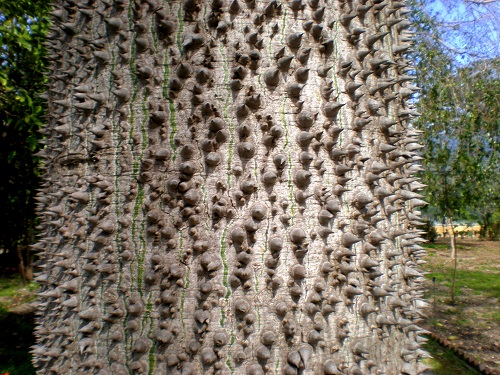
As for the topology, which stays the same for the rather puzzling sequel to Piero's explanation (the chase of prodigals pictured above), although Dante talks about Piero being a 'great thornbush' ('gran pruno') in Line 32, he has earlier described 'not green leaves, but dark in colour, not smooth branches but knotted and twisted no fruit was there, but thorns with poison', which gives me licence to think of those terrifying thorny giants from Brazil which are to be found in abundance in Palermo's amazing Botanical Gardens. Any excuse to wheel out three specimens I snapped on our first visit:


I find fascinating the link between these mortal trees and the metamorphoses of antiquity; Dr. Scafi cited Daphne and the three sisters of Phaeton, while Dante seems to invoke Virgil's tree-bound Polydorus whom Aeneas discovers transformed in Thrace. My question was whether Dante was doing something completely new in giving his trees the voices of former humans - again, not figures within the wood, but the wood itself? Yes, came the answer, as with so much else, he has transformed the original transformations.


I expected to find something sweeter in the Bach cantata for Septuagesima Sunday, BWV 144, which takes its title from Matthew 20. 14 - 'Nimm, was dein ist, unde gehe hin' ('take what is yours, and go your way'), from the Parable of the Workers in the Vineyard. But all is austerity here. The men plunge in without preface in the opening chorus, a short fugal elaboration with multiple repetitions of 'gehe hin'; the alto air is wonderfully severe, with its low, rich pulsing strings. Rilling and that superb contralto Helen Watts conjure the necessary grandeur here.


There's some softening with the two chorales, but even the soprano solo (Auger again) is in the minor, with spare support from oboe d'amore and bassoon.  A short but far from conventional cantata for the Leipzig choristers in 1724 to get through quickly before the winter cold inside the Thomaskirche froze them to the spot.

It's such a rich time, with this weekly Bach and Dante running alongside my Monday classes on another work of inexhaustible riches, Wagner's Das Rheingold. Our only genius of the stage Richard Jones returned this week to talk about his Ring, as well as his recent Royal Opera production of La bohème, and he was more relaxed and funnier than ever. Maybe more on that anon; but suffice it to say that once we've left Wagner's 'preliminary evening' behind, we'll be moving on to another strange masterpiece, Janáček's From the House of the Dead, so the revelations should keep on coming.

Wednesday, 24 January 2018

After a lecture on Dante


NB: Warburg blurb gives conflicting information. Start is 6pm.

Liszt's overblown 'Après une lecture de Dante' actually means 'after a reading of Dante', and in Monday evening's case we got reading and lecture combined at the highest level of enthusiasm, knowledge and inspiration. In a bid to find a less frequent alternative to the Tuesday soirees she used to run before going off to found her mud hotel in Djenne, Mali, Sophie had proposed a reading group following Dante's Divina Commedia - in English, of course, but thanks to doyenne in all things Italian Jill Dunkerton I have my dual-language edition with a fairly literal translation by Robert Durling plus a CD of selected readings from the Inferno, so I was prepared to benefit from that (pictured below: Botticelli's image of Dante's topography - hell as a funnel, starting with the widest, first circle at the top).


Before the intended launch, however, Sophie had discovered that there was a free series of lectures taking place on Monday Evenings through the Spring and Summer terms at the Warburg Institute in connection with University College London and the Italian Cultural Institute. As Monday's session took the sorrowful tale of Francesca da Rimini in the context of Canto V, as its theme, I was especially keen to check it out. And so, after two hours of my own lecturing on Wagner's Das Rheingold, I cycled from the Frontline Club to the Bloomsbury university zone (a nice straight line heading east). And I'm glad I made the effort. This is the Dante reading group for me, though I grant that we could carry on discussing the ramifications for a lot longer.


The format is perfect. Each week Dr. Alessandro Scafi of the Warburg (pictured above) reads the chosen Canto in Italian, accompanied by slides and the text on the screen in both Italian and English. He then goes back over the text clarifying the meaning and footnoting the references. Then Professor John Took of University College London - who seems reluctant to have a photo of his very characterful face with its thoughtful, furrowed brow on the internet, so I make do with this portrait accompanying his self-introduction -


gives us his take on the Canto in question. That then leaves 40-odd minutes for questions.

Those are the bare outlines, but I can't communicate how well the two academics themselves put across their passion for the subject. Dr Scafi's reading is so, well, poetic - and sensitive, better, I fancy, than the voice of Claudio Carini on my CD, who tends to drop at the end of most lines. Oh, those bird similes - especially the one about the cranes (which I'll leave you to look up for yourself). He even made me want to learn passages by heart, as I did after I'd read Pushkin's Boris Godunov with my late, lamented Russian teacher Joan Smith. Prof. Took said he found discussing the Francesca narrative almost too painful, but left us in no doubt of what he takes from it, or at least a part of that.

It's a masterly compression in which Dante, we decided, forges his own myth from a story which would have been recent history for his readers: while reading of Lancelot's love for Guinevere, Franceca and her husband's brother Paolo Malatesta - whom she may or may not in real life have taken for her intended before the truth was revealed - discover their own love in a passionate kiss, only to be murdered by the jealous Lanceotto. Dante's treatment is oblique: the unknown shade who comes closer to Dante through the 'aere maligno' (Blake's depiction shows the aftermath, where Dante passes out with emotion)


tells him first that she was born 'beside the shore where the Po descends to have peace with its followers' - in other words, Ravenna - and is only named Francesca at line 115.

She abnegates her own responsibility by blaming Love for 'seizing' her and others, then when Dante pins her to relive her past happiness by narrating it in present misery - Prof. Took thinks 'dimmi', 'tell me', is one of the most drastic and severe commands in the whole of Dante - speaks only of the reading and the kiss in a highly charged 12 lines (sketch by Rossetti for his famous triptych below).


Paolo, referred by Francesca only as 'costui', 'this one,' weeps and Dante 'fainted as if I were dying, and fell as a dead body falls'. That's the end of Canto V (here depicted by Fuseli, a study for a painting which no longer exists).


With passionate eloquence, Prof. Took emphasised what I had always hoped to find in Dante even before I started reading him properly: that this Inferno is not about divine wrath, but 'the agony of what the soul chooses for itself' - and therefore the most profound meditation on the human predicament, then and now. The second circle is full of 'carnal sinners who subject their reason to their lust' (lines 38-9). Yet while Dante subscribes to the sexist view of Semiramis, who seems to have committed no sin in history other than to have been a powerful female leader, he makes Francesca so piteous in her graciousness. Three lines especially tear at the heart, Francesca of course addressing the deeply suffering Dante:

    se fosse amico il re de l'universo,
noi pregheremmo lui de la tua pace,
poi c'hai pietà del nostro mal perverso.

('If the king of the universe were a friend we would pray to him for your peace, since you have pity on our perverse pain'). Yet at the same time, Took stresses how the heroine tries to mythologise her guilt away. In both aspects lies the complexity: 'mortality, psychology, ontology in 70 lines - a literary miracle'. That compression has never found its equal in any of the many homages since in art and music, though Tchaikovsky catches the pathos of Francesca and the ache of happiness lost and of illustrators the imaginations of Blake and Doré (pictured below) are surely the finest.


Next week we embark on a daunting subject, the  Suicides in Canto XIII. Come along if you can and you like the idea then and/or on 5, 12 February, 5, 12, 19, 26 March - no registration needed. I hope you'll find it as inspiring as I do.