Showing posts with label orchids. Show all posts

Saturday, 22 June 2019

A full day in North Norfolk


Absolutely no church interiors this time, though we did stop off at All Saints Burnham Thorpe to pay our respects at the graves of friend Jill's parents and brother. As the chosen church to receive money from our annual Norfolk Churches Walk, it got £2725.50 from the four of us and a grand total of £3846. I also won a £50 prize in the annual photographic competition, but as often I thought the choice was an odd one, though not ungrateful, of course.

The destination was Burnham Overy Staithe where our dynamic friend the composer and mezzo Susie Self was giving a special preview of her one-woman opera Analysis (we think it has to be called Self Analysis). The long drive with multiple stop-offs entailed revisiting a few old haunts from the time when Jill's mother lived in Burnham Thorpe. But if anything I love the area around Southrepps, where Jill is now settled  - to be strict, in Lower Southrepps - even more.


Her garden is now evolving into a little miracle, and with so much insect-friendly planting, it was buzzing and humming with life on a hot June weekend. Quite a few species of bee were to be found on the rockery, especially around the nepeta. My first conscious sighting of orange-bottomed bumble bees (Bombus lapidarius), and plenty of them.


As for the dragonflies, oh my, What colours, what a size! I'm grateful to Ellie Colver of the British Dragonfly Association for identification, having failed in my online search. Alas, these are no rare species, but nature's design is the thing. This one, with its plump blue and yellow thorax, should have been easy to classify, though I didn't find what I wanted: it's a male Broad-bodied Chaser (Libellula depressa).


More confusing were the candidates for this beauty out of three or four that had refused to settle, whizzing around the lawn for ages - a Four-spotted Chaser (Libellula quadrimaculata).


Jill outlaws some colours from her garden scheme, and wouldn't let these giant oriental poppies in, but how splendid they look against a wall on the lane.


There's a boardwalk around a preserved wild common/marsh five minutes from Jill's house, formerly managed by local residents and now in the care of the Norfolk Wildlife Trust, which will assure the right money spent on preserving it. Always bliss to visit if one has a spare half of an hour, especially in the evening.


Crossing a shady stream, I came across what I was hoping to see - quite a smattering of wild orchids


including this one, the Common Spotted Orchid (Dactylorhiza fuchsii).


White poplar fluff was drifting everywhere - a sight I remember multiplied a thousandfold from arriving (like Lenin) at St Petersburg's Finland Station one July (it was Stalin's favourite tree, apparently).


Our leisurely drive west to Susie's show needed to take in one big walk. It had to be a mostly shady one on a hot day, so we elected to do the big loop round Sheringham Park, Repton's role in which I hymned in an earlier blog post.


This was full rhododendron time, with occasional glimpses down to the sea.


We caught more of it fringing the estate before turning inwards at the point where the steam trains arrive at what is the terminus for the standard route.


Foxglove flourishing in the woods on the way back.


Then it was back in the car to head for lunch at an old favourite, Cookie's Crab Shop at Salthouse, which has become a hotspot since we used to visit in its humble days. The crab and lobster special did not disappoint. Then a short amble to see the salt marshes here.


and on to a garden centre in North Creake beloved of Jill, and I can see why: it just seems to have the ones you want. This magnificent cistus was not for sale.


though I duly noted this Halimiocistus 'Merristwood Cream'.


Tea at North Creake Abbey next, also quite developed since we last visited. The fields and stream over the way saw sheep and geese in happy co-existence.


Finally, the bathe at Holkham Beach, though another half-hour walk necessary from Burnham Overy Staithe to get there.


The water wasn't particularly cold, though there are no shots of me in the water, and the one of the other two in the dunes isn't permissible. So here's sea kale in the dip of the dunes on the way back


and a fading sun over the marshes.


Folk were assembling at the splendid old boathouse venue when we got back to the Staithe


and the singer-composer was in fine form both receiving on her set with its installation - true Renaissance woman, is our Susie -


and for the opera itself, a highly varied free-flow musical-theatre piece about the more analysis-worthy phases of her life. She is a fearless entertainer, engaging each member of the audience directly at one point or another, and she uses her voice superbly through many octaves. Michael, the 'sexy Canadian' who took her on a spin around his native land when they were both music students (a lively road-number), was there to support on cello; that's quite a partnership. Here they are after the performance.


For the after-show, they'd generously prepared a picnic of smoked salmon sandwiches, brownie and apple, following the prosecco at the start.


So we sat very contentedly watching a fine sunset.


Perfect end to a perfect day, if you'll forgive the cliche; I can't think of a better way to put it. And do make your way to the superlative 10th anniversary Southrepps Music Festival run by top tenor Ben Johnson and pianist Tom Primrose, held mostly in one of Norfolk's tallest-towered churches (simple inside, but excellent acoustics). Events from 7-11 August include recitals by phenomenal guitarist Sean Shibe, Ben in duo with former BBC Young Musician of the Year Martin James Bartlett (now well on the way with his superb EMI debut disc,which I need to write about) and my pals Benjamin Baker and Jonathan Bloxham in Mendelssohn's Second Piano Trio with Daniel Lebhardt (who also gives a duo recital with Ben B). The culminating event is a performance of Britten's The Burning Fiery Furnace. So cue a 'playout' with the burning fiery firnament at Burnham Overy Staithe.


Thursday, 8 September 2016

Summer bees


Kew Gardens had laid out a vast herbaceous border with 27,000 mostly bee-friendly plants, and there was plenty of apine activity among the agapanthus planted around the Palm House


while two strips of the order beds in the Chelsea Physic Garden - on the Dicotyledon side - were humming


and in our friends the Van der Beeks' garden in Lacock, Eryngia were among the preferred sources of nectar.


Perhaps this is the unexpected one, though the Mayfield lavender fields are on the tourist map now: a big tourist attraction opposite my childhood haunt of Oaks Park near home 'village' Banstead.


The big one this summer has been Kew, with its extraordinary new structure the Hive.17 metres tall, made out of 169.300 mostly aluminium components and first seen as part of the UK Pavilion at Milan Expo 2015, where the theme was Feeding the Planet, Energy for Life. Nottingham artist Wolfgang Buttress reacted accordingly and consulted a researcher at Nottingham Trent University who studies how bees communicate. It's now found its natural home surrounded by a meadow of 34 native wildflower species, 19 outsiders and three grasses, edged with a hedge of six other species.


The idea of accelerometers in a hive measuring the bees' activity from vibrations has been translated into 900 pulsing LED lights which react to behavioural vibrations. I imagine this would be more spectacular at night, but you can still spot the light-ups, rather bee-like in themselves


and there is sound, too. A drone bass relayed from a nearby hive of 40,000 bees (literally, what Buttress calls a 'deep visceral hum') activates musical phrases 'in C', which are triggered by the various vibrational messages. There are two levels. On the ground you can apply a lolly-stick to a panel to hear the vibrations more immediately. And you can see people above in the central panel; these kids knew it and were playing to the parterre.


I sat against the ?plexiglass? walls on the upper level for much longer than I'd intended, fascinated by the bonding experience which brought all ages together to respond to the magic.


A small Chinese boy really got it, lying on the floor contentedly for long periods looking up at the sky through the opening in the top of the Hive.


It was a good connection to be able to walk straight to the herbaceous border - gone now, I fear, , the fiery pokers of Kniphofia triangularia -


 and see the bees in action on scabious and the like.


Kew's other August stunner is the Waterlily House, where Victoria amazonica, grown from seed every spring, waxes most impressive


and all shapes, colours and sizes of nympheas put on a display.


Around the fringes loofahs (strictly soeaking, Luffas)


grow so big they have to be supported before they fall.


Next port of call, reading-wise, after my Pamuk binge is very definitely Dave Goulson's A Sting in the Tail, about the life and variety of bumblebees, warmly recommended to me by a beekeeping lady as I browsed in the Chelsea Physic Garden shop yesterday. It was a humid, grey Tuesday, nothing like the high days of summer when the bees were in full swing (though they;re still doing their stuff, albeit not so prolifically). Oh, the profusion of pollen and nectar then.


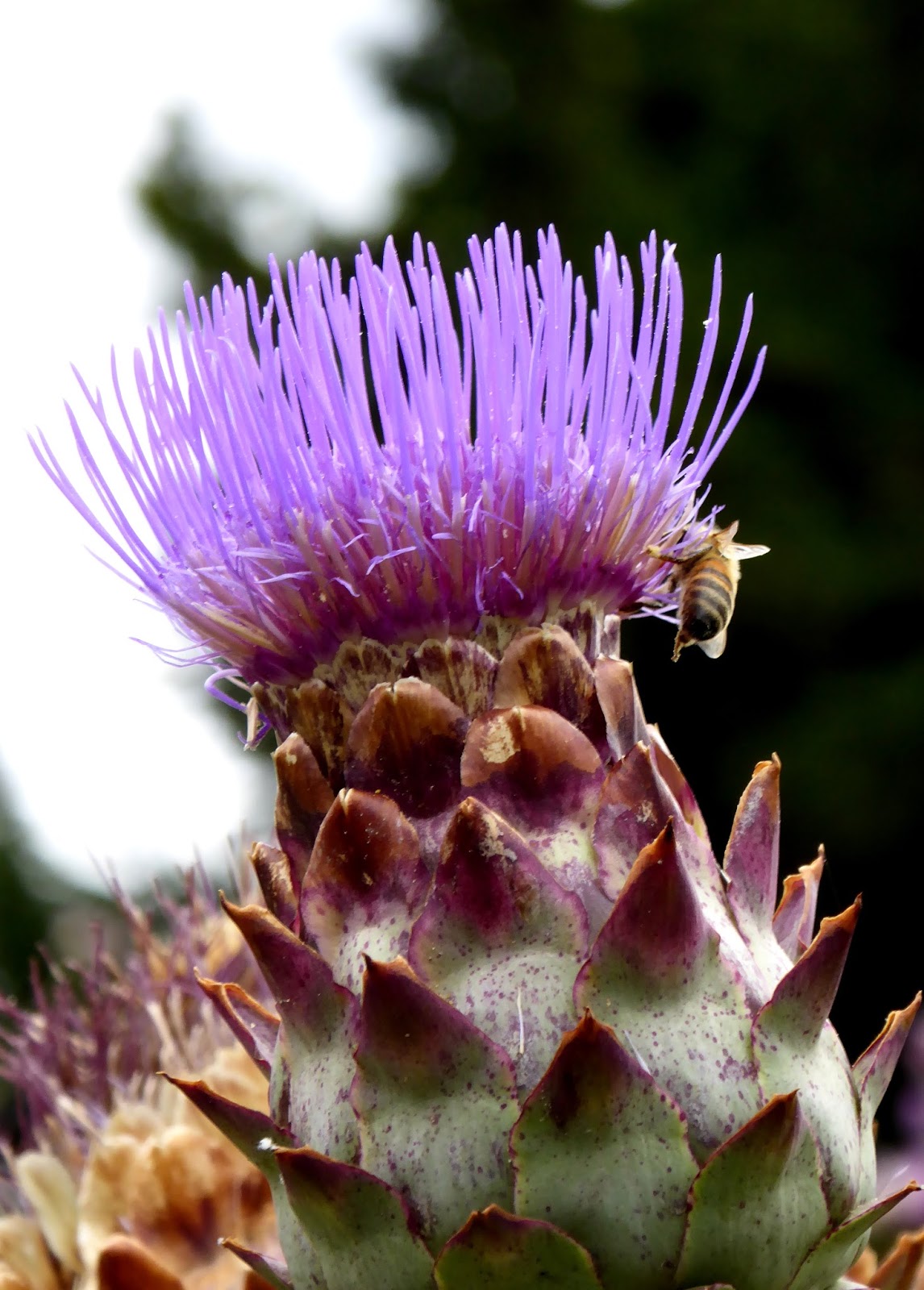
As at Kew, cardoons were a firm favourite


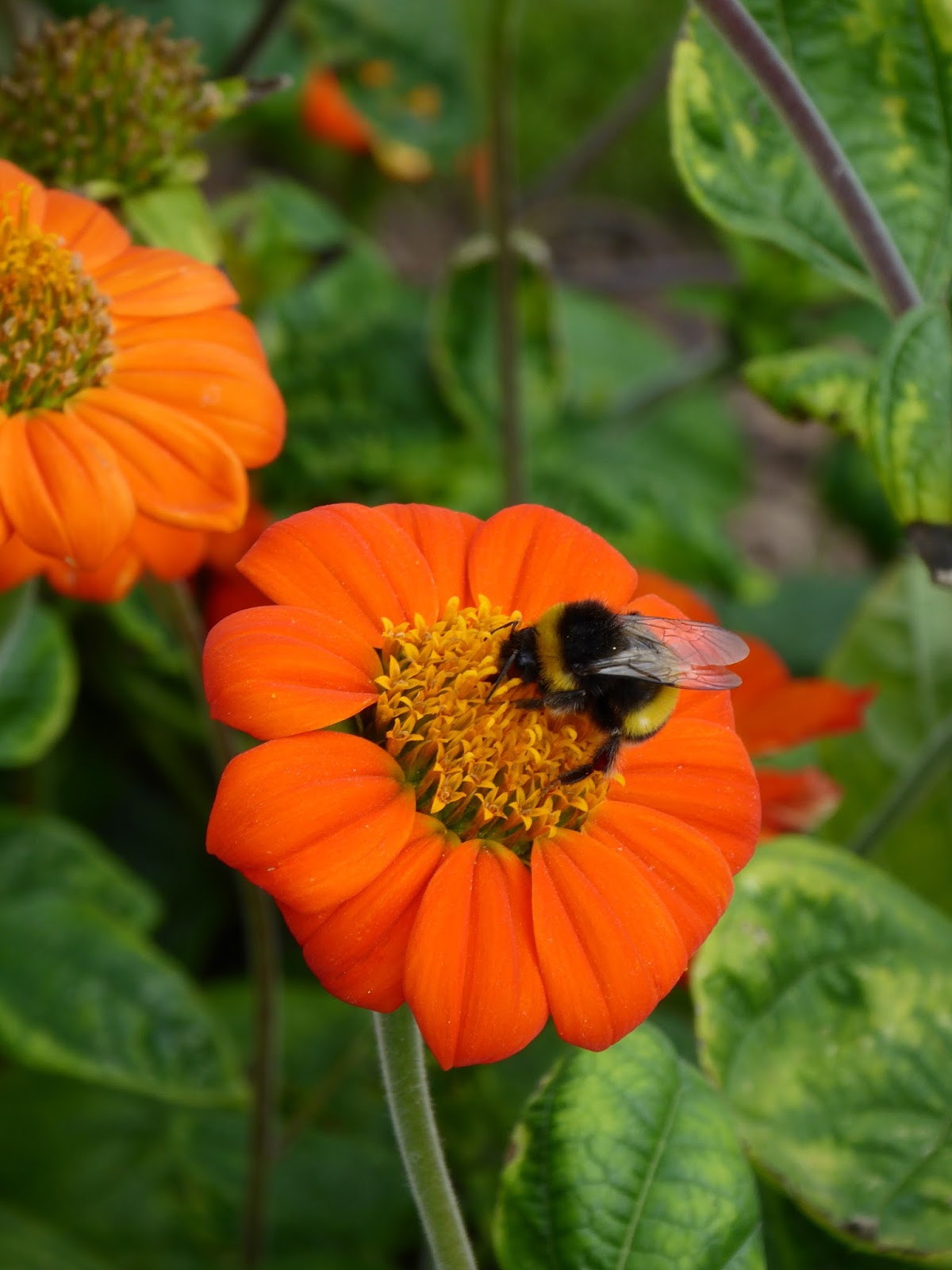
along with this extraordinary variety of dahlia, still going strong.


Two more, the second one another type of Eryngia, I think.


Pitcher plants, drosera and Venus fly traps in the little greenhouse by the Tangerine Dream Cafe were all in their creepy prime, too.


As for the wonders of Cantax House, Lacock, I start from the particular, as up top,


and move to the general. The garden is looking very inviting from the wall and pavement outside


though Deborah's fecund topiaried goddess was in need of a haircut, and was about to get one:


I realise I've over-extended myself here and have to postpone the wonders of Iford Manor, a performance of The Magic Flute in the cloister of which was the focus of our visit. But I can't ignore the miraculous orchid field Deborah led us to, a walk down into a beautiful valley from the village of  Biddestone. Why should all species gather in this one field, I wonder? So many names for so many similar-looking varieties - Deborah may be able to help here - but surely the Common Marsh Orchid (addendum: see DvdB's comment below) and the Common Spotted Orchid are among the range:


No mistaking this one, though, the Bee Orchid. I gnash my teeth because Deborah had promised an abundance, but they were at the end of their season. I'd all but given up when she headed south and found this representative - and I wasn't with her, but I'm grateful for the image.


Last but not least, an ordered profusion of purple at the Mayfield lavender fields. I've been here before, but they seem to have extended their territory, just as well because in mid-August the lower slopes were losing their strength. But up over the hill, there was a profusion


which also meant an abundance of bees.


It was good for me to stand in the upper lanes with apines buzzing past me and occasionally hitting me: I had to remember, you're not near a hive, it's unlikely you'll get stung. And I conquered my fear, which in any case is of wasps rather than bees, very quickly.


Couldn't begrudge the international tourists either as they were all having such a good time. Chinese especially seemed to have found their way to Woodmansterne in small groups; many were waiting by the nearest bus stop as we left. I was photographed with two Philippino women and I loved seeing the pleasure kids got out of running up and down the lanes


as well as being photographed by the phone box, another new feature to please the visitors.


A final reminder, in case I don't get round to posting more before the event, that we'll be out in nature on Saturday*, making our annual pilgrimage to 13 or so places of worship covering about 17 miles on the Norfolk Churches Walk. Raising money, as before, for the Norfolk Churches Trust: all donations welcome.

*Or Sunday - Saturday is the one day surrounded by a sea of sunshine for which torrential all-day rain is forecast. So Jill, our leader, suggests we tour the churches by car getting signatures on Saturday and do the walk on Sunday. INNOVATION: you can give via one of 'my dear walking companions' (what he said) here.