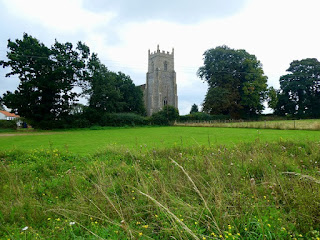
Above represents the high-noon of our latest walk for the Norfolk Churches Trust (begging-bowl still out here) - actually around 3pm, when we finally had our picnic lunch in full sun in the splendid isolation of St Mary's churchyard, Great Witchingham before walking across fields to St Faith, Little Witchingham, a treasure half-hidden in the woods. Thanks to a crucial discovery, it's no longer 'disused and ruinous', as Pevsner found it in 1962.
Lucky as we were to have every church to ourselves, there was a major disappointment this time as we collected 10 in 14 miles (a distance I was dreading owing to my poor right knee, all strapped up, but in the end no more than a minor inconvenience): no one sitting inside to welcome us at any of them, and refreshments only on offer in two. I'll expand on my big beef about this when we get to Elsing, but a very plausible reason for the lack of pride or interest on the locals' part may have something to do with the route's close proximity to Norwich: presumably these are dormitory villages for people who commute to and from the city, so a sense of local ownership is absent.
Anyway, where we started could not have seemed more remote: St Peter Ringland, where a lady who'd just opened up encountered us in the churchyard and reminded us to shut the door behind us when we left. Here's the merry band of 2020 reunited: Cally, J, Kate, Jill - who worked out such a wonderful walking route for us, as always - and Fairless.

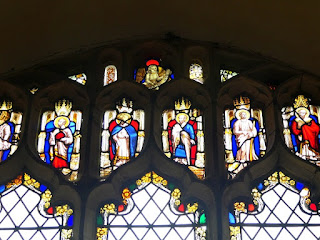
Nor could a church have been richer in treasures. The clerestory windows still have much of their medieval glass scenes and figures - you might have thought they were too high for the iconoclasts to get at them, but evidence suggests this was not their original place - and above them is a hammerbeam roof disguised by ribbed coving ('concave under-surface', declares Pevsner's glossary).


This, says Pevsner, is 'what has made Ringland famous among Norfolk churches'. Closer to the mark in an overall appreciation is Simon Knott in his thorough and always entertaining Norfolk Churches site: 'There may be bigger churches, there may be more famous ones, but none so artistically and historically significant as St Peter'. Knott begins with an appreciation of Norfolk man Munro Cautley and his 1949 Norfolk Churches and their Treasures, but since I'd not heard of either, I refer you to the relevant entry for enlightenment. Pace Pevsner, the beauty first is in the ensemble of clerestory and roof


and next in the details of the glass. I've not been as thorough in my documentation as I might have been - time was short at the start of our route - but you may certainly decipher Saint John the Baptist, donors, Annunciation, Crucifixion and Virgin and Child.


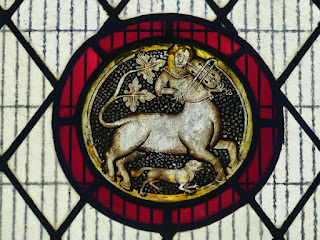
Even so, the most fascinating glass of all is the roundel in a lower window opposite, of a centaur with vine leaves growing out from his tail, and playing a fiddle, quite a good symbol for musicians walking the route.

There's more, not least a font with four lions - like the one at Acle, but that has wild men too - at the base and against the bowl, Evangelists, angels and flowers,


and another of those painted rood screen bases in which Norfolk excels, in this case not necessarily from the church (thinks Nott). There are only eight disciples out of 12 - a ninth panel is placed on a wall - and iconoclastic defacement has occurred, though the colours are bright. Thus Nott: 'The survivals here are St Jude, St John, St Andrew and St Peter on the north side, and St Matthew, St James, St Thomas and St James the Less on the south side'.


Our day's plan was a complicated one (at first), and only made possible by two cars. Thus both took us to a church we would only come near to on our return to Ringland (in the dark, as it transpired), All Saints Weston Longville, before going on to Elsing, where Jill and Fairless drove back to Ringland and then back again together in one car (geddit?) From Elsing our walk could properly begin. But I leap forward. All Saints is hedged in close by houses, so a slightly harried setting, though with plenty of lichened gravestones.

Its fame is due partly to the diaries of the Rev James Woodforde - refer to Nott again on that - and partly to the north aisle wall painting, a mid-14th century Tree of Jesse. I'm intrigued not only by the grapes, but also by the green paint among the colours.


There are also two vivid St Johns flanking the chancel arch - the Baptist with his lamb the finer of the two,

the Evangelist with his poisoned chalice.

The rood screen is handsome and graceful in its tracery and the painting (presumably touched up, but very pretty)


Pevsner thinks 'the twelve paintings on the dado thoroughly bad'. Really? Aren't we lucky to have them?


Just as well that he finds the sedilia and piscina 'delightfully decorated', for this was my favourite thing in the church. How wonderful to find figures including a Green Man among the foliage.


Not having brought the Pevsners (the churches are split between the two volumes, one too many to carry), and seeing no guide, we might have missed the brass to Elizabeth Rokewood (died 1533) with two kneeling children, had it not been reproduced on a wall - a tell-tale carpet suggested it was underneath, and so it proved.

This floor memorial included only because I like the name.

A much-restored window above the south aisle has some original glass. We missed two medieval angels (not for the last time on this walk) further along.
The 14th century door to the side is handsome, or at least grand, both inside and out.


So on we drove to Elsing, getting lost in the maze of lanes on the way. The bicycle ornamentally flowered by the wall is a reminder of how we might have rode, rather than strode, for our cause, and collected more churches; but of course you see so much more on foot, and use paths where no bike should go.

The inn opposite looks quaint - but strange to find a mermaid so far inland.

I'd been anticipating St Mary Elsing with such excitement after what I'd read, but it let us down on several fronts. We spied a lady with a little dog going in to the church and out again - the dog had peed just inside the door - but by the time we entered there was only an old man sitting there (these were the ony two people we encountered inside any church on our entire route). I think he must have been hard of hearing because he didn't answer our greetings, and there was no signing-in form. Turned out he was a former resident returning from Kent - I gathered from what he wrote in the visitors' book that there had been possibly a death of a son which necessitated a return memorial visit. Later I got talking to him and learned that he was 92 and walked three miles a day.
The lady came back, and we asked if we could get the key to what remained of the church's famous brass - of Sir Hugh Hastings (d. 1347), who because he founded the church had pride of place incarcerated in a wooden box in the middle of the chancel - but she told us that the person who had it was 'indisposed'. J got understandably shirty about no-one bothering to have this treasure open on the annual display day for the Norfolk churches.
Never mind. There was a full replica, including reconstructions of the missing parts, up against the west wall.

Two angels hold Sir Hugh's pillow; 'Over his head,' writes Pevsner, 'a cusped ogee arch at the apex of which a plaque with tiny angels receiving his tiny soul. Steep gable and in it Sir Hugh on horseback in an octofoiled circle...To the l. and r. broad band with on either side four tiers of canopies and mourning relatives under them (two of them lost). They represent or represented among others Edward III, Thomas Beauchamp Earl of Warwick, Lord Grey of Ruthyn, Henry Plantaganet Earl of Leicester, the Earl of Pembroke, Lord Stafford.'


The chancel does at least have two visible memorials worth noting: an elegant script on a memorial wall plaque to 'Dame Anne, Sir Anthony Browne his wife, in hope of resurrection unto life, 5 October 1623', and below it a stone tomb chest with two Browne family crests.

I like this three-pigs insignia on a floor memorial, too (poignant, or pointed, in the light of the current wave of totally unnecessary slaughter).

The octagonal Decorated font has a tall Perpendicular canopy with some of the original colouring on the west side.


You can see the church is large and wide, but - and our lack of meeting with any kind of reception didn't help - unwelcoming. The church guide quotes a 'scathing historical reference' to the effect that 'the East Window has been beautifully adorned by painting, and indeed have all about ye Church w'ch were never broken by design, but Suffered from fall to ruin by the Incuriousness [the guide's bold print, or the reference's, not sure which] of the Parishioners'. The incuriousness of invisible villagers was certainly a blight on this walk. True, the East Window also suffered from having its glass blown out by a gale in 1781. There are fragments of original glass in a fraction of the window

and they include this ass or ox, presumably from the original Nativity.

Otherwise what remained has been gathered into two of the south chancel windows, with three saints (Matthew, Jude and Philip) and a medley of other fragments. At least this glass had the benefit of recent restoration by the Churches Conservation Trust.


By the time Jill and Fairless returned, the sun was beginning to break through
and we got glimmers of it, framed by two silver birches, on our first stretch of woodland walk

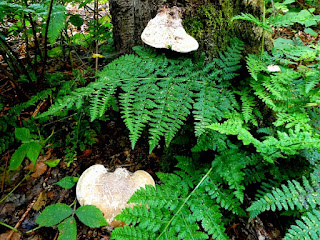
with plentiful fungi, suggesting a long mycelium, and a couple of the bracketed variety, lining our left hand side.

Crossing a minor road, we entered a small local wood of significance,

crossed a field of big swedes

and headed along an oak-lined path up a gentle incline

to the hill above Lyng, a pond on our right and a handsome beech stand of the kind Paul Nash loved to paint, rather disfigured by the motor-cycle course below it, on our left.

The messy farm continued to blight the view on the road down to Lyng, and we met lots of folk heading in the opposite direction to a local yard sale - all the rage in Norfolk now - before crossing the bridge and heading via a lane of old cottages to the green churchyard of 13th century St Margaret.

The church was dark inside, missing a north aisle arcade, and with a chancel rebuilt in 1912. It felt not especially loved, nor rich in furnishings, but it does have a fine south door,

a 13th century octagonal font of Purbeck marble

and steps up to the bell tower with a fine arch above.


Lyng straggled northwards like a suburb of Norwich, but the coffee addicts among us were delighted to find a decent machine, and good cakes, inside the local shop-cum-cafe, and took a lazy breather at tables outside, well behind our time schedule by the time we'd finished. Fortunately our cicerona relaxed into a che sarà, sarà mood and so there was no pressure from this point on.
The village is more attractive as you walk towards the Wensum, and the famous view of the old bridge and mill house does not disappoint.

After this we had a long walk in nature until the next church. First we took a path alongside Sparham Pools, a bird sanctuary, but with little avian activity at this time of year.

This was the only stretch where we encountered other people. Ahead of us I saw a lady unleashing four little dogs. In the idiotic way that is my wont, I did a little bark, and set them off - they all came running towards us. The lady was rather tearful - among them was a little Chinese Crested Dog, so much more attractive than the usual hairless variety (horrifyingly they put down many of the hairy ones because it's not what people want). and it had been at death's door with two near-fatal illnesses. This was its first bark and its first lively movement. So I am clearly something of a dog whisperer, or rather barker.

We also encountered a group of garlanded girls - so pretty an idea for a hen gathering (our friend Pia gave us garlands for our wedding party), though I see from a similarly-adorned crowd at Clapham Junction Station yesterday that it's a thing.

Our map-reader - you see how I'm passing the buck - carried on up the hill (yes, hill, very undulating, Norfolk) instead of taking the right turning. but that gave us a fine perspective on a broad valley. We also encountered a lady picking damsons, very defensive about our getting a share. At that point we realised we needed to come back down the hill.

The next stretch was attractive, though flat, at first on a boardwalk over poplar- and willow-lined tributaries of the Wensum

abundant with dragonflies, the rather familiar Common Darters. This photo isn't brilliantly in focus, but wait until I unleash my dragonfly post in the near future - it's been a summer of revelations on that front.

Then a well-kept farm, with a fine dappled perspective on our left

and a woodshed with a lone hollyhock on the right.

There was a short stretch of road to be negotiated. You can see who the main employer is here - probably having trouble getting the staff right now - though the sign makes 'Bernard Matthews' look like another village.

Turning off from the built-upness ahead, we walked into the secluded heart of the walk. What a wonderful arrival at St Mary Great Witchingham, though you couldn't see the tower at all from our approach. Then, suddenly, there was the church in its leafy surroundings.

Another view from the west end.

The churchyard is beautiful and quiet - we'd left busy roads behind - so perfect for our annual picnic in honour of Jill's mum, the late Mary Dunkerton, warden of All Saints Burnham Thorpe, who always prepared chicken rolls with mango chutney and coffee buns. Jill sticks to the rolls. I hope no-one is shocked that gravestones were appropriated, but this for me is a lovely photo of Kate and Fairless.

The church was locked, so Fairless and Cally went off to knock on the door of the lady with the key. Not a happy encounter: 'I've been bothered by five people already today'. 'Well, it is the big day of the year for the Norfolk churches'. Eventually she conceded that we would leave the church open for the rest of the afternoon and the key in the door.
The 15th century south porch makes a good start, with flint flushwork friezes delineating M for Mary.
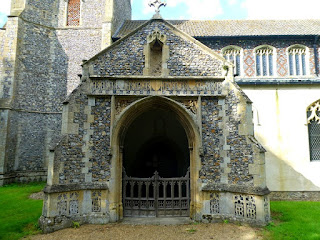
The spandrels above the entrance feature an annunciation scene (the Virgin in the niche above is missing). Regretfully I didn't snap the Virgin of the annunciation, in shadow, but this detail of the Archangel Gabriel shows how fine the work is.

Without the key, we would have been deprived of seeing a beautiful, light-filled interior and some unmissable treasures. First, the late 15th century Seven Sacraments Font, defaced but rare in having the original colour.

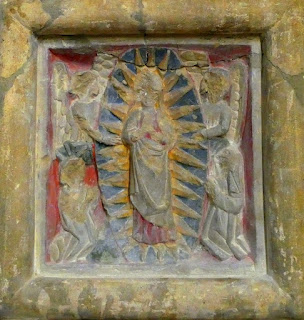
Each panel is impressive - this is extreme unction -

but the bonus is the Assumption, which would have been the correct dedication of the church. The rays are also to be found in one of the glorious East Window panels of East Harling, the biggest glory of last year's walk.
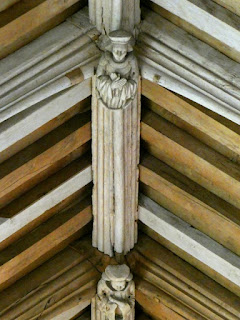
The late medieval nave roof has figures along the ridge.

In the south aisle are a Victorian eagle lectern and associated steps from the chapel of New College Oxford. Here they once served as a pulpit.


Much older carvings are to be found on benchends - this row has an angel at one end
 T
and what looks like a devil at the other.

The monument to Oliver Le Neve in the chancel has a dramatic story behind it. This High Church Tory, hunter and farmer came to live at Great Witchingham Hall in 1692. Four years later the Whig Sir Henry Hobart of Blickling lost his seat in Parliament and, on learning that Le Neve had accused him of cowardice during William III's Irish campaign, challenged him to a duel on Cawston Heath. Le Neve was wounded in the arm, but Hobart died of a wound to the stomach. Le Neve fled to Rotterdam and returned in 1700 to stand trial at the Assizes, to be cleared. His only son died four months before his own demise from apoplexy in 1711.

I'm assuming this Elizabeth was the wife of an earlier Oliver Le Neve (the father?) The script is pleasing.

The route to Little Witchingham was across fields above a valley. Fabulous late afternoon light made it all look rather romantic,


and in the flowering ivy along the lane we reached, there were dozens of Red Admiral butterflies (maybe the two here aren't so clear in the size of image).

St Faith, Little Witchingham, is almost hidden in a wooded area where the lane curves round.

'Ruinous' it certainly was when Pevsner published the North-East Norfolk and Norwich volume of The Buildings of England, and in the Shell Guide to Norfolk by Wilhelmine Harrod and C. L. S. Linnell, we read that 'Little Witchingham church, nearly a ruin, has an early carving of the Crucifixion on the outside wall of the chancel'.

But in 1967 the art historian Eve Baker climbed in through an empty window, peeling ivy away from the whitewash inside and discovering a wall painting beneath (a framed newspaper obituary on one of the pillars celebrates a similar redeemer, Tom Davey, who had some rather nasty opposition over the years from Satanists at St Mary the Virgin, Houghton Hill - we have to include that next year. Here's a lively homage to him on the Norfolk Churches Trust website). The NCT put in a programme of conservation at Little Witchingham which eventually resulted in the building passing into the hands of the Churches Conservation Trust. What you see on entering, especially on a sunny afternoon like hours, is a clean, spare wonder.

On the north wall is a whole series of ind-14th century (pre Black Death?) paintings dealing with Christ's Passion. What looked at first like three graces turns out to be the scourging

and what looks like a crucifixion is in fact the deposition, its incompleteness somehow only adding to the magic.

Clearest of all, on the right, is the 'noli me tangere' of the risen Christ to Mary Magdalene in the garden. The vine-patterning below makes a link to the Tree of Jesse painting in Weston Longville.

On the opposite wall, there are a few paintings to be made out, though the subjects aren't clear (Cain and Abel or Abraham and Isaac, perhaps, in the second?)


No mistaking the Evangelists' symbols in the spandrals of the south arcade opposite, though. The best ones, which I have here, are the eagle of John, the lion of Mark and the angel of Matthew. The ox of Luke was partially destroyed in a 17th century shortening of the south aisle.


Finally, just a few more general perspectives. I didn't want to leave the interior behind then and I'm equally reluctant to do so now.


Next came an easy amble down Kett's Lane, strewn with crabapples,

to a valley with a small stream, and Swannington - I'm so glad we took the alternative route round the back of the early 18th century Swannington Manor with its splendid brick end-gables and the topiary which, somewhat surprisingly, a branch of the path closely skirts.


The park in the front of the house is almost as attractive, with a great copper beech,

and there, across the road at the end of the driveway is the tower of St Margaret.

We were now getting to the point where, just after 5pm, we might have expected churches to be shut, but this one wasn't. Again, radiant late afternoon light in the interior, approached via another of those Perpendicular porches with flushwork lettering - this one spells out I H S Nazarenes (Jesus of Nazareth). In the spandrel, as you can just about see in the second photo, there's a dragon with people on the left and other figures, including an armoured lady, with the dead dragon on the right. St Margaret! I wouldn't have worked it out without Simon Knott's help. Above is an intriguingly bitten-off sundial.


This church was not only open late, but had a wealth of refreshments and an open kitchen where we were even able to make cups of tea, oh joy. It had a well-cared for feel , with armorials handsomely ranged along the north wall.

The chancel is wide and has a grand assembly of glass in the east window,

including two 17th century heads of Christ from the continent.


Even the windows without much glass look handsome with the green beyond them.

I couldn't quite make out the wall painting of St Christopher compared to its clarity on a church board reproduction,

but there is a decided gem of a piscina using a Norman capital with St George and the dragon on it.


Next to it is a 'sumptuous Dec Sedilia with ogee arches and large leaves in the spandrels' (Pevsner).

More handsome lettering and crest on a floor memorial.

The surroundings demanded more lingering than we could, by this time, afford: the view across to the timber-framed cottage is attractive
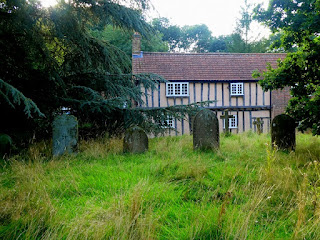
and there's plenty of space around the church, which looks good from every angle.

We retraced our steps back to the manor, crossing the stream on another boardwalk with poplars

and then met a couple of busy-ish roads to get to early 14th century St John the Baptist Alderford, its tower dwarfed by a high pine.

This one was shut, but would have been anyway because the Norfolk Churches Trust is carrying out renovation work inside.

Here we could at least see 'the plate for the knocker with cross-wise fleur-de-lis extensions' (Pevsner). What we missed were another Seven Sacraments font and some fragments of medieval glass. Anyway, we tramped around the outside

and J and Fairless did some stretching - we were beginning to feel the strain of the walk.

A little more road walking took us past a handsome house, verging on Strawberry Hill Gothic (though there's a 1666 date beneath a chimneystack)

and then we turned right to cross Alderford Common, a 'Site of Special Scientific Interest' with 'thin layer of glacial sands and gravels over chalk' giving rise to diverse features - including this first stretch, what felt like primeval woodland.

Then we were heading back down into the Wensum valley again, sun setting to our right.

We didn't encounter a single car on our descent along Station Road (the station is disused), so all the more curious to come across this sign for the first time.

St Andrew Attlebridge, on a mound above a villagey collection of buildings, is lucky that the Fakenham Road now bypasses it.
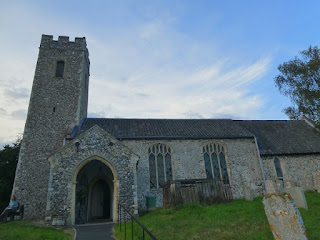
Surprisingly it was still open, but there wasn't a lot to see inside (and I missed what I should have noticed, a 16th century brass presumably concealed under a carpet). This last of the clear windows showcasing the scene beyond seemed the most attractive thing about the interior at the time.

But the porch had a carved stone panel which I don't find mentioned in any reference work

and one corbel of interest.

The priority, however, was the division of the rhubarb cake Kate had made that morning and carried around with her all day - moist and delicious.

By now I felt I'd pushed through the pain in my right knee (praise be to the support pad), but J was suffering and found himself faced with the choice between sitting in the porch and waiting for us to pick him up when we had regained the cars, or pushing on. Which he boldly did.
So we crossed the Wensum one last time just before meeting the busy road

and were lucky in our last goal, St Margaret Morton-on-the-Hill. Jill had phoned the lady of Morton Hall to see if she'd keep the church in the grounds open for us. She was delighted to do so because the Norfolk Churches Trust had helped in its preservation, more of which anon. That also meant the gate to the long drive was open, alongside the fanciful gatehouse

and now we crossed the private estate, sun truly sinking now on our right

while the track between high-banked woods further up the hill plunged us in near darkness (the flash keeps it bright here).

Then a left turn took us to the hall and the church above it. Still open!

The tower collapsed on Easter Sunday 1959.

Crucial work was done in the 1970s, when Lady Prince-Smith of the Hall enlisted the help of the Norfolk Churches Trust. A board of press clippings gives information.

A glass screen now separates the (open former) nave from the east end of the church.

The font was moved east to its present location
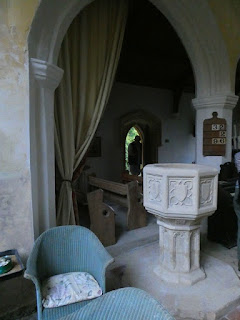
and there's one notable brass, of Katherine Awdley (died 1611), taken away at the time of the church's seeming demise but restored to the Hall after the rebuilding.

This lady was the aunt of Robert Southwell, hung, drawn and quartered for his Jesuit faith and canonised as a martyr by Pope Paul VI. An annual service is still held here in his memory (thanks again to Simon Knott for this information - he got to talk to the lady of the house, but we didn't want to disturb her at the late hour).
The curious twofold nature of the present construction can best be seen from the north,

where a tailfeatherless peacock was strutting and darting about between the gravestones (very distantly glimpsed here) in the twilight.

Heading south-east from the church, it felt like we were on a high plain, with the crescent moon above the maize field to the right,

the last of the light behind us

and dark woods ahead.

Here, I fancy, we may have lost our bearings a little, but it was exciting to walk through the trees with the regular sounds of hooting owls

until we came out of the wood and down to a field near the lane that would take us back to Ringland.

What sounded like an Elvis impersonator at a not-too-distant Saturday night party was oddly haunting; meanwhile the owls we recognised and a bird we didn't (with a weird upward glissando) kept us company along this secluded valley.

Then finally, there we were, back where we started.

A pint at the blissfully close pub for those of us who had only to wait while cars were retrieved provided a nice coda, but the usual concluding meal out seemed a stretch too far. We were in any case meeting up with musical friends Susie and Michael with irrepressible terrier Tristan and conductor David (Jill's near neighbour) the next lunchtime at the Suffield Arms, art dealer Ivor Braka's latest fantastical creation/re-creation, a very happy occasion.

The only thing I didn't manage to tick off as a success was the intended swim at Overstrand; just as on our last visit, the tide was at its highest and the water rough. But an essential walk along the promenade to get sea air and sun together wasn't bad at all.

Just for the record, here are all links to previous chronicles (which don't go back as far as the walks from Burnham Thorpe) :
Happisburgh to Winterton, 2017
Beechamwell to Gooderstone, 2013
Ingoldisthorpe to Thornham, 2012






 Posts