Wednesday, 26 June 2019
Faust damned and saved
In the 1840s, Berlioz took the decision that Faust's ride with Mephistopheles, briefly featured in Goethe and pictured below by Delacroix, should end up not at the prison with the condemned Marguerite but in Pandemonium.
When he completed his original Huit Scènes de Faust in 1828 (his official Op. 1, preceding the Symphonie fantastique), Berlioz knew only of Goethe's Part One, where Marguerite is saved and a big question mark hangs over the protagonist's soul. By the time of La Damnation de Faust, he could have read the vast and astonishing Part Two, nominally completed two months before Goethe's death in March 1832 (what a span - first drafts begun 60 years earlier, in 1772), but chose to ignore its conclusions. There's much more striving towards the light here, not least the 'Classical Walpurgis Night' which culminates in the sea processional for Galatea on Venus/Aphrodite's shell, inspired by Raphael's gorgeous fresco in Rome's Palazzo Farnesina, which Goethe knew well (it's certainly on my list of top 10 things you have to see in the Eternal City),
and also the failed flight, Icarus-like, of Faust's son with Helen of Troy, Euphorion - the source for this creature of light here seems to have been Annibale Carracci's The Genius of Fame.
I've now spent six Mondays on La Damnation with my Opera in Depth students, and while our circlings round Berlioz have yielded plenty of other musical riches - so pleased to discover the Abbado recording of Schumann's Faust-Szenen, for instance, with a young and burnished Bryn Terfel following in the footsteps of Fischer-Dieskau on the patchily-cast Britten recording - as well as the revelation of Gustaf Gründgens, Klaus Mann's and István Szabó's model for Mephisto, in a colour Hamburg film of Goethe's Part One, it's been the reading of the colossal Part Two which has taken me on a psychedelic journey, with plentiful focus in the 150 pages of 'interpretive notes' by Cyrus Hamlin to Walter Arndt's translation in the Norton Critical Edition.
No wonder the San Francisco bookship City Lights published a translation of Goethe called Tales for Transformation, a copy of which I picked up when we visited; it's all so trippy. But also underpinned by Goethe's scientific studies and his humour (I love northern devil Mephistopheles finding himself overwhelmed by the older monsters of the Grecian world in the 'Classical Walpurgis Night' act). In Act 5, Faust's enlisting of infernal help to reclaim land for a flashy modern kingdom by a pushed-back sea, and having simple inhabitants of an older way of life dispatched for getting in the way, is so disturbingly contemporary.
After this you wonder why his soul is saved. But praise be for Goethe's final 'Mountain Gorges' scene in which the Eternal Feminine leads the immortal part of Faust upwards, completed very late in Goethe's life: it's given us apotheoses from Schumann and Mahler greater far than Berlioz's sugary acceptance of Marguerite into heaven. I played the last 15 minutes of Mahler's Eighth in Chailly's Leipzig DVD on Monday, and we nearly blew the roof off Pushkin House. A treat in splendid sound and on a large screen (Chailly's Lucerne performance is to be avoided. What a shame Abbado never got round to the Eighth in his unsurpassable series there. Why any conductors dare to follow in his footsteps with the Festival Orchestra beats me).
Take your pick of other performances on YouTube, but be warned - the Haitink one from the Concertgebouw has some uncharacteristically filthy singing from Gwyneth Jones at the crucial final rise... If it's just audio you want, I'm very fond of Markus Stenz's Cologne interpretation with the best tenor in that impossible part, Brandon Jovanovich, and the splendid Orla Boylan as Soprano II (she should have been on the very top line). The whole thing levitated me at the live performance.
I can understand why Richard Jones wanted to avoid Berlioz's apotheosis in his Glyndebourne production. Robin Ticciati said he couldn't, so they found another incredible solution in which the devils have the last word (first of Richard Hubert Smith's production photos above) and Rosemary's Baby is the last reference. What an amazing achievement. Whether you buy it or not is beside the point; Jones has found a way to tell the Faust story in all those chunks of Berlioz which have only the most tangential bearing on the drama (Rakoczy March, in which he's bullied as a tutor in a military academy, and further narratives in all the later military padding).
It's sustained through a creepy Blue Angelish brothel scene for the enchantment on the banks of the Elbe, an unexpected visit to the prison where Marguerite awaits exection, and which Faust doesn't reach in the 'Ride to the Abyss'
and beyond to his bleeding guilt, a disturbing realisation of said Apotheosis in Heaven.
In Christopher Purves - magnificent in the French adaptations of Goethe punctuating the musical 'action' as in the singing of Berlioz's music -
Allan Clayton (a stunning 'Nature immense') and Julie Boulianne, meaningful in every physical gesture as well as vocal phrase, a perfect performer for Jones, we have three great artists.
And the sounds Ticciati draws from the LPO are super-refined, though I wished at the final rehearsal they'd let rip. RT's assistant in the house said it was deafening at times; well, let it be, at key points. Possibly it now is.
Richard came to talk to the students the Monday before last, hotfoot from the final rehearsal of his Boris Godunov in the Royal Opera revival. He was in a good mood, both because of that - his admiration of Bryn is boundless; he singles him out as one of the few megastars prepared to work with directors, on the language and on general understanding of the roles - and his return to Glyndebourne to see the previous Saturday's performance of Damnation. He said it was 'middle', which apparently is the highest commendation; all the singers had settled into their roles, everything was working. And from that most self-critical of directors, that's high commendation indeed. No-one took pictures this time - pity, because the blue light from the projector cast on his head made him look like one of his own demons - so I cast back to the second of his visits to the class in 2013, when I had a room at the City Lit with a piano.
We expanded upon what we'd discussed in the interview for the Glyndebourne programme, conducted some months before rehearsals had begun, namely the difference between operas which work under the steam of their own dramaturgy - Katya Kabanova, his Royal Opera production of which had so much visually in common with Damnation, Puccini's La bohème and La fanciulla del West - and those for which he had to work out a new 'book' (Handel, the Berlioz). Which takes him years. When I asked him if he would take on the entire Goethe drama, he said he didn't have the time to come to grips with such a vast cosmology: respect. And I love it that he's ever more relaxed with us, and as a result extremely funny. Love that Mensch. Meanwhile, we're on to Dvořák's Rusalka next Monday, and next term, so far confirmed, Handel's Agrippina, Gluck's Orfeo ed Euridice, Weill's Der Silbersee, Wagner's Siegfried and Strauss's Elektra, with one more tbc. If you're interested in joining, leave me a message with your email - I won't publish it but I promise to reply
Saturday, 22 June 2019
A full day in North Norfolk
Absolutely no church interiors this time, though we did stop off at All Saints Burnham Thorpe to pay our respects at the graves of friend Jill's parents and brother. As the chosen church to receive money from our annual Norfolk Churches Walk, it got £2725.50 from the four of us and a grand total of £3846. I also won a £50 prize in the annual photographic competition, but as often I thought the choice was an odd one, though not ungrateful, of course.
The destination was Burnham Overy Staithe where our dynamic friend the composer and mezzo Susie Self was giving a special preview of her one-woman opera Analysis (we think it has to be called Self Analysis). The long drive with multiple stop-offs entailed revisiting a few old haunts from the time when Jill's mother lived in Burnham Thorpe. But if anything I love the area around Southrepps, where Jill is now settled - to be strict, in Lower Southrepps - even more.
Her garden is now evolving into a little miracle, and with so much insect-friendly planting, it was buzzing and humming with life on a hot June weekend. Quite a few species of bee were to be found on the rockery, especially around the nepeta. My first conscious sighting of orange-bottomed bumble bees (Bombus lapidarius), and plenty of them.
As for the dragonflies, oh my, What colours, what a size! I'm grateful to Ellie Colver of the British Dragonfly Association for identification, having failed in my online search. Alas, these are no rare species, but nature's design is the thing. This one, with its plump blue and yellow thorax, should have been easy to classify, though I didn't find what I wanted: it's a male Broad-bodied Chaser (Libellula depressa).
More confusing were the candidates for this beauty out of three or four that had refused to settle, whizzing around the lawn for ages - a Four-spotted Chaser (Libellula quadrimaculata).
Jill outlaws some colours from her garden scheme, and wouldn't let these giant oriental poppies in, but how splendid they look against a wall on the lane.
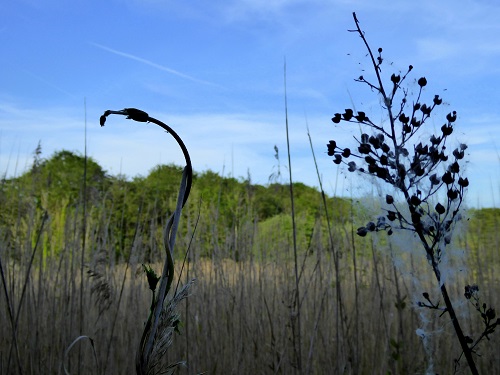
There's a boardwalk around a preserved wild common/marsh five minutes from Jill's house, formerly managed by local residents and now in the care of the Norfolk Wildlife Trust, which will assure the right money spent on preserving it. Always bliss to visit if one has a spare half of an hour, especially in the evening.
Crossing a shady stream, I came across what I was hoping to see - quite a smattering of wild orchids
including this one, the Common Spotted Orchid (Dactylorhiza fuchsii).
White poplar fluff was drifting everywhere - a sight I remember multiplied a thousandfold from arriving (like Lenin) at St Petersburg's Finland Station one July (it was Stalin's favourite tree, apparently).
Our leisurely drive west to Susie's show needed to take in one big walk. It had to be a mostly shady one on a hot day, so we elected to do the big loop round Sheringham Park, Repton's role in which I hymned in an earlier blog post.
This was full rhododendron time, with occasional glimpses down to the sea.
We caught more of it fringing the estate before turning inwards at the point where the steam trains arrive at what is the terminus for the standard route.
Foxglove flourishing in the woods on the way back.
Then it was back in the car to head for lunch at an old favourite, Cookie's Crab Shop at Salthouse, which has become a hotspot since we used to visit in its humble days. The crab and lobster special did not disappoint. Then a short amble to see the salt marshes here.
and on to a garden centre in North Creake beloved of Jill, and I can see why: it just seems to have the ones you want. This magnificent cistus was not for sale.
though I duly noted this Halimiocistus 'Merristwood Cream'.
Tea at North Creake Abbey next, also quite developed since we last visited. The fields and stream over the way saw sheep and geese in happy co-existence.
Finally, the bathe at Holkham Beach, though another half-hour walk necessary from Burnham Overy Staithe to get there.
The water wasn't particularly cold, though there are no shots of me in the water, and the one of the other two in the dunes isn't permissible. So here's sea kale in the dip of the dunes on the way back
and a fading sun over the marshes.
Folk were assembling at the splendid old boathouse venue when we got back to the Staithe
and the singer-composer was in fine form both receiving on her set with its installation - true Renaissance woman, is our Susie -
and for the opera itself, a highly varied free-flow musical-theatre piece about the more analysis-worthy phases of her life. She is a fearless entertainer, engaging each member of the audience directly at one point or another, and she uses her voice superbly through many octaves. Michael, the 'sexy Canadian' who took her on a spin around his native land when they were both music students (a lively road-number), was there to support on cello; that's quite a partnership. Here they are after the performance.
For the after-show, they'd generously prepared a picnic of smoked salmon sandwiches, brownie and apple, following the prosecco at the start.
So we sat very contentedly watching a fine sunset.
Perfect end to a perfect day, if you'll forgive the cliche; I can't think of a better way to put it. And do make your way to the superlative 10th anniversary Southrepps Music Festival run by top tenor Ben Johnson and pianist Tom Primrose, held mostly in one of Norfolk's tallest-towered churches (simple inside, but excellent acoustics). Events from 7-11 August include recitals by phenomenal guitarist Sean Shibe, Ben in duo with former BBC Young Musician of the Year Martin James Bartlett (now well on the way with his superb EMI debut disc,which I need to write about) and my pals Benjamin Baker and Jonathan Bloxham in Mendelssohn's Second Piano Trio with Daniel Lebhardt (who also gives a duo recital with Ben B). The culminating event is a performance of Britten's The Burning Fiery Furnace. So cue a 'playout' with the burning fiery firnament at Burnham Overy Staithe.
Thursday, 13 June 2019
Rouvali: great performances with dodgy endings
I get no medal for having predicted, in my Arts Desk review of Santtu-Matias Rouvali's December 2018 Strauss concert, that either he or Jakub Hrůša would be appointed to succeed Esa-Pekka Salonen as the Philharmonia's Principal Conductor in 2021. Hrůša is the more experienced of the two, and a deep thinker open to ideas in interview - one of the most memorable I've ever had the pleasure to be granted - but apparently the players found him 'too demanding'. So they've gone for the wow factor and the mad hair (straight as a dye in a photo I found of SMR in his student days). All recent images here by Camilla Greenwell for the Philharmonia.
Two further performances in just over a week gave me a chance to discover further what makes Rouvali tick (in interview, he's surprisingly nervy and a bit evasive, or that may be a language thing). Biggest asset: he shows that natural sense of freedom/rubato and the ability to quicken or slow the pulse in an instant. Abbado, Haitink, the Järvis, Mirga Gražinytė-Tyla and Yannick Nézet-Séguin all have it; Rattle and Salonen don't.
The interpretation I heard of my favourite Strauss tone poem, the Symphonia Domestica (alongide Don Quixote, which I know is objectively the finest), launching Gothenburg's fabulous Point Music Festival was mostly miraculous. All the better, too, for coming from that most refined of symphony orchestras - stringwise, to my mind, up there with Berlin, Amsterdam and Vienna - in a hall which really allows big sounds to breathe and not attack you like an angry rice pudding (as my nearest and dearest once said of an Ashkenazy Alpine Symphony in the Royal Festival Hall).
As I've already stated in my Arts Desk roundup, Rouvali's genius was at its brightest in the difficult ebb and flow of the huge slow movement. And then, as the crazy family-reunion grand finale should goes up a notch in fruitcakiness to sehr lebhaft (crotchet = 116), Rouvali kept it steady. No wonder people were criticising the work itself for going on too long. The parody of the Beethovenesque not-knowing-when-to-stop can only succeed if it's wild. Yes, the horns got their insane whoops right, but that's not the point. A fall at the last hurdle.
The following Thursday, the Philharmonia were using his latest concert here to celebrate the appointment (didn't hang around much at the Ballroom 'welcome', too many platitudes being spouted). It began sensationally, with a deliciously layered account of Adams' perfect curtain-raiser The Chairman Dances. Pekka Kuusisto seemed a bit too muted - not literally - for the overloud brass in the opening movement of Stravinsky's Violin Concerto, and saved heartfelt expression for the beautiful homage to Bach which proves the work has soul.
Petrushka was bound to be a brilliant showcase for Rouvali's sense of refined colour, as the Musorgsky/Ravel Pictures at an Exhibition had been in an earlier Philharmonia spectacular. He favoured tone-painting and conductor's tricks over storytelling, which was fine on its own terms. All solos were flawless and characterful; the trumpeters were going great guns. Then, after the Rite-ish onrush of the Masqueraders - swelling trill; finish. The concert ending, which I'm sure Stravinsky must only ever have intended for performance of the orchestral 'three pieces'. No pathetic death, no ghost on the roof.
This shock happened to me only once before, in a BBCSO/Bělohlávek Prom for which I'd prepared the nine-year-old son of a friend I took as guest. I was aghast then that he didn't get the full story, and I went into a spin here. What kind of musician does that? Surely only one without theatrical instinct. Rouvali partly redeemed himself with a virtuoso performance on the 'bones' with Monti's Csardas (accompanied by the wonderful Liz Burley, superb in 'Petrushka's room'). But I'd much rather have had the last five or so minutes of the ballet. My Arts Desk colleague Bernard Hughes hit the nail on the head (which means I totally agree with him).
Redemption, then, on his SMR's first recording with the GSO, which I finally listened to. Hair standing on end from the first string tremolos of the young(ish) Sibelius's first movement onwards. A magnificent performance from start to finish. Let's hope for more like this, and no deflationary endings. Which reminds me that there won't be anything deflationary about the greatest living conductor, Bernard Haitink (pictured below at the Barbican in March by Mark Allan), bowing out in September.
He's decided that a Lucerne appearance will be his last, having celebrated his 90th birthday with the LSO in style. Wise self-knowledge to the end (of his professional career, that is; may he enjoy as many more years as he wants feeding his endless curiosity). I'll never forget his totally inspirational masterclasses in Lucerne, his Bruckner 4 or Beethoven 6, among the most recent performances, and so much else going further back. Don't miss the Vienna Philharmonic Prom on 3 September; queue for an Arena place (£6) from noon if necessary. I did just that for Bernstein and the same orchestra in Mahler Five, and that's a concert which likewise I'll remember as long as I live.
Friday, 31 May 2019
Medieval terracotta in Tartu
Have you ever seen the like? Following advice to 'head for the 14th century Jaani [St John's] church and its abundance of statues,' I guess I was expecting something like the interior of Bamberg's magnificent Dom.
There are in fact three 'big' statues, the largest according to their medium, of the Virgin Mary, Christ on the Cross and St John, but that's only relative to the material - terracotta.
I'd long wanted to visit Tartu, Estonia's major university town, but I expected something different, more along the lines of the other Hanseatic cities. It was indeed a member of that league, though very far inland, situated on the river Emajõgi. But it feels so remote: the drive from Tallinn is half an hour longer than the trip due south to the 'summer capital' Pärnu; halfway, you head east towards the Russian border, and similarly you see little but storks, fields, woods and the occasional lake, with only the occasional settlement. Most of the buildings on the hill, including the cathedral, were destroyed by Peter the Great's troops.
I only had time in the centre to walk around the old town, not much bigger than Pärnu's, though it has an attractive square (triangle) at one end rising towards the Town Hall
and includes the neoclassical university building.
The visit of composers and writers from the World Music Days Festival took us first to the National Museum, a vast and impressive new edifice built on a disused airfield 20 minutes' walk from the centre.
After our international group was welcomed by a village band playing some of the songs heard in Estonia's first Choral Festival, a tradition which started here,
we had a lunch, a tour of the 'Finno Ugric migration' exhibition (one of two permanent fixtures, well done but hardly revelatory, though it clarified for me that Estonians belong to this group and aren't Balts like Latvians and Lithuanians) and a rather dreary concert. Much better, in fact a festival highlight, was the programme given by the superlative Latvian Radio Choir in the Jaani Church. For the two of us who walked there, half an hour beforehand permitted a whizz around the university's botanic gardens and a quick perambulation of the streets.
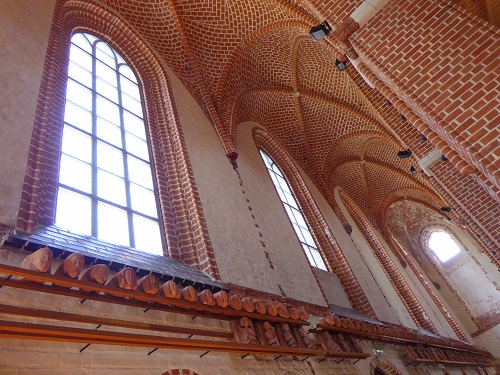
The Jaani Church, its present version essentially of the 14th century, was originally decorated with around 2000 sculptures, uniquely modelled out of wet clay, not put into moulds, and then burnt. In August 1944 the church itself burnt down during the Soviet invasion. It was reconstructed in 1989 to serve as a concert hall.
Further work continued after Estonia's regained independence in 1991, with reconsecration in 2005. The people of Tartu gave a great deal of money for their city's greatest treasure, but there was also funding from the Republic, the Church of North-Elbe and the City of Lüneburg (also full of red-brick buildings; it's a place I'd love to visit). German organisations initiated the restoration of the sculptures, many of which sit on racks along the north wall.
For our evening event, we headed to the riverside
and the perfect small offspring of the National Vanamuine Theatre for Märt-Matis Lill's impressive full-length opera about the First World War, Into the Fire, catching a glimpse of Tartu's most unusual modern tower, the residential Tigutorn, on the way.
Tallinn's walls and towers looked as good as ever through fringes of leaves as Estonia's spring began, on cue in early May. My daily walk took me past the Pikk (Tall) Hermann tower Toompea Castle
before the tower of the Niguliste Museum (former St Nicholas Church) came into view.
Favourite eating discovery: the Väike cafe-restaurant opposite St Nicholas, with the friendliest waiting staff and every detail just perfect (superb bread, excellent soup, exquisite cakes). Two years ago on the way back from the Pärnu Festival, I sat outside here with fellow write Nahoko Gotoh and I remember how they wrote little notes on the napkins, a bit twee, but friendly. This time I got 'may the rest of your day be as nice as you seem to be'.
Another route to the coach stop took me through beautiful gardens, the Dome Church spire just visible here.
Church interiors were for concerts - including the first I've heard in said Dome Church on Toompea. The only rooms I hadn't seen were in the House of the Brotherhood of Blackheads - bachelor merchants who took black St Maurice as their saint when the Hanseatic League was established.
The White Hall, walls fanning out from the performance space, had perfect acoustics for the two-piano recital I heard (and loved) there,
but clearly the treasure is St Olaf's Guild Hall upstairs with its splendid vaulting. All was remodelled in the 1920s, but extremely well.
Unpleasant to think that after I'd left the horrible Helmes of EKRE, the far right party, hosted Marine Le Pen here, an act which did not go unprotested. Estonia's horrifying embrace of extremists, gaining seats in Parliament thanks to an opportunistic power-sharing deal, is a blot on the new democratic dream of a young nation. Let's hope it survives the shake up.
Subscribe to:
Posts (Atom)