Showing posts with label Cendrillon. Show all posts

Friday, 23 November 2018

What we 700,000 marched for...


...seems like standing a real chance of becoming reality as day by day more influential figures call for a People's Vote and Mrs Mayhem's 'deal' seems doomed in Parliament.


Now's the time to start thanking the organisers for having a long-term goal in mind and keeping up the momentum. Because a poor deal and no deal are no longer options.


Not that I was able to follow the route, as I did earlier this year, in March and June, and for the anti-Trump march. My good friend Deborah had come up from Lacock and we were both due at Glyndebourne at 4pm for the tour production of Massenet's Cendrillon.


So we got to Hyde Park Corner for the start, realising that bigger-than-anticipated crowds were likely from the queues up the escalator at the tube station.


By all accounts it took three hours for the march to get started, by which stage we were gone, though J marched on our behalf later. Still, the start was a merry melee, and just about the first familiar face we saw was Anna Soubry's.


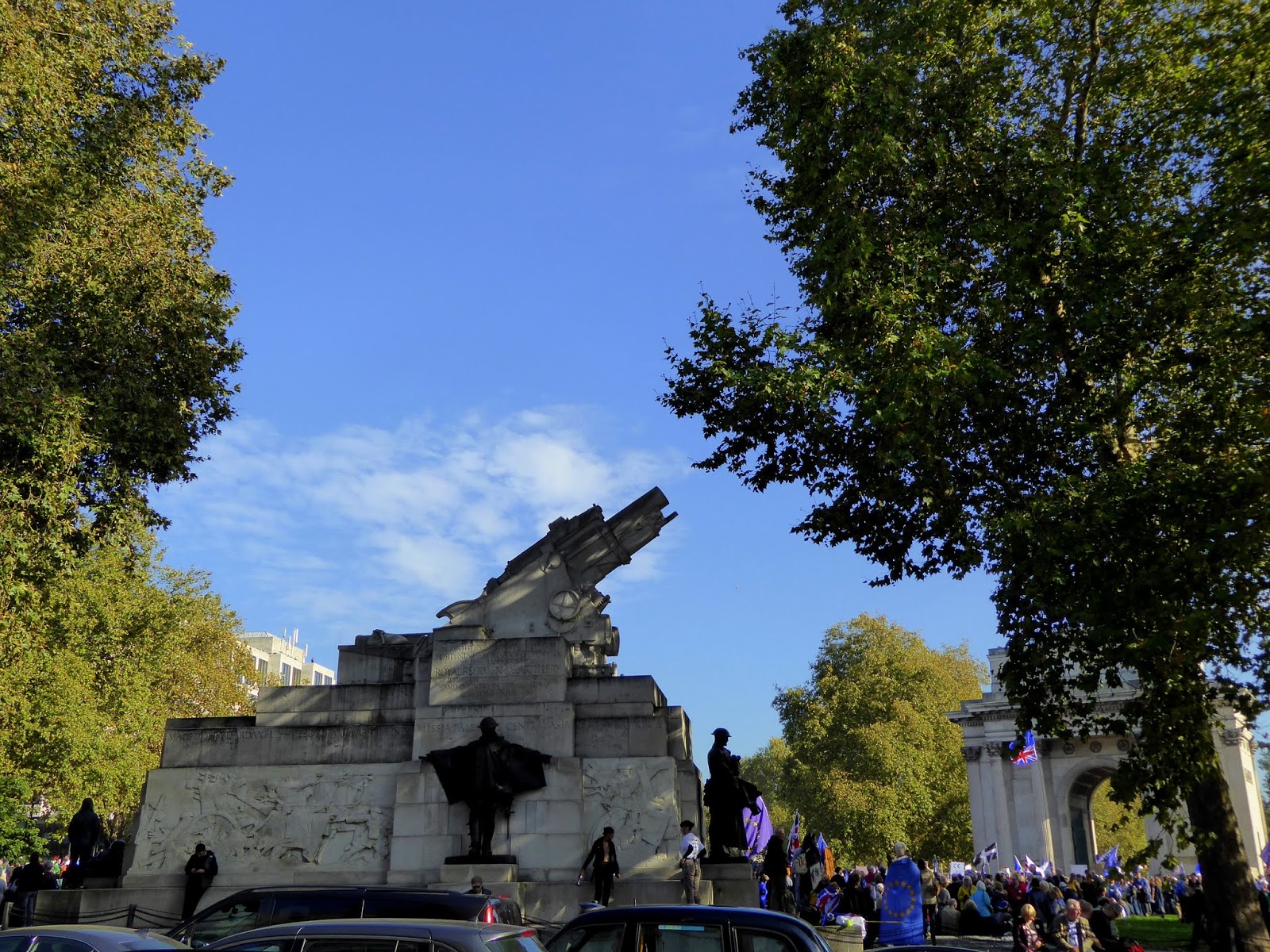
Plenty of monuments supported the fighting spirit


and the banners I remember from the spring march were out in force again


along with quite a few sporting this witty commentary on the First Big Lie (for which BoJob looks up for prosecution). This was the best designed that I saw.


At the entrance to Hyde Park, a different cause was being espoused


and I don't know if this band was part of the set-up, but they helped the carnival spirit,


Heading to Victoria, we finally saw the young who had been very much in the minority at the start finally having risen to join. And then it was a convoluted journey to Glyndebourne, bus replacement included, but nobody minded too much on a glorious afternoon. We decided not to change


and had nothing but delightful conversations with operagoers who wished they'd been able to attend. If anyone was hostile, nothing was said. Great gardener Deborah was fascinated by the abundance of purple-flowering sage. This is the best, along with Japanese wind anemones, for the end of season


and of course the trees were all displaying in advance of a change in London.


Walking round the lake couldn't help but remind me of one tour visit the day after the big hurricane - the opera was Nigel Osborne's punchy and very short The Electrification of the Soviet Union - when so many specimens were uprooted and showing their chalk-covered roots.


Sheep were back across the haha


and folk were out enjoying a very warm sun. 


If only Fiona Shaw's production of an opera I adore hadn't been such a mess. Much work to be done if it's to make sense in the main season next year. Meanwhile our labours continue to get to that People's Vote. Golden October may have declined into sombre November, with 24 hours of lashing rain and cold on Tuesday marking the start of winter - this was the view from the study window -


but we keep our hearts and minds stoked.

Tuesday, 19 July 2011

After the ball


So our three City Lit Opera in Focus classes on Massenet's Cendrillon - it should have been five, but Verdi's Macbeth took more time, which I still think was right - came to an end yesterday. I haven't converted everyone; one of my students still thinks Massenet equals operetta, and that operetta is a bad thing. But the main thing is that I treasure the opera even more for what it is now, with its delicate shifts of tone, and Massenet's orchestration, sense of timing and gentle melodic gifts seem to shine the brighter to me now.

I've been doing a bit of soul-searching in the light of the Havergal Brian debacle (by which I mean not the performance, impressive in itself if hardly beyond reproach given some of the ludicrously awkward writing, but the work itself, which should have been laid to rest after its last two Albert Hall outings). Surely there's much more substance in supposed froth like this than in a failed attempt at more profound thought. Especially in the sphere of music where, as in art as Delaunay had it, 'colour itself is form and subject' - or at any rate can be.


The instrumental ingenuity Massenet lavishes above all on his ballet music, following his good friend Bizet's example, seems boundless. I thought yesterday we'd listen to an Act 2 divertissement with a difference, starting with the chorally elaborated Entree du Roi/Les Filles de Noblesse and ending with the Rigaudon which incorporates the arrival of Pandolphe with Madame de la Haltiere and her daughters. I'd happily have played the three dances in between, all of them brilliantly costumed by Laurent Pelly at Covent Garden and choreographed with abundant invention by Laura Scozzi. Instead, I inserted the Castillane, Aragonaise and Aubade from Le Cid, even more dazzling in terms of orchestral colour and dance panache, shown to best advantage in one of the best ballet performances I've ever heard, with Jean Martinon conducting the Israel Philharmonic Orchestra.


The best Cendrillon orchestral number of all is surely the culminating Marche des Princesses in Act 4, again wittily staged by Pelly as a slipper-fitting. This YouTube recording isn't ideal, but it gives a sense of its 'allure gaie'.


So we moved on rather swiftly yesterday to the two love duets. It's almost a paradox that the one which, dramatically speaking, is redundant should contain perhaps the most inflaming music in the opera. I still wish Pelly had given us not chimneystacks but a big oak in a broom-flowering heath with the moon and the sea in the background, not least so that it would be made clear how the Fairy Godmother makes the Prince Charming and Lucette invisible to each other by conjuring up a fragrant hedge. But it still sounded good, with the great Alice Coote burning as ever. I still don't mind going back to a tenor Prince since Gedda and Von Stade are so fine on that recording. I've since found a 1973 snippet - not enough, alas, to take us back to the magical framework - with Marilyn Horne as the Prince and a young Von Stade. The tempo for the 'extase supreme' sequence is terribly slow, as conducted by Horne's husband Henry Lewis, but the voices do fire us up.


The scene prompted a bout of pure indulgence yesterday. Which are the French duets which make the concept of the 'melodie eternelle' shine brightest? Two, I thought, from Delibes's Lakme - the passionate exchanges of the heroine and her English army officer - and three from Esclarmonde, that piece of dramatic hokum and rare musical genius composed for the freakish compass of beautiful American soprano Sybil Sanderson.


I'd have particularly liked to illustrate Esclarmonde's Act IV glory here, but all we have duets-wise on YouTube is the middle to the end of the 'nuit d'amour' in Act 2. At least it gives us a chance to hear one of the most beaten-bronze tenor voices of all times, that of Giacomo Aragall, alongside Sutherland.


Ici, tout fini bien: we've had our fun with Cendrillon, and now it's back to the Russian whetstone.

STOP PRESS: You may have guessed I've been fiddling about with this while listening to - rather than watching - the Murdoch enquiry. And then, suddenly, cries of 'outrageous' - I flick to pull up the screen, and it's frozen. Shots of a wall which looks like it's had three stripes of paint chucked over it. What I've just been getting, along with half the rest of the country, is a repeated 'Portcullis House. Line 4. The Wilton Room'. Beep. We'll all know the rest imminently - it seems Rupert Murdoch's been attacked by someone in the public gallery with a plate of shaving foam...Such is the strangeness of blogging 'real time'.

Saturday, 16 July 2011

London: pictures in place


Cities are waking up to how you can change the look of a favourite location by installing temporary artworks to grace, contradict or change it. In November Durham will come alive with a festival of light that includes a stunning projection of Lindisfarne Gospel images on to the cathedral, which they did a couple of years ago, and which will be repeated along with much that's new. I hope London will do the same at that darkest time of year: remember the sunflowers projected on to the big arch in the middle of Hyde Park Corner?

In the meantime, one of the happiest serendipities was to stumble across Swedish photographer Anders Ryman's UNESCO-backed Rites of Life exhibition on the embankment just outside City Hall.


Quite apart from the fact that these images of people of all ages ceremonially marked out for a big change are stunning, they make a startling foreground to monuments we know all too well - not least the Tower vs the young man and Ethopian rituals as pictured above and this young woman (a Berber ceremony, I think, but I need to go back and take a closer, less hurried look, and maybe buy the book).


Then there's the baby further softening the curve of Boris's City Hall.


No time, alas, to linger: I was on the way to meet the Suthren-Lanes to experience in a very different fashion from its first night Laurent Pelly's mostly wonderful Royal Opera production of Massenet's Cendrillon. I knew from the 2009 screening of Rossini's Barber of Seville that the image and the sound of the big screen experience, in Trafalgar Square at any rate, is first class, and, ma foi, how the craze for this sort of thing has grown.


I couldn't quite get over the predominance of the young, in all shapes and sizes, happy to sit through an entire opera, maybe to picnic and chatter a bit, but as I wrote in the Arts Desk Buzz piece, everyone around me was quickly hooked by the look of the thing, and the sound of it, too, not least in the shape of our fabulous Ewa Podles with chest notes to die for as the affected stepmother.


A sly shot of diverse neighbours near the fountain:


and a more professional panorama by Rob Moore of the crowd at the previous Butterfly screening, kindly supplied by the Royal Opera.


Well, there's opera for the people indeed - though at the slightly questionable price of BP's conscience-salving excursion into the arts (all this was cleverly and not aggressively raised by the White Swan campaign I quoted in the piece; shame I missed the 'guerrilla ballet' performance). And when it comes to concerts for the people, the fiver that will buy you the only place to be in the Albert Hall, albeit standing, has to be the best bargain in the world. I warmed by degrees, as I think did the performers, to the First Night of the Proms, as you can read in my Arts Desk review. But here's a shot of the first approach, 7.15 yesterday evening, with the building part-wrapped in what looks like a Christo art work and the strange man who wanders about with a book of photos sitting hopefully, or maybe resignedly, at the top of the steps.

Wednesday, 6 July 2011

Bizet in Provence


Last Tuesday I went into BBC Broadcasting House to record this coming Saturday's Building a Library for Radio 3's CD Review: by my own choice, following on from the sunny time spent with Delibes' Coppelia, the subject was Bizet's incidental music for Alphonse Daudet's Provencal tragedy L'Arlesienne. It was actually a chance remark by my friend and unofficial former mentor Dr. Roger Savage that Bizet's Adagietto must be behind Elgar's most introspective moments that led me to listen again, and fall in love.

Of course I can't give even a hint of the 'winner' among the 20 or so recordings. But I would like to sing the praises a little more of the work itself. As I've discovered, all of Bizet's 27 numbers for Daudet's play are worth doing, though they need some kind of dramatic context - and only one of the three contenders there gives that, though unhelpfully it uses German actors (excellent all) rather than French. So it boiled down to a choice between various versions of the famous Suites: the first put together and re-orchestrated by Bizet himself, the second assembled by his friend Guiraud after his death (with a not exactly appropriate borrowing, the Minuet from La Jolie Fille de Perth).


Beyond the striking sax-solo portrait of L'Innocent, the hero of the drama's slow-witted brother who 'comes to his senses' just as Frederi, the protagonist, is abandoning his, and the tragic lovesickness of Frederi himself, there's not much here to tell you what a predominantly dark work this is. You need to hear all the melodramas for the play proper to know that it all ends badly, with a dramatic defenestration. As in Carmen, the merrymaking of the crowd - in the opera, for the bullfight, in the play, for a celebration of the feast of St. Eligius - serves as background to the tragic denouement.


And what a strange play it is, beyond the evocation of Provence which has so much in common with the later images of Van Gogh I've reproduced here. The 'girl from Arles' who gives the hero so much grief never appears: is she a Carmen-like vamp or just an ordinary woman with a history? There's a morbidity about our Frederi which apparently casts back to Daudet's unfortunate experience in his youth: one in which he contracted the syphilis which was to lead to a slow, lingering death (I've just picked up a copy of his sketches on the subject). Like Don Jose, his passion is unquenchable, but the violence is turned against himself. And there's also a Micaela, the village girl Vivette who loves him unquestioningly. Her music provides the real raison d'etre of the Second Suite, apart from its brilliantly effective orchestral combination of Farandole and old Provencal marching song, which we used to sing in Christmas carol services as 'De bon matin, j'ai recontre le train de trois grands rois'.


What did I take away from repeated hearings of the music? That Bizet's woodwind scoring, like Glinka's, is simple but perfect and goes straight to the heart. That the Menuetto's quiet ending may have influenced the Gavotte of Prokofiev's Classical Symphony; that the four-part string writing of the incredibly brief but profound Adagietto, which really ought to be played in the original by a string quartet, undoubtedly made its mark on Elgar, Mahler and Strauss.

This is potent writing on a miniature scale which finds it hard these days to carve out a niche in the concert hall, just as the fastidiously wrought, discreetly sensuous operas of Bizet's devoted friend Massenet no longer play a major role in the repertoire. And I doubt if that will change with the Royal Opera's production of Cendrillon, much as I love the piece and enjoyed most of the production. Read all about it on The Arts Desk, where I've also briefly commented on the Opera North vs Lee Hall presumed-homophobia kerfuffle (fellow blogger Jon Dryden Taylor wrote the response Opera North should have given). In the meantime, enjoy this striking production shot by Bill Cooper of simpatica if surprisingly pale-voiced Joyce DiDonato as Cinders with the stunning mezzo Prince of the real star, Alice Coote.


And don't forget to tune in to Radio 3 on Saturday morning, or go to the iPlayer for a week thereafter. I hope you come to love Bizet's music as much as I do. Next season it's back to the Russians, and I intend to give Prokofiev Vol. 2 a much-needed kick this summer, but I've enjoyed my Gallic interlude beyond measure.