Showing posts with label Nazis. Show all posts
Sunday, 15 April 2018
Elegy for Paula
To the world that knows her - and it's not nearly large enough - she is Paula Modersohn-Becker, born in 1876, died untimely in 1907 shortly after the difficult birth of her second daughter. In February of the previous year she did what, thanks to Ibsen, we call 'a Nora' and left her husband, Otto Modersohn, also an artist but a much more conventional one, for a far from secure life in the Paris she already knew and loved. She wrote to him from there on 9 April 1906:
How much I have loved you...I cannot come to you now, I can't do it. I don't want to meet you anywhere else, either. There is much that was yours, that was a part of me that has now left me. I have to wait and see whether it returns, or something else takes its place.
According to Marie Darrieussecq in one of the most simply poetic and elusive biographies I know, she didn't know how to sign off to the old friend whose help she needed, Rainer Maria Rilke:
I'm not Modersohn and I'm not Paula Becker anymore either.
I am
Me,
And I hope to become Me more and more.
How much of that 'more' we should have known, had she not slept with her husband while he came on a mission to Paris to win her back; he seems to have succeeded, for she wrote to her best friend Clara Westhoff, briefly Rilke's wife, as she was leaving, 'The main thing now is peace and quiet for my work, and I have that most of the time when I am at Otto Modersohn's side'. She conceived a second time, with fatal consequences - as Darrieussecq notes with horror, 'to die at thirty-one with her work still ahead, and an eighteen-day-old baby'. Darrieussecq tells us she was led to PMB by this image, the first totally 'real' one she'd seen of a breastfeeding mother.
The artist's last word as she fell to the ground, apparently, was 'Schade' - 'a pity'. 'I have written this little biography,' writes Darrieussecq
because of this final word. Because it was a pity. Because I miss this woman I never knew. Because I would have liked her to live. I want to show her paintings, speak about her life. I want to bring her being-there [the motto taken from the seventh of Rilke's Duino Elegies, 'Hiersein ist herrlich', 'Being here is marvellous'], splendour.
Nevertheless we have an amazing output from 1900 to 1907, mostly self-portraits and scenes from the lives PMB knew. She painted birch trees and locals in the artistic community of Worpswede where she lived with her husband
and some consummate still lifes.
Her place in history as well as art (more important, of course) is assured by the fact that she was the first woman, that we know of at least, to paint herself naked and pregnant (at a time, curiously, when she was not in fact expectant). Fortunately that groundbreaker also happens to be a remarkable work of art, illustrated on the cover of Darrieussecq's book, and having pride of place in the splendid museum where I picked up Penny Hueston's English translation to read on the plane back from Bremen. The context was a magical trip with the 150th anniversary performance of Brahms's Ein Deutsches Requiem from Paavo Järvi, the Deutsche Kammerphilharmonie Bremen and the Latvian State Choir as centrepiece. More about that on The Arts Desk tomorrow.
The Museum is part of an amazing complex assembled by Ludwig Roselius, pioneer of decaffeinated coffee (Kaffee HAG is still a name, of course). Having purchased a fine old Dutch-style renaissance house in Böttcherstraße, a narrow street leading south just off the overwhelmingly beautiful main square in Bremen,
between 1922 and 1931 he enlisted Bernard Hoetger as artistic supervisor to restore the decaying 'street of coopers', nearly derelict since the relocation of Bremen's harbour (to Bremerhaven at the mouth of the River Weser, also to fall out of use in time). The right side of the street as you walk down from the Marktplatz towards the Weser remains in traditional style; the left uses the same brick, but in an independent version of Expressionism. What most guides don't tell you is that Hoetger's bold relief above the entrance, showing St Michael slaying the dragon,
was supposed to celebrate 'the victory of our Führer over the powers of darkness'. Both Hoetger and Roselius were ardent would-be Nazis, kept outside the party because of their support of 'Degenerate Art'. Modersohn-Becker never lived to experience the horror, but she had the highest compliment paid to her work by Hitler's rabble when two of her works were displayed in the Entartete Kunst exhibition and described in terms of which she would have been proud, or which she would have laughed to scorn:
Her vision is so lacking in femininity and so vulgar...Her work is an insult to German women and to our farming culture...Where is the sensitivity, the essence of the feminine-maternal spirit?...A revolting mixture of colours, of idiotic figures signifying farmers, of sick children, degenerates, the dregs of humanity.
Conventional Otto didn't think much more of her work in the early 1900s: 'The expression! Hands like spoons, noses like cobs, mouths like wounds, faces like cretins. She lays it on too thick...A great gift for colour - but unpainterly and harsh'. Hoetger dishonoured her after death in Worpswede with what Darrieussecq calls a 'horrible' monument, the overwrought, pious opposite of what she herself had imagined (a black wooden tablet with her name, no dates, around it a trellis of roses, in front of it two juniper trees). Rilke, whose lover she (uniquely) never was, yet who clearly loved her, and whom she painted,
memorialised her in his 'Requiem', but does not name her for posterity. Yet there is the Paula Modersohn-Becker Museum, the first ever dedicated to a woman artist, a house of irregular shapes and fascination without and within
abutting the Roselius Museum
which by contrast is a shrine to Medieval and Renaissance art,
not without modernist touches in its skylights
but otherwise a world apart. Its finest nook is perhaps the Gothic quasi-chapel
at the other end of which is a superb Pietà by Tilman Riemenschneider.
The Nazis destroyed 70 of Modersohn-Becker's paintings; but still the street was listed as an architectural monument on 7 May 1937, albeit as an 'example of the degenerate art of the Weimar Period'. Bombed in 1944 - 60 per cent of Dresden was destroyed in raids - its buildings were restored to something like their original appearance by 1954, thanks to the ongoing fortunes of Kaffee HAG. Sparkasse Bremen bought the street in 1989 and undertook another major restoration, completed a decade later.
There are fine new adornments, like Jenny Holzer's LED-installation homage For Paula Modersohn-Becker in the splendid staircase.
And, whatever its vicissitudes, I can't think of a more beautiful gallery for 20th century art. There was also an impressive temporary exhibition rediscovering the works of Josef Scharl (1896-1954), Between Two Worlds - Munich and New York, Expressionism and Neue Sachlichkeit.
Historically the most fascinating of his large-scale works is Blind Beggar in a Cafe. Among the cafe habitues are Lenin and Stresemann; the beggars include the faces of Scharl himself, Van Gogh and Gauguin, being sent out by a waiter who's clearly intended to be Hitler himself, well known in Munich at the time the picture was painted.
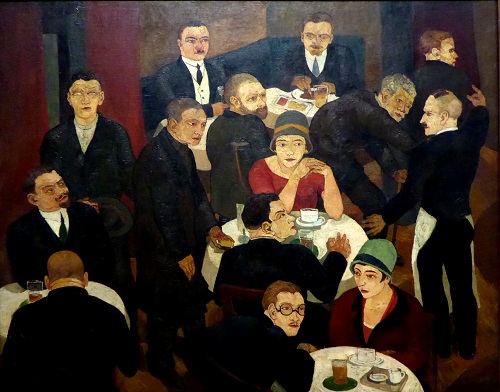
Scharl represented his disgust at the events of 1933 obliquely with an apocalyptic painting of Burning Stars, the battered body of Pietà,
Three Mourning Women and Slaughtered Lamb.
Having refused to join the Nazi Party, he left Germany for America in 1938. The works of the later years have integrity, but not the same urgency. At least in this exhibition partial amends are made for Roselius's complicity; but the great survivor remains 'Paula'.
Sunday, 5 February 2017
History rhymes: Kessler and the world today
It was because of his involvement in the scenario of the masterpiece we know as Der Rosenkavalier that I turned to a biography of Count Harry Kessler, but as usual if the personality catches one's fancy, I'm now on his trail. This is a writer as fascinating as Stefan Zweig for the picture he gives of his troubled times. Thanks to Laird M Easton's biography, published by University of California Press with an attention to detail worthy of Kessler as meticulous book-producer, I've ordered up the two volumes of diaries. One copy of the first I presented to Dame Felicity Lott on Monday as a present for her visit to my Opera in Depth class at the Frontline Club; more on those wonderful two hours in a future post, but this is a good excuse to put up one picture of the lovely lady, self looming larger only because the photographer, David Thompson, was sitting on the left side.
Suffice it to say she was charming, natural, very funny and very moving (especially on Carlos Kleiber, for her as for anyone who cares about conducting absolutely the greatest). She also read several of the Marschallin's monologues in an English translation I'd originally done for another deserving Dame, Harriet Walter, to perfection
As for Kessler, I wanted not to review, as it were, the whole book, but just to offer some quotations from the Count's post-First-World-War years, unhappy ones, inevitably, and one reads with dread of his hopes for a better world against the background of a Germany in turmoil. A brief thumbnail sketch first, and no-one could do it better than Easton in his epilogue:
Kessler was neither a professional politician nor a diplomat, neither an artist nor a professional writer [I take that to be in the narrowest sense, for he was/is a superb wordsmith], neither an academic nor a professional museum director, not quite a soldier and not quite a secret agent, not English or French, but not, in the end, fully Germanic either. He had no firm vocation, and no fixed abode [though it should be added in this context that he was immensely rich, at least up until the First World War]. Kessler's life seems to lack clear contours, spills out over all banks, meanders, in places runs into the sand. The number and scale of his concrete achievements, while impressive enough, pale admittedly against the myriad unrealized or only partially realized ambitions, schemes and projects which, like a vast nimbus of potentiality, accompanied him up until the very last years [he died, a refugee from the Nazis, in November 1937]
The other point crucial to the background here is what Easton described as Kessler's perception of 'the great axis of his life, the agonistic relation between Macht and Geist, between power and spirit'. A child of the Wilhelminian/Bismarck era, he didn't easily set aside his sense of Germany's supremacy in the early part of the First World War. But then disillusion set in, and he moved more towards socialism and pacifism. His espousal of the new when contemporaries like Hofmannsthal were turning their back on him is an attractive trait: quite often he missed the mark, one suspects because he fancied the young male artist in question, but he did also see the value in Georg Grosz, for instance. Perceptive from a man painted (splendidly and several times, see up top and lower down) by Munch in the pre-war days.
Kessler's activities in the 1920s and 30s make for depressing reading only because we have the gift of hindsight. Funny, though, how many of his observations could be made today - this is certainly a case of finding the present in the past. In the lectures published in Germany and Europe (1924), he argued that the way to mitigate suspicion of France towards Germany was to seek 'common interests recognized by both countries and sufficiently powerful to minimize the risk of aggression from either side'. As Easton points out, his plea for democratic control of both countries' industries anticipated 'by 27 years the formation of the European Coal and Steel Community, forerunner of today's European Community'.
At the same time, he misjudged Hitler as 'a local agitator endowed with some sort of magnetism for Bavarians'; sounds familiar to many of us who thought Trump and Brexit couldn't go beyond the lunatic fringe.
His visit to America at that time is fascinating for some of the judgments:
Nothing here really has roots: not the Good, nor the Bad, not the houses, not the people; neither the friendships, nor the enmities. The soil, both the spiritual and the instinctual, is still too new and too loose. Feelings and judgments grow like asparagus and like asparagus are soon "out of season"...Will America ever become deep?
And later:
I feel the old maids of both sexes will kill America like the priests killed and emasculated Spain. Nobody can have any conception of this moral oppression and tyranny who has not been here. The atmosphere of America, its fear and hatred of the truth are those of a tea party in the back parlor of a parsonage. There are a few faint signs of revolt; but up to date they do not amount to much considering the huge mass which takes its firm stand with the old ladies.
The only route that might offer help to the world, he thought, was the League of Nations, subject to certain amendments he recommended. He feared the rise of the Nationalist Party in Germany:
For us there is only the League of Nations and England or a war of revenge and Russia. Any middle path leads to the abyss just like our tacking back and forth between England and Russia under Wilhelm II...now the struggle has been finally decided and it is only disastrous to put forth the old,,,Ludendorff. Now only a united Europe can still retain her control of the world.
He noted how the paramilitary violence blocked the way in Germany and had reached an impasse: 'the narrow-minded people at home and the ghost-seeing here [in Paris] join hands in a danse macabre.' And he told his audience, in a motto for our times, too,'both here and there we must take up the fight with the same decisiveness and bitterness as our enemies or bury our hope for peace. Contentious and reckless pacifists are needed, not whining.'
Well, we know what happened. He thought that the poison of National Socialism was 'a disease of the German lower middle class'; I reckon we need to use that unfashionable term, rather than 'working class', of Trump's chief constituency if we are to move forward and stop beating ourselves up about 'the people v the elites', which may be true in part - the disease of the banks and the corporations has never been properly addressed - but isn't the whole story. There was no proper opposition to the Nazis then; it is incoherent so far in America and, as represented by Corbyn's lamentable 'command' over the Labour Party, disastrous in the UK. Anyway, I'm sure I'll have cause to return to the Kessler of the Diaries in these pages. In the meantime, I'm back to the lighter ironies of Péter Esterházy's dazzling family pseudo-history Celestial Harmonies, which is oddly comforting as well as very funny at times.
Monday, 11 April 2011
Himmel über Berlin

That, of course, is how the Germans know Wim Wenders's Wings of Desire, a film which so coloured my early trips to this ever-changing city. Funny how each return can be tinted, or tainted, by other second-hand impressions: this time I couldn't get away from the ruined horrors of 1945, courtesy of Fallada's Alone in Berlin and Jonathan Littell's The Kindly Ones. To be honest, you don't have to look far beneath the shiny surface for signs of those times. Even the winged Victory, whose perch was also shared by Wenders's angels, is poised atop a sandstone-and-granite column heightened and moved by Hitler from outside the Reichstag to form the centrepiece of his east-west axis.
I suppose every city has its dualities, in any case: on the very day I was cycling through our own central greenlands and wondering at the new-budding trees, a body was fished out of the Serpentine. Cue diversionary snapshot.

Last Tuesday the weather in Berlin was so mild, if not as brilliant-blue as the above proves it soon was in London, that I gave up on museums and exhibitions, including an Ingmar Bergman special I really shouldn't have missed, and decided to walk from my hotel near the Philharmonie to Schloss Charlottenburg. I had four hours between my genial late-breakfast interview with Andrew Litton and the journey back to Schonefeld Airport, and it turned out to be quite a hike, by no means all of it pretty. From the leafing trees and wild flowers of the Tiergarten's south side


I crossed a couple of the roads meeting at the Siegessäule and found myself in a less salubrious woodland around the Fauler See. We're talking midday, but this zone was full of stunted and deformed eastern cruisers who kept on dropping out of the ugly tree. The hassle was so, well, I'll be frankly prudish and say disturbing, that I walked the rest of the way up to the Charlottenburger Tor along the road. Now there's another ugly beast for you, built in 1905 for the 200th anniversary of enlightened Queen Sophie Charlotte


but considerably adapted by Hitler in 1937 to make way for his military parades. A long walk up Otto Suhr Allee past very indifferent 1960s building brought me to a more fascinating monstrosity, Charlottenburg's Rathaus - still very much in use, so you can wander the vast corridors and the library with the rest of the area's inhabitants. This colossal pile, built by Heinrich Reinhardt and Georg Süßenguth between 1899 and 1905, shows all too clearly what the belle epoque meant to Prussia. But I do like some of the bas reliefs, and the ironwork above the left entrance is impressive.


It makes Schloss Charlottenburg, albeit heavily restored after 1945, seem all the more elegant. I've been here before, to see the Caspar David Friedrichs as well as Nefertiti when she was housed in one of the smaller museums to the south, but I wanted to compare and contrast late 17th-early 18th century Charlottenburg in spring with mid-17th-century Versailles in winter (would have gone to Potsdam, into which Frederick the Great channelled his energies, had there been more time - that I have yet to see). The south facade includes gilt railings to match Versailles (first shot)


and handsome trees
though the space before it can't compare to Versailles. Toyed with the original plan of going round Berggruen's collection of Picassos and Klees, now housed across the Spandauer Damm, but lunch called, so I stopped at the cafe of the Sammlung Scharf-Gerstenberg, with its intriguing-looking collection of fantastic art from Piranesi and Goya through to Magritte and Dubuffet.
The weather was now overcast but fair, so the Schlossgarten needed exploring.

There's an intriguing mausoleum, built to a neoclassical design by Gentz as a tomb for Queen Luise between 1810 and 1812, extended by the great Schinkel after the death of Friedrich Wilhelm III - that's his effigy below; Luise's is a finer work of art, but by that stage I realised I wasn't supposed to be photographing.

Presumably further touches are part of the 1890–91 extension to accommodate the graves of Wilhelm I and his wife Augusta. At any rate, it's a hotchpotch of styles, but not without grace in some of the details.

There was just time for a quick wander of the park. Beyond the formal gardens - which I'm delighted to see were indeed inspired by Le Notre's Versailles - the looser English style takes over; in fact the whole park looked like this after 1787, but following war damage the baroque portions were restored. At any rate the lakes tie in well with the distant Belvedere

and the palace proper looks handsome across the waters.

I suppose I should have followed what my guidebook described as the 'beauty and the beast' itinerary and gone to see the memorial on the site of Plötzensee, the slaughterhouse of political prisoners between 1933 and 1945. But time was up, so I took a brief detour along the Spree, with willows and cherry trees framing enormous factory chimneys, past a functional newish Russian orthodox church

and a monumental piece of wall-art

back to the Rathaus, Richard Wagner-Platz

and the U-bahn back. There was just time before taking the train to the airport to pay homage to another grim memorial, this time opposite the hotel, to Stauffenberg and the members of the German resistance who tried to overthrow Hitler in the July plot of 1944.

It's inside the yard of the Bendlerblock, former Nazi army headquarters, where they've also erected the statue of a defiant, chained naked man, worthier than the flatulent inscription on the ground in front.

I'm guessing that even this building had to be reconstructed after 1945. It's astonishing to see a photograph of Scharoun's Philharmonie, newly constructed in 1964, surrounded by open space and only a handful of semi-ruined edifices. Couldn't find this image on the web, nor on the Philharmonie's website - for which I sought permission in reproductions below - so will have to hope this poor copy of my postcard will suffice.

I didn't have time to see the museum within the Bendlerblock, but it's worth quoting inscription on the banner which is one of the exhibits, highlighting Pastor Martin Niemöller's wise words:
When the Nazis came for the Communists, I said nothing, for I was not a Communist. When they locked up the Social Democrats, I said nothing, for I was no Social Democrat. When they came for the trade unionists, I said nothing, for I was not a trade unionist. When they came for the Jews, I said nothing, because I was not a Jew. When they came for me, there was no-one left to protest.
Now - he grandly proclaims - go away and read Hans Fallada's Alone in Berlin, and don't think of taking a jolly jaunt to Berlin until you've finished it.
Subscribe to:
Posts (Atom)