You'd think I might want a break from music after six glorious nights of it in Estonia. Not a whit; to return to the Pärnu Music Festival was to fall in love with a group of superlative musicians all over again, and to get to chat to some lovely folk I haven't spoken to there before. While I await the continuation of the party at the Prom tonight, I've been listening around the experience during a relatively lazy day at home.
A perfect morning palate-cleanser was the CD utterly delightful Japanese viola player Mari Adachi gave me, called Winterreise because at its heart are transcriptions of nine songs from Schubert's cycle. Some work better than others in their wordless context; better to hear the naturally introspective voice of the viola in such subtle hands, beautifully partnered by pianist Ryoko Fukasawa, than a singer who doesn't inscape properly. Best of all, for me, was to hear Mari soar in Schumann's Andante and Allegro, and there are some very original touches in the Schubert 'Arpeggione' Sonata. I won't forget her exquisite Pärnu performance, poised halfway between stage and organ, of Tõnu Kõrvits' Wanderer's Song.
This is also a good excuse to use a few more specimens from Kaupo Kikkas's comprehensive Pärnu photo-gallery - it won't be the last time - so here's the admirable Kõrvits last Wednesday, receiving the Lepo Sumera Prize awarded annually to a composer who has made an outstanding contribution to Estonian music.
Of all the orchestral performances, it's Lutosławski's Concerto for Orchestra as curtain-raiser (!!) to the second EFO concert which has stayed with me, so I put on one of Christoph von Dohnányi's better Cleveland recordings, razor-sharp.
What a total masterpiece this is, in shape as well as colour and idea. Is it heretical to wish that Lutosławski had written more in the same vein - did finding his own voice entail a certain arcane quality I don't always 'get' or warm to? On which note, Paavo told me the other night that Boulez came backstage after a performance he (PJ) had conducted of the Concerto for Orchestra. He'd never heard it before, though he knew WL's later works very well.
Finally, a proper listen at last to the earlier, composition-wise, of the two Arvo Pärt discs Paavo brought out with the Estonian National Symphony Orchestra in the early 2000s, for which I wrote the liner notes. That battle towards the essence reached after a five-year silence was so hard-won. I now find most affecting the early children's cantata My Garden - almost a parody of Young Pioneering, certainly ambiguous; the end of the Second Symphony too.
I'll be lucky to hear the Third tonight for the third time in five days (I was also lucky to be at the rehearsal where Pärt played an active part in the process, pictured above). It's a work I've known to some degree since Järvi senior's 1989 Prom performance, and I'll be listening, hopefully, with even greater awareness.
14/8 update: the Prom, which Pärt attended to the audience's huge delight and surprise (photos by Chris Christodoulou), was mostly a spectacular success. My Arts Desk colleague Boyd Tonkin is reviewing it, so we'll see what he thinks*. Paavo and the orchestra mastered the tricky acoustics of Albert's colosseum, from where I was sitting, at any rate, in a box with the Estonian Ambassador; textures had maximum clarity, phrases high definition, and the pianissimos were magical - PJ seemed to have taken heed of Barenboim's maxim that in this hall, you draw the listener in rather than push out. The Pärt symphony, now with a halo around the sound, moved me more than ever, and the Sibelius had more space than in Pärnu.
The liability was the gifted but oddly narcissistic Khatia Buniatishvili. While Leonskaja found fresh depths in every line of the Grieg Concerto in Pärnu, making it sound like a new work, Buniatishvili was self-regardingly soft-loud, slow-fast. Murderously fast in the finale, which ceased to be a dance. I heard that she'd adopted a completely different tempo in the rehearsal. And it was disconcerting to see her descend from a high trill with the right hand and flick her hair out of her eyes with the left.
Our genius clarinettist Matt Hunt's phrasing in the Sumera encore, playing with the space but always joining the notes with supreme musicianship, was everything Buniatishvili's insane encore - Debussy's Clair de Lune - was not. Heck, the moon could have done an entire revolution around the earth in the time that took.
Two Sundays ago, I was basking in the focused glory of the Latvian Radio Choir singing Rachmaninov's All-Night Vigil (Vespers) at a late-night Prom (photo courtesy BBC/Mark Allan; the rest apart from the Vereshchagin painting are mine or taken on my camera in the case of the Imperial College shot).
On the following Tuesday morning, by pure serendipity, I happened to be in Riga, where my wonderful Latvian friend Kristaps took me to see St John's Church in the Old Town, knowing it was where the choir had recorded the Rachmaninov.
That Sunday before I could take off to Latvia and one of my favourite places in the world, Pärnu in Estonia, was quite a bit of work. First I had to prepare for and then speak at the afternoon Proms Extra event in the Imperial College Union just down from the Royal Albert Hall. Here I am, below, with one of Radio 3's very best presenters, Louise Fryer, and my New Best Friend (we hadn't met before), Royal College of Music doyenne and Taneyev expert Anastasia Belina, a very vivacious person. You can hear an edited version of the talk in the interval of the BBC Radio 3 broadcast of the main orchestral concert, with introductory chants from the LRC, for a while at any rate here - the Proms Extra slot starts at around 1:00:27. The choir's late-night performance of the Vespers is here.
Then I very willingly attended both Rachmaninov Proms and wrote about them on The Arts Desk - though the review had to be pieced together en route for Riga. The full Baltic experience of basking once again in the amazing performances of the Estonian Festival Orchestra players, both collectively and in chamber music, is covered here.
Kristaps packed such a lot in to the three hours we had in Riga before taking the coach to Pärnu at lunchtime that I can't cover it all here - another post will be necessary for the famous street of Art Nouveau buildings where the small publishing house for which he works is based. But I think we can justify two religious edifices and two places with a connection to a very famous composer. Our first interior was that of the Russian Orthodox Cathedral of the Nativity, built between 1876 and 1883 at Alexander II's behest, two of its golden domes glittering through the trees here on a hot summer morning.
It became a Lutheran church during the German occupation of World War 1, and later a planetarium under the Soviets. Its lavish restoration was completed in 2000.
The faithful line up to kiss their favourite icons
and under this fresco of the Nativity,
painted by Vasily Vershchagin. There are two 19th century Russian artists of that name, and I hope it's the more significant one, if only for the stark contrast of his most famous image painted on the eastern battlefield.
I got quite 'bolshie' when ferociously asked by a headscarved lady not to photograph (I did so without flash, and saw no prohibitive signs): this is as close as I could get to a Pussy Riot act against the wretched Russian Orthodox Church of today, Putin's poodle and hijacked by a vicious leader.
Of course it's all impressive, but much more to my taste was the modest and more ancient artistry of St John's, founded by Dominicans in 1200 and taken over by the Lutherans in 1587.
Rebuilt several times, extensively so after a major fire in 1677, it retains its beautiful Gothic ceiling, the finest in Latvia.
Kristaps knew of my Wagner passion so he managed to get us into an apartment block on Brīvības iela which stands on the site of the young(er) composer's dwelling between 1838 and '39. Here he wrote Rienzi, which I have the dubious pleasure of declaring I've now witnessed live, or about half of it. The stained glass window dates from 1913
and there's a plaque plus a portrait in an alcove, too.
The present building is impressive, in any case, with its fine staircase.
Pushing it a bit for time before the coach (which we caught, eventually, but not at the coach station), K kindly detoured down Richard Wagner Street - all names undergo rigorous Latvian reworking -
to see the concert hall he frequented when it was an opera house, with its appropriate dragons. During his time in Riga, he staged five different operas and conducted another 20. In orchestral concerts he focused - no surprise - on Beethoven. There's more useful information on Wagner in Riga here.
The hall/theatre subsequently played host to other very distinguished figures (I leave you to make them out).
And so, speedily, back through the green belt and via the Opera House, to a scramble for the coach, which concerned my laid-back friends and taxi driver far less than it did me. But I'm a great admirer of the brinksmanship which wants to show the visitor as much as possible: I do it myself, much to certain folks' consternation.
Certainly not that, or rather not just that. The ghastly Bill Cash just reveals his ignorance by saying so. First, the Last Night is a celebratory party for everything that's gone before, all 74 Proms in the Albert Hall. Which began with Russians (Tchaikovsky and Prokofiev) and an international British master (Elgar) between them and has seen the visits of three outstanding German orchestras in the past week (below, Thielemann and the Staatskapelle Dresden - the image, ahem, is by Thielemann's approved photographer, Oliver Killig; thanks as ever to the wonderful Chris Christodoulou for the rest). It also includes French and Italian music in the finale, sung by a Peruvian tenor and conducted by a Finn.
Indeed, Sakari Oramo (pictured up top) donned a Union Jack waistcoat for the second half of a previous Last Night, and has championed British music, G&S included. But he's as splendid an example of international versatility as anyone who's appeared at this year's Proms.
Crowdfunding supporters have raised enough money for 500 EU flags to be distributed tomorrow night. Of course the disgusting, immigrant-persecuting Daily Mail and Express howl that it's a Corbynist conspiracy - unlikely given his own disappointing if not entirely unpredictable take on the EU - and the Brexiteers wail foul play. But it's our turn now after years of attack from the lunatic fringe.
I won't be there - as on every occasion for the past 10 or more years, we'll be walking for the Norfolk Churches Trust. I'm privileged enough to be admitted to a final rehearsal of the Verdi Requiem before we catch the train tonight; had to hear something of the great Tamara Wilson. If I have to pick my favourite Proms of the ones I've managed to attend, the internationalism speaks for itself: London-based Russian Pavel Kolesnikov with the National Youth Orchestra of Scotland conducted by Israeli Ilan Volkov in Tchaikovsky's Second Piano Concerto (pictured above), a Finnish diva (Karita Mattila) and a Czech conductor (Jiří Bělohlávek) leading a stupendous performance of Janáček's The Makropulos Case
and the Berlin Philharmonic conducted by 'our own' Simon Rattle in Mahler's Seventh Symphony. Oh, and if you want more Britishness, there was Mark Wigglesworth conducting Welsh forces (and American Wilson superb alongside UK soloists, having made her first partial and compelling test of the role of Brünnhilde) in Tippett's A Child of Our Time. No doubt which kind of flag Sir Michael would be waving tomorrow night.
Frankly, this is first and foremost a shop-window alert to see if anyone else wants to come along to the remaining two talks I'm giving on Proms-related works: on Janáček's The Makropoulos Case tomorrow (10 August) 2.30-4.30pm at an address in Lancaster Gate, and on Mahler's Seventh Symphony, Thursday 18, same time, in St John's Wood. Addresses supplied on enquiry to me at david.nice@usa.net. Tamara Wilson is also due to return to the Frontline some time in the week of 5 September before her guaranteed-amazing performance in the Verdi Requiem on 9 September. She'll get back to me once she knows her rehearsal schedule. And you'd better believe that Tamara is almost as good a talker as she is a singer (only 'almost' because the singing is something superhuman...). There she is below with Mark Wigglesworth and James Creswell in the closing scene of Act Three from Wagner's Die Walküre.
Back in July we covered Mahler 3 and Berlioz's Roméo et Juliette, and I learned a lot more simply retracing familiar territory - there's no end to what you can keep on finding in the great masterpieces. Nor did the performances disappoint - though I felt a little distanced from Haitink's magisterial and at times very slow Mahler and JEG's Roméo would have been perfect if he'd had a Friar Laurence as good and true-bass-y as David Soar for Andrew Davis earlier in the year.
Highlights of the ones I've caught so far? Unquestionably Mark Wigglesworth's converting me almost completely to Tippett's A Child of Our Time, with fabulous soloists alongside Tamara and an apotheosis that really was levitational, and 27-year-old Pavel Kolesnikov as soloist in Tchaikovsky's glorious Second Piano Concerto alongside the superlative National Youth Orchestra of Scotland under Ilan Volkov (who quite transformed the imperial style into something altogether more humanly joyous).
The NYO experience the previous evening was a little tainted by Ed Gardner's dim view of Strauss's Also sprach Zarathustra - no idea what he wanted to say, if anything, with the work - and by my neighbour, who sketched throughout. This, inevitably, I didn't mention in the review, but he started by thinking he was some kind of artistic seismograph attached to Iris ter Schiphorst's Gravitational Waves, pencilling squiggles and zig zags as the music took him. You can imagine the resulting chaos on paper. For Strauss and Holst, he contented himself by drawing the players and clearly thinking this would be the main event of the evening for his neighbours, whom he immediately started showing the results.
Halfway through The Planets, I thought that instead of getting into an altercation with him if I asked him to stop, I'd unostentatiously put my rucksack on my knee so I couldn't see his drawing, but this of course impeded his wide-ranging right hand so he got indignant. Then he and his ferocious wife changed seats. I knew she'd be spoiling for a fight at the end, and determined to avoid one, but she got it by sitting and refusing to move as we and a nice, baffled gentleman behind us wanted to get out. 'You are the rudest audience I've ever encountered!' she blustered - having fidgeted throughout and hummed along out of tune to Holst's 'Jupiter' tune aka 'I vow to thee my country' - whereupon I cried shame on her. Oh dear - these conflicts are not to be stoked, but what can one do? Otherwise, the Proms audiences haven't been bad at all, and it was redeemed the next afternoon by my being able to tell the little girls sitting in front the story of The Firebird before it began. Which meant they enjoyed it enormously, if a little actively, playing princesses and ogres, which I didn't mind at all.
Fondest peripheral memory so far: seeing the huge queue stretching around the block ten minutes before Haitink's Mahler 3 was due to start. Even though it may have been mixed up with another waiting for the late-night Bowie Prom (which I switched on the telly back home to watch live, and off when the rapper came on), it reminded me that nothing has changed since I joined the queue for his 'Resurrection' in 1978. As I recount in the Arts Desk review, it was my first Promming season and I arrived too late to be admitted into the Arena; my one and only Gallery experience taught me never to go up there again. Still, it was the summer of Discovering Mahler and Abbado's Chicago recording was the first symphony recordingr I borrowed from Banstead Library.
Thrilled, too, to take dear friend Chris Gunness's 18-year-old nephew Andrew Lavelle to Proms while he was visiting from Houston. His first experience of the Albert Hall - that was good to get - and as he has a very wise head on young shoulders his responses were all perceptive. He soon takes up a place as a very talented viola-player at the Juilliard: what discoveries lie ahead for him. There he is above with uncles and friend.
And this is the Albert Memorial at c.9.30pm. Darkness on emerging from a Prom is a sure sign that the days are getting shorter again - September visits are always tinged with a certain circumstantial melancholy.
The nearby Serpentine Pavilion is a triumph this year, one of the best, from Danish architect Bjarke Ingels. That will last us well into early Autumn.
And I have still to seek out the smaller projects around Kensington Gardens, though I'm told they're not up to scratch.
Proms photos by Chris Christodoulou except lead image of NYO, by Mark Allan. All courtesy of BBC.
In fact the Respighi binge is past now, but I still ought to honour it. After Dutoit's surely unrepeatable Proms feat of running Roman Festivals, Fountains and Pines together as a single second-half sequence, I reeled again from the surprising depth of the invention: quite apart from the superlative orchestration of Rimsky-Korsakov's pupil, it strikes me more than ever as a question of feeling, not painting or picture-postcarding. Which is why, perversely, I thought to launch this entry in Piranesian black and white. The darkest colours and some of the most haunting invention, to be sure, reside in the last of the trilogy to be composed, the four interlinked Festivals, which Dutoit wisely placed first since the ultimate Albert Hall spectacular would have to be left to the organ and the three extra trumpets capping the revived glory of the Roman cohorts in the 'Pines of the Appian Way'.
Feeding the Christians to the lions in the Colosseum obviously leads Respighi to invoke early Panavision and Technicolor garishness, though even this sequence is a cut above most film music (though not the scores of Nino Rota, Respighi's best follower. I'd put La Strada third only to Prokofiev's Ivan the Terrible and Shostakovich's King Lear music in that sphere). More haunting are the sounds rising at the start of the second 'picture' and, supremely, 'Ottobrata' from the sleighbell-accompanied passage onward, eerie and suspenseful. Here's Toscanini, followed by an outrageously fine performance of the final Epiphanic bacchanal from our own National Youth Orchestra under Vasily Petrenko at the Proms: apt, because his interpretation of Shostakovich's Fourth Symphony with the European Union Youth Orchestra was my absolute highlight of this year's Albertine festival, alongside the Stemme/Runnicles Salome (the NYO Petrushka under Gardner was stunning, too. Just to show that I'm not exclusively obsessed by complicated orchestral scores, I'd put William Christie's late-night Rameau motets in there too, and why not bung in the impassioned debut of the Borusan Istanbul Philharmonic earlier that evening).
The introduction of the mandolin in 'Ottobrata' is especially magical: the whole of the nocturnal slow fade sequence matches the second 'Nachtmusik' of Mahler's Seventh Symphony. Which I'm sure Respighi must have known. There's also a bewitching night picture in the first of the Brazilian Impressions, conducted by Dorati on a CD of early-stereo Mercury recordings which also includes the delicious suite of discreet arrangements The Birds- Going for a Song probably doesn't mean much to the younger generations these days - as well as the two usual subjects. The second Brazilian Impression here is of a visit to a snake institute, complete with Dies Irae.
I finally got round to listening to Respighi's Sinfonia Drammatica of 1914, and the Mahler influence is undeniable in this monument to the shock and grief around the outbreak of the First World War. I expected it to be turgid and overblown, but the varied use of orchestra, a year before Fountains properly made the composer's name, can be extremely subtle and on a superficial listening to the late, lamented Ted Downes's recording with the BBC Philharmonic Orchestra, I could already grasp that Respighi is doing something unique with form in the slow burn-out which marks the last third of the first movement.
From there it was on to investigate some of the songs, in a disc I'd been given some years back by a Dutch friend and never listened to; the singers are a perfectly Italianate soprano, Andrea Catzel, and a barely adequate tenor whom it would be fairer not to name, but I'm grateful to pianist Reinild Mees for masterminding the project, of which the CD I have is the second volume.
It's so marvellous to hear beautifully set parlando Italian, as in the early 'Storia breve', and I'll never forget 'Nebbie' performed by Teresa Berganza in an encore to a Royal Opera House recital. Among the songs of 1909 there's charming pentatonic style, more suitable to evoke China, in 'Serenata indiana', a setting of Shelley, and more word-sensitivity in 'E se un giorno tornasse', an adaptation of Maeterlinck. And Respighi's gift to be simple but still individual comes in an ideal encore, 'Canzone sarda'.
The big number for mezzo-soprano and string orchestra of 1918 Il tramonto, a winner as performed by the glorious Christine Rice on Pappano's EMI Respighi disc, is also a Shelley setting, by the way. How the poet of 'The Sunset' must have wished there were a word as beautiful as 'tramonto' in the English language.. Any excuse to re-use my shot of Shelley's grave in Rome's English cemetery from the 2011 Death in the South blog entry.
Then it was time to revisit Respighi's orchestrated selections from Rachmaninov's Etudes-Tableaux, and back to the best Fountains I've ever heard - even in less than state-of-the-art sound, from Victor de Sabata. This sets the seal on the work itself being my favourite of the Roman trilogy for its poetry as a whole (I've been there already on the blog, but de Sabata's exceptional interpretation merits a revisit). Sadly the entire recording of 1947 isn't up as a single unit on YouTube, which means that the highlight, the horn blasts for the Triton fountain, lacks its proper impact bursting out of the silence of the Valle Giulian poetry. Still, you get a sense of de Sabata's electricity as well as his control.
This was a serendipitous discovery bringing me back full circle after a coincidental excursion into the delicious music of Ermanno Wolf-Ferrari: I knew de Sabata's recordings of his Overture to Il segreto di Susanna - the Gardelli recording of which was a favourite LP in my teens, sadly never on CD to my knowledge - and the Intermezzo from I quattro rusteghi, an encore winner if ever there was one (so is the quirky little waltz from I gioielli della Madonna).
They're on a two CD EMI set as fillers to the Verdi Requiem, but I don't think I'd ever got as far as the Respighi or the Rossini William Tell Overture, a lesson in articulation that almost outdoes Toscanini.
It may have been an unconscious echo from my Respighi listening, but I came back to Wolf-Ferrari simply as a result of seeing an unheard disc on the piles of unindexed CDs and popping it on.
Most of the Violin Concerto could have been written in the 1890s - in fact at least one of the themes dates from that time - but was actually premiered, close to its composition, in Munich on 7 January 1944. Hardly an auspicious time or place, and I still haven't quite got to the bottom of why Wolf-Ferrari and his muse-violinist, Guila (sic) Bustabo were there (nor indeed clarified Respighi's links to the Fascists).
The anachronistic quality isn't, to my ears, as much of a liability as it is in Korngold's sticky concerto of the same period. While Korngold was mired in late romanticism, Wolf-Ferrari somehow kept his favoured neoclassical mode fresh. Heavens, the tag - Arthur Lourie's re Stravinsky, contrasting Schoenberg's 'neo-Gothic' - was nearly two decades in the future when the Italo-German gave the cue to the next similarly duo-national composer, Busoni, with the Goldoni-based operas Le donne curiose (1903) and I quattro rusteghi (1906 - and yes, dear reader, I've seen it, in Zurich. Charming in parts but way too long-winded, though that may have been a false impression given by a rather cumbersome production).
The Violin Concerto certainly charms in its opening dream-tune, brought back Dvořák and Elgar style in the otherwise sparkling finale's nostalgic cadenza. The work even surprises us with galloping anger in the third-movement Improvviso, which while not exactly stylistically of the 1940s may express something of the pain Wolf-Ferrari felt at what he and his beloved Guila were going through. It's all well documented in the CD's 96 page accompanying booklet. Looking for something to demonstrate from YouTube, I came across this performance, accompanied by the violin part. Seemingly it's not embeddable, but do click on the link. Maddening that there's no credit for the performers, but I'm fascinated to see a comment asking if this is the Bustabo/Kempe recording - I didn't know there was one. Anyway, it's very fine, but then so is the slightly cooler one I've been listening to at home.
There Vienna-based violinist Benjamin Schmid and conductor Friedrich Haider, who's obviously worked wonders on the Oviedo Filarmonía, were discoveries for me. Haider loves his special composer-project to bits, and it's quite something that his performance of the delicious, encore-worthy Rusteghi Intermezzo is every inch as good in its way as de Sabata's. That miniature is surely the very essence of what protagonist Adrian Leverkühn tries to define, rather surprisingly, in Thomas Mann's Doktor Faustus when he speaks of his old teacher:
For him, music was music, if that was what it was, and his objection to Goethe's statement that 'art is concerned with the serious and the good' was that something light can be serious, too, if it is good, which it can be just as easily as something serious can...I have always taken him to mean that one must have a very firm grasp of the good to be able to handle what is light.
Spellbound by my re-reading of this extraordinary novel, which is nothing like what little I remember of it from my teens, and now I can't wait to get to the end; it's turned into quite the metaphysical thriller. But in the meantime, some 'serious-light' music (Prokofiev used the term interestingly, too). JEG's performance of the Rusteghi Intermezzo is almost as fine as the ones I cite above, and you get a glimpse of Wolf-Ferrari's Venice, though I apologise for the naff dancing.
Finalmente, let's wheel back to Toscanini in what sounds like a very early (pre-electrical recording era?) performance of the delicious and authentically neoclassical overture to Il segreto di Susanna.
It looks like an end-of-term line-up, though in fact this photo by the indefatigable Chris Christodoulou of cast, conductor and director of the Proms Die Walküre was taken at the mid-point of a Ring that no-one will ever forget (who ever forgets any Ring, for that, matter, but this one was special from the very first low E flat). There's an even better version, without Barenboim - who hardly stands out as the only unjolly one above - and with the immensely likeable Justin Way seemingly doing a Rhinemaiden on the laps of Terfel, O'Neill and Halfvarson, to head my Arts Desk retrospective on Wagner at the Proms.
I knew I had to honour it, having been stunned quite as much in different ways by Tannhäuser and Parsifal as I had by Das Rheingold and Die Walküre (the reason I had to miss the last two Ring instalments and the Tristan is, as I've been at pains to point out before, Norfolk and Britten related). Surely the artists would have as awed a perspective as I did? Well, they're an eminently more practical bunch, thank goodness, but I think I got some interesting results. I'd been a bit reluctant to do phone interviews as time was short, but when it seemed like the only option for a very busy Donald Runnicles, Sir John Tomlinson and Way, I took it on board and loved the results.
Runnicles, pictured in a photo from Chris's extraordinary gallery of conductors in extremis for The Arts Desk which we instigated in 2010, was a consummate pro, giving me the 200 words in almost perfect straight-off-the-top-of-the-head form. Courteous, too: 'You will be very welcome, sir, at the Deutsche Oper'. Sir John belied his title and was instantly so amiable and friendly. He'd been on a family holiday in Rome, so we talked about the new film hymning that great city, La Grande Bellezza, which I can't wait to see. He told me he'd been doing Gawain in Salzburg, and was flabbergasted when he found out that the director had a whole new concept - not working with the singers. So in effect he had to help out others who'd not done it before with the staging.
This led to the Proms's great virtue - putting the performers first, really focusing on the one to ones. Neither of us would usually say that such a context is better than a full-scale production at its best, but that special magic doesn't happen often enough in the opera house. It did with Kupfer's Bayreuth Ring, where JT cut his teeth alongside Daniel Barenboim and which occasioned my only visit there so far (and that would be enougn; I had my Bayreuth vision). There was plenty more fascinating chat once I switched the mike off.
And the beauty of retrospective? Well, I'd been thinking earlier about how much more interesting it can be to interview artists AFTER they've done something. The only reason it doesn't happen more often is because publications are reliant on the pre-performance publicity machine. But I treasure both of Richard Jones's visits to my City Lit opera class once his Welsh National Opera Meistersinger and Royal Opera Glorianawere up and running (still got to write that last up here).
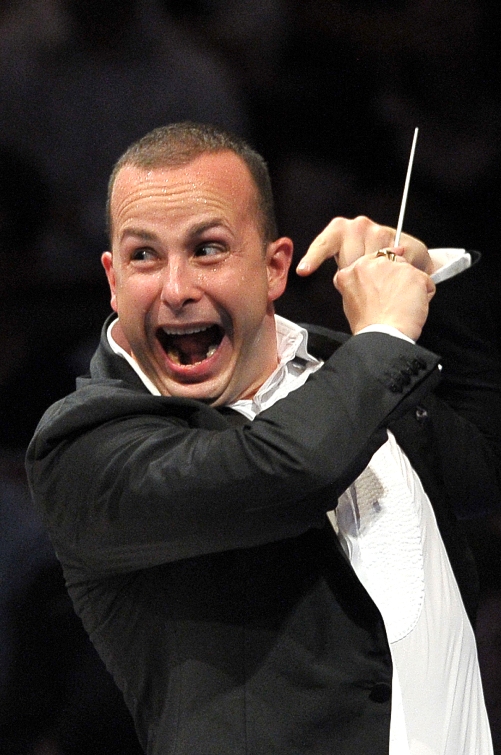
It always strikes me as dishonest when critics talk about 'the best Prom of the season so far' when they won't have seen so very many; only the most fervent of season-ticketed Prommers has the right to say so. I managed 14, and the peaks stand out. Of the Wagners, which were one long high, Act 1 of Walküre was possibly the most electrifying I've encountered live (Way's personal highlights were the whole of Walküre and Act 2 of Gotterdämmerung, where I'm told Nina Stemme really came into her own, though she's never less than dependable). Otherwise, no question: the late night Malians and Azeris, Lisa Batiashvili with Oramo in the Sibelius Violin Concerto and Yannick Nézet-Séguin's Prokofiev Fifth, the best I've ever heard. His sheer, unfeigned delight and energy shine in another of Chris's best pics.
Amazingly that whole performance, as televised on BBC Four, is up there on YouTube (not for long, I shouldn't wonder, but enjoy it while you can).
Wish I'd been there for the Spanish song and dance - astonishing to think it blazed out in the middle of the big Wagner week - and no regrets about missing the Last Night (three-line whip for friend Father Andrew's 50th birthday dinner in an excellent Nepalese restaurant). We caught it on the iPlayer on Sunday night. My, the final jamboree goes on these days, as a sort of extended showcase to the world. But Alsop's discipline and her focused energy were always impressive.
Joyce DiDonato - what a trouper, looking great, plastering over the cracks in an instrument which I've never found hugely individual, but it's still a demonstration of what artistry is all about.
Nige - well, even the Diplo-mate, usually unamused by musical comedy and like me a bit troubled by the ongoing Kennedy persona ('like a down and out Irish navvy'), was in stitches at the fun and games of the much-treated Monti Csardas. Spot all the references?
New seasons have been opening and stunning in the meantime. What a scorcher is the National's Edward II, a Young Vic kind of show in a usually much more conventional space.
Attractive John Heffernan (pictured for the NT by Johan Persson) didn't dominate, but only because it was such an ensemble production. On Monday lunchtime, heavenly Anne Schwanewilms's Schumann Op. 39 Liederkreis was a perfect partnership with Roger Vignoles (only connect: when I met him after Kozhukhin's Prokofiev triple bill, he expressed his surprise at the connection between the Seventh Sonata's Andante caloroso and Schumann's 'Widmung', and here he was playing it). Anne's website man and a loyal student of mine, Howard Lichterman, introduced me to her and I took a shot of the perfect duo which wasn't professional enough to appear on TAD.
A renewed Weill crush has just been put on hold as I rediscover Paul Bunyan in the wake of the British Youth Opera staging (which was good, but not as dazzling as their staging of Cimarosa's The Secret Marriage). I fiercely defend the total brilliance of the collaboration with Auden, which given that I've also been listening to The Rise and Fall of the City of Mahagonny strikes me now as a determinedly optimistic riposte to Weill and Brecht. If you have any criticisms about the poetry, just ask who apart from Da Ponte, Hofmannsthal or Brecht could come anywhere close to the best of this genius text.
I went back to the Plymouth Music Series' 1988 classic recording, coinciding with the epoch-making Aldeburgh revival, and I don't think it can be beaten for American authenticity. Love Pop Wagner as the balladeer. And isn't this Britten's most unambiguously joyous stage work?
New seasons elsewhere: the now old chestnut about the 'show solidarity' petition and the Met opening rumbles on, with signatures being added all the time and further dissatisfaction with Gergiev, who now echoes Putin's equation of homosexuality with paedophilia: disgraceful (scroll down the Onegin piece and the comment at the foot of the companion article on The Arts Desk for an update). Michael Petrelis and his loyal companions have been making the right kind of stand at the San Francisco Opera opening gala - ie no disruption of the performance itself, in which married lesbian soprano Patricia Racette stars - and have got a very decent statement out of the San Francisco Symphony Orchestra (how could it not so reply with Michael Tilson Thomas at the helm?)
I love this photo of a grande dame* showing her solidarity with the friendly protest before the opera gala - from Petrelis's blog, courtesy of him and the photographer Bill Wilson. What a great redemption of that famous Weegee shot in which two overmadeup socialites with tiaras sweep in to the Met past a gaping pauper.
So towards an annual interlude: our walk for the Norfolk Churches Trust. Jill has planned out a route of 15 or so miles and 13 churches. The forecast, alas, is for less good weather than we've had over the past few years. Maybe that will encourage folk to give more generously - though I hope I don't have to invoke the kind of disaster scenario we experienced back in 2006. By way of reminder, here's last year's report and a photo of St Margaret, King's Lynn, alongside which we stay each time, so it's always our starting point.
And, at last, another sunny farewell. This one will mean going over to a page on the Emerging Indie Bands site where godson Alexander's Lieutenant Tango has just been feted. Makes me wonder why he never enlightened me over the 'kwela beat', and what it is. Happy to plug away at a third track, 'So, Go', because, while the million-sellers J sometimes plays on his iPad - following a Facebook commendation, just dipping - sound like dross to me, this is dance music with a genuinely creative edge.
*The lady, Michael now tells me, is glamorous grandmother Joy Venturini Bianchi, owner of San Fran's Helpers House of Couture, at 74 still a redoubtable socialite and staunch friend of the gay community. For the charitable origin of 'Helpers', read the linked article. What a woman! I love the comment on fashion's Alexander the Great: 'McQueen, Jesus Christ almighty. I have a dress by him with a hood so chic that I can't even stand it.'
All observations, questions and challenges are welcome: resistant to tweeting and Facebook (though long converted to LinkedIn), I still like to exchange ideas. You don't have to be signed up, and you can be anonymous, but comments are moderated.
Copyright
If you wish to use any of my own photographs featured in the blog, or any of the text, just let me know in the comments. Acknowledgment and a link are all it takes.




 Posts
Posts