Tuesday, 12 April 2016
Zweig on Erasmus v Luther, Shortt on God
He always gets to the dramatic heart of things in his 'popular' biographies, does Stefan Zweig. The polarities clearly chime with his own divided soul in one way or another. His Erasmus study, not easy to get hold of these days, is both more brief and more reserved than the Marie Antoinette quasi-novel I read a couple of months ago. It even takes rather a long time to get over the faint whiff of the platitudinous in setting up Erasmus's virtues and flaws, his 'ambiguities and contradictions,' but once Martin Luther appears on the scene we know we're into material which would make an exciting screenplay.
'I must insist,' writes Zweig, 'on the facts that Erasmus of Rotterdam was, of all the writers and creators in the West, the first conscious European, the first to fight on behalf of peace, the ablest champion of the humanities and of a spiritual ideal'. But the 'universal language' he expressed himself in was Latin, and he remained an elitist, neither understanding of the ordinary people nor aware that the path of Enlightenment which he took could be upturned by the barbarism that lurks in human nature.
You feel Zweig is talking a bit about himself and his times here; and his knowledge of Freud convinced him that there was no steady progress in humanity. For both himself and Erasmus, 'an aristocracy of the spirit' could be swept aside, and not just by the unlettered:
An educated man, a civilized man - and herein we see the tragical failure in their [the humanists'] reasoning - was no longer capable of resorting to gory violence, and when once the educated, the cultivated, and civilized got the upper hand, chaos and brute force would inevitably disappear, and war and persecution of opinions would become anachronisms. In their overevaluation of the effects of civilization, the humanists failed to take account of the basic impulses and their untamable strength; in their facile optimism they overlooked the terrible and well-nigh insoluble problem of mass hatred and the vast and passionate psychoses of mankind.
The representative of that, for Zweig, was Luther (Cranach's portrait of him in 1529 pictured above), 'an emanation of the dark, daimonic forces of the Germanic peoples'. Erasmus and he were opposite poles: 'the conciliatory temperament as opposed to the fanatical, cosmopolitanism against nationalism, evolution versus revolution'.
At the midway point of the biography, Luther in all his crude vigour and energy - his study in the Wartburg above Eisenach, snapped on last year's unforgettable Bach pilgrimage, pictured above - takes centre-stage: a potential force for the good, flawed by intemperance and irrationalism, sure that 'my confidence is God', 'a cheerful and friendly father and house-master' who 'as soon as battle was joined...was transformed, becoming a werewolf raging with uncouth and unjustifiable scorn and fury', a 'hot and mighty hater' who never 'put in a word to save an enemy condemned to death'.
There are dramatic points of no return and moments where if Erasmus had become more involved and Luther less intransigent, Europe would have been spared the tide of blood.
Even when the battle was joined, Erasmus, the peacemaker, went a long way to meet his opponent. He took occasion to warn his contemporaries not to place too great importance on such discussions, but, rather, 'to ask themselves if it is right to set the whole world in a conflagration for the sake of a few paradoxical conceptions' [the chief issue over which Erasmus and Luther had locked horns was the one of predestination].If only Luther would yield but the fraction of an inch, would take but one step to meet him, this intellectual squabble would end in peace and harmony. But could Erasmus hope for compromise from the most iron-minded man of that century, from a man who in matters of belief and conviction would not, even if tied to the stake, sacrifice a jot or tittle of his principles, who, born fanatic that he was, would prefer death or the destruction of the world to giving up the tiniest and most indifferent paragraph of his doctrines?
For Erasmus, even the refuge of Basel where he had found true acceptance and tolerance and where he would be buried
was not immune from Reformation fever. That beautiful city is once again a centre of enlightenment and harmony, more outward looking than other Swiss centres of excellence; our trip there first put me properly on the Erasmus trail.
Yet Zweig's epilogue carries the grain of hope at the bottom of Pandora's box, in his argument that 'no thought that is the outcome of the fusion of clear thinking with high moral energy can wholly disappear':
An idea which does not take on material shape is not necessarily a conquered idea or a false idea; it may represent a need which, though its gratification be postponed, is and remains a need...Those ideals only which have failed to put on concrete form are capable of everlasting resurrection.
Resurrection: is it a metaphor or a parable in Christianity? On that, and on the issue of miracles, I can't quite grapple with what my new friend the excellent Rupert Shortt has to to say in God is No Thing. In every other respect, I agree with him wholeheartedly on the essence of good Christian teaching, tolerant and respectful of other opinions, and on most of its tenets - but despite the overlap, it's still not enough to persuade me in to the fold. I like this:
An American historian and agnostic...summed up her diagnosis [of today's malaise of disrespect towards Christianity] like this: 'I've always seen Christianity as involving an encounter with the depths of experience,' she told me. 'Yet so many educated people on this continent [Europe] seem to associate it with nothing beyond the shallows.'
I believe, like Shortt and so many scientists (and Darwin, one of the best formulators of thoughts about the existence of God in his autobiography), that 'science...explains how this or that process has taken place, but cannot say why'. Neither first causes nor what people call God are nothing. Shortt quotes Denys Turner:
'Nothing' has no process, no antecedent conditions, no random fluctuations in a vacuum, no explanatory law of emergence, and, there being nothing for 'something' to be 'out of', there can be no physics, not yet, for there is nothing yet for physics to get an explanatory grip on.
Hence the book's title, and the title of the chapter in question, 'God is no thing, but not nothing'. I believe - this is turning in to a credo - in the likelihood of a numinous world beyond the phenomenal; how could I not, being in a constant state of bewilderment at the examples of creative and performing genius in my sphere? Let me share the epitaph Kurt Vonnegut wanted for himself - can't work out from this picture whether his wish was realised:
Vonnegut and Shortt both cite the Sermon on the Mount as one of the great texts, if not the only text you need for life. They're both immensely likable beings. So even if you're a confirmed atheist, I recommend you read God is No Thing - and don't let the recommendation from hack writer A N Wilson on the cover put you off. Pleased to see it's among the best sellers already.
Labels:
Christianity,
Erasmus,
God is No Thing,
Kurt Vonnegut,
Luther,
Rupert Shortt,
Stefan Zweig
Sunday, 10 April 2016
Lacock weekend 1: Easter Sunday, with rainbow
Back to our inspiring friends Andrew and Deborah, familiar to regular readers as the occupiers of Cantax House - Dumbledore's residence to Potterfans - and doyen/ennes in their respective spheres of music and art. Meals at home feature plentiful garden produce, but this time there was a choice rarity for the first evening's dessert - chocolate made from cocoa pods gleaned while Andrew was running a choral course on Tobago. This of course is Deborah's photo.
And the small but rich pickings of her labours - wrapped up here ironically in a Ferrero-Rocher arrangement -
were like no chocolate I've ever tasted - bitter and intense; I swear I loved it.
Variable Easter weekend weather meant that we did less walking than planned: a non-stop-rainy Saturday saw us moving from one gallery to another, very hastily, in Bath (planned for a post or two ahead). We took our chances on a Sunday of heavy showers and sunny intervals with a hike around the valleys beyond Box, starting at the head of the wooded glade where the Cherry Tree Project runs its courses and going beyond the point at which we'd turned on a previous occasion.
Still in March, the trees on the hilltops still kept their skeletal winter outlines
but it was lusher down by St Catherine's stream in the beautiful valley of that name, up which we subsequently headed, past the church, house and farm - also St Catherine's - occupied by Jane Seymour (the pretty actress, not the unfortunate wife of Henry VIII)
and following the course of the stream with its alders and sycamores (catkins barely visible in this size image)
until we reached a lane, badger's tracks on one side
and wild primroses on the other.
Mud made the going slow. Then it was up another valley, towards the less quagmireish uplands, at which point dark clouds spelled inexorable rain
which burst in a wild squall (I was fine in waterproofs from head to toe). The immediate moving away of the black sky
suggested a rainbow must be found, and it was, rather unusually, seen from above now that we were at the highest point arching down into yet another valley (probably the very top picture makes it clearer, letting you know what you're looking for here).
An old track, almost as straight as the nearby Roman road, took us on the level with views to the south
and south-east
with very premature bluebells in the hedgerows
and horse chestnuts in bud and semi-leaf.
At a gatehouse with a hare on the roof
we turned into the estate of Ashwicke Hall, now run as the SABIS International School UK, and found the lambs in its fields inquisitive and unafraid.
And thus, surprisingly, back to where the car was parked. The lamb surprise came late on the walk, as it had on Good Friday evening when we did our usual circuit of Lacock. The Abbey is well positioned to catch the evening sun
which was setting beyond the Avon - very low that day; by Monday it was flooding the water meadows.
The river in turn separated us from the last field of sheep and gambolling lambs (they really do leap with all four feet off the ground). That tree in the middle distance has always had a special magic; in the summer, the sheep are grateful for its shade, all that's available in the open field.
A group of particularly adventurous, danger-seeking lambs skedaddling up and down the bank held us rapt for a good 10 minutes, and then, once across the bridge, we caught them at close quarters
with some calmly trotting over to the other side of the path to regain their mothers.
We knew the sunset was to be savoured; rain was forecast for Saturday and behaved even worse than anticipated. More on that day's discovery of the wonderful Holburne Museum anon.
Labels:
Avon,
cocoa,
Lacock Abbey,
lambs,
rainbow,
St Catherine's Valley
Friday, 8 April 2016
Shostakovich covers
Having been stunned by the Françoise-Green Piano Duo playing Mahler's Sixth Symphony in Zemlinsky's arrangement last night, I came across two rather more outlandish adaptations, this time of Shostakovich. Heavy metal wouldn't work for the greater part of the works in question, but to paraphrase Iestyn Davies, who drew our attention to the string quartet movement below, it's somehow how I also imagined the movements in question. Here's the whirlwind scherzo of the Tenth Symphony from Conor Gallagher x 4 (plus some wacky drumming).
There's only one snag - the very few bars of p and pp can't be achieved in this medium. Of course we also have an invaluable four-hand version from Shostakovich himself and his great acolyte Miecsylaw Weinberg, briefly available on the short-lived Revelation label but helpfully up on YouTube with a rather odd accompanying photo.
The whole performance is available in a single slice on YouTube too. Finally, let's hear the talented Mr Gallagher in the 'cover' which led to my finding the above, of the Eighth String Quartet's second movement. The quotation from the Second Piano Trio sounds especially wild and unexpected on electric guitars.
There's only one snag - the very few bars of p and pp can't be achieved in this medium. Of course we also have an invaluable four-hand version from Shostakovich himself and his great acolyte Miecsylaw Weinberg, briefly available on the short-lived Revelation label but helpfully up on YouTube with a rather odd accompanying photo.
The whole performance is available in a single slice on YouTube too. Finally, let's hear the talented Mr Gallagher in the 'cover' which led to my finding the above, of the Eighth String Quartet's second movement. The quotation from the Second Piano Trio sounds especially wild and unexpected on electric guitars.
Thursday, 7 April 2016
BBC Music Mag Awards: with a smile and a song
Happy for all the award winners at this year's ceremony, without having actually heard any of the CDs in question (the nearest I come is the world premiere of James MacMillan's Oboe Concerto, pretty much a masterpiece like all the other concertos he's composed to date). None of the candidates I'd reviewed - Barry's The Importance of Being Earnest at its London premiere, Tchaikovsky's Queen of Spades from Jansons and Strauss's Symphonia Domestica along with a revelatory Die Tageszeiten from Janowski - actually won, but that's not really the point. In those categories, I don't doubt that Sakari Oramo's Nielsen is superb - his BBC Symphony Orchestra cycle was the concert highlight of last season for me - or that Pappano's Verdi Aida with dream team led by the great Harteros and Kaufmann deserves its accolade as a studio rarity in the current climate.
A copy arrived this morning, and just dipping into the Nile scene - I infinitely prefer the last two acts to the first two - I can tell why it's so special. Producer Stephen Johns spoke movingly of how Pappano, hearing the offstage chorus, said 'I wish my father had lived to hear this' (they played through the opera and sang all the roles when he was young). Harteros communicates so much in 'O patria mia'; it was obvious when she first appeared at the Royal Opera as Amelia in Simon Boccanegra that this was the best Verdi soprano since Mirella Freni - see the 2008 (!) blog post 'The real thing' - and so it's proved in the performances I was lucky enough to catch of Otello and Don Carlo in which she appeared.
It was a fun evening, not least because I got to sit next to my best pal in the business, Stephen Johnson, whose Behemoth Dances are (is? Must ask him whether second word is meant as verb or noun) due to be premiered in Moscow followed by first London performance in the Cadogan Hall on 12 May. He's just sent me score and preliminary sound which I look forward to seeing and hearing. We were attentive to the many splendid speakers, with editor Olly Condy kicking off with an amusing clip from Call Saul in which a character reads the first issue of BBCMM in bed, and James Naughtie being naughty as often, and presumably off the cuff with his wit. There were two oddities, though, whom I won't identify, but one seemed high as a kite and the other - well, I've got into trouble enough already referring to her as La Fragrantia (sexist? insulting? Not particularly, IMO), so let's just leave it at that.
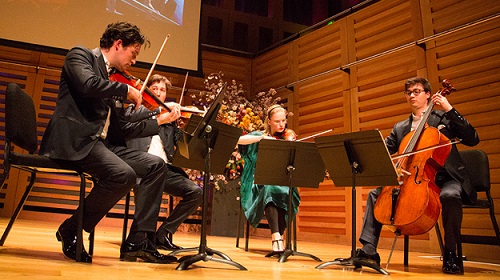
The two live performances were totally engaging - the Schumann Quartet (pictured above), voted best newcomer (though how do you decide when there are so many first-rate quartets emerging all the time?), in the typically quirky, quote-conscious second movement of Ives's Quartet, and Tenebrae pitch and tone perfect in Bruckner's motet 'Christus factus est' (pictured up top; had to remind Stephen that we'd sung 'Locus iste' at his wedding to the marvellous Kate). Most astonishing for me was a film of Nick Daniel with two fellow oboists playing MacMillan's Intercession for that unique combination - not even Martinů wrote for it - in honour of the composer, whom it was good to see again in person.
Best speech, no question, cellist Paul Watkin (second from left above in his Scottish Chamber Orchestra trousers - he's Welsh) claiming his award for the six Bach Cello Suites on Resonus Classics (have ordered them up). He stood up for music education in the clearest terms and recommended learning about musical narrative from reading to children (claimed to have got through the entire Lord of the Rings with his kids); at least I know something about that from touting around Russian fairy stories to various godchildren with bits of music on cassette - that dates us - to accompany. John Eliot Gardiner's introduction was equally eloquent, showing how good he can be at heartfelt, precise tribute to a loved fellow musician. I had no idea at the time that Watkin can't play any more following diagnosis of an auto-immune condition called scleroderma; that adds post-event pathos, but it was touching enough then and there.
As far from perfunctory coda, let me sincerely hymn the praises of two discs I was sent by the performers or people close to them. If I hadn't thought much of them, I'd simply have kept stumm. That phenomenal harpist and most generous of human beings Sioned Williams had me sent a disc of works by Michael Stimpson, performed by her and the equally wonderful-on-both-counts baritone Roderick Williams in a recorded concert programme, part of which I'd been hoping to hear repeated at RIBA (in the end I couldn't make it). The Drowning of Capel Celyn I'd seen and heard in Sioned's 60th birthday concert at the Purcell Room. The song cycle Dylan is rich and varied, a marvellous introduction to some Dylan Thomas I didn't know, and all the better for the spoken passages (Roddy doesn't attempt to sound Welsh; Sioned's sing-songy native tone comes in useful for Mrs Cherry Owen). A beautifully presented disc, too.
I won't say much about the other CD because Rebecca Franks at the BBC Music Magazine has just accepted it for review. The background is important: the best of all press officers during her long stint at ENO, Jane Livingston, sent the disc to me because she wanted to support Julian Gavin, the tenor who gave so many extraordinary performances at ENO and, indeed, the Royal Opera (I saw his Don Carlo on the night when Roberto Alagna wasn't singing, and loved it). The year after he recorded this disc with his sister May (both pictured below) he was diagnosed with encephalitis, which called a halt to his international career. Val, their extraordinary mother, died only three weeks apart from their father in 2013.
Even if you knew none of this, I'm certain that the extraordinary emotional fervour of Gavin's very distinctive voice - lyric verging on the helden - would impress; and the songs, too, are late romantic in style and yet, it seems to me, genuinely inspired at times, with melodic writing of truth and beauty. It's useful to have settings of Housman's A Shropshire Lad which offer just as much as Butterworth's. More in the July issue of the BBC Music Magazine.
There, too, you should find my review of a disc which has sent me giddy with delight, the Smetana Piano Trio's recording of all Martinů's major works for that combination. This is already on my shortlist for best of year, and I can't stop playing the ecstatic dance-finale of the Third 'Great' Trio.
Sunday, 3 April 2016
ENO at the Oliviers: winners not present
Congratulations to the English National Opera Chorus and Orchestra for winning the Outstanding Achievement in Opera at the Olivier Awards. I'm sure stupendous Tamara Wilson, Leonora in the company's Force of Destiny, and the evergreen Felicity Palmer, the Countess in last season's Queen of Spades, also nominated, will have been cheering them on.
Yet it's baffling that no-one from either chorus or orchestra was present to claim the award, not having been invited. At the very least the spirited co-leader, Janice Graham, should have been there. Isn't this a very symbol of the gulf between the CEO and Board on the one hand and the 'creatives' who have always delivered through thick and thin on the other?
I understand Martin Fitzpatrick of the Music Staff made a perfectly fine speech about treasuring what they have, presumably ironic when you bear in mind that the majority of the administration who attended have been doing their best to dismantle what makes this company great. It's still not too late to make the right kind of changes. Mark Wigglesworth remains to show the ENO in all its glory in the Jenůfa this season and two more productions in the next. As I predicted last month, the artists will all put up a fight to keep him.
Proud of my colleagues on The Arts Desk, chiefly theatre critic Marianka Swain, for tweeting so trenchantly throughout the event and declaring TAD's allegiance to the ENO cause. And there really is only one (cause): to survive and change, but not at the cost of becoming a part-time company.
STOP PRESS (4/4): Our Tamara - as I think I can say after two hours in her grounded, funny company when she visited the opera class at the Frontline Club - has just won the prestigious Richard Tucker Prize for 2016, following in rather distinguished footsteps (Renée Fleming, Lawrence Brownlee, Stephanie Blythe, David Daniels, Angela Meade, Joyce DiDonato, Michael Fabiano and Jamie Barton). ENO casting has been criticised for over-use of American singers, and it does need to get back to promoting a UK ensemble, but I've NEVER heard Verdi singing like hers at the Coli (and Marjorie Owens's Norma was a good call, too). She'll be back here in July, but doing what I can't as yet say*. Photo above by Aaron Gang.
*Update (1/5) - I can now: the soprano part in Tippett's A Child of Our Time and testing out a bit of Brünnhilde in the final scene of Die Walküre Act 3 with James Cresswell as Wotan: my doing, says Mark Wigglesworth, who's conducting the Prom in question.
Saturday, 2 April 2016
Barry and Jones at the Frontline
Alas, a 'Twin Peaks' event, as the composer wryly put it, was not to be. Gerald Barry had a slipped disc so couldn't fly over from Ireland to join us at the Frontline Club* on 14 March, but Richard Jones made it, after rearrangement, an hour earlier than scheduled, since there was a final lighting rehearsal from 3-6pm at the Royal Opera before his new production of Musorgsky's Boris Godunov opened that evening. And very, very grateful we were to him for that.
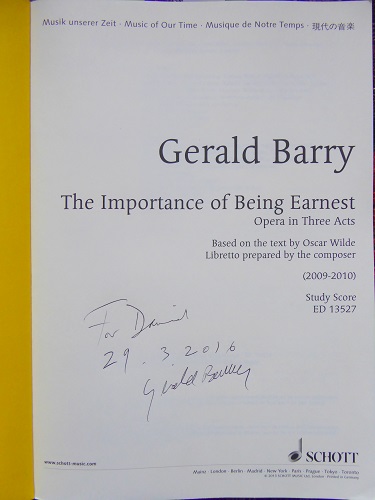
Likewise to Gerald, who came along on 29 March before HIS first night, albeit a revival of The Importance of Being Earnest.
Ask any of the students from my Opera in Depth class who made the talks, and each will tell you both visitors were such fun as well as eye-opening with regard to the mysteries of composing and directing. Let's take the first in order of appearance. Richard, who's visited three times now, still seemed rather startled that we'd spent six weeks on the two versions of Boris (he does bemusement well).
When he summoned me to a preliminary chat about Musorgsky's masterpiece over a year before the production, he was toying with all sorts of ideas, admitted he loved the different atmosphere of the Polish act in the revision, not to mention the Kromy Forest scene which replaced the encounter between tsar and Yurodivy outside St Basil's Cathedral, at least in 1872 (Tarkovsky's so-called 'supersaturated' edition at Covent Garden included both). Ultimately, though, it was Kasper Holten's choice, and he wanted unadulterated 1869 since the Royal Opera hadn't done it. Below: Bryn Terfel as a troubled Boris in the Coronation Scene, one of two images by Catherine Ashmore for the Royal Opera.
My feeling is that too many other companies havc, and Richard admitted that it's quite cerebral, mostly keeping the viewer at an emotional distance - through a glass darkly, as it were. But, struck as I was this morning by watching an interview with Martyn Brabbins, it's clear that what he said about conductors, at least of new works, applies to directors too: they are re-creators, artisans who work with the given material. Jones, of course, is a visionary artisan and only he could take a single line from the text - when Shuisky describes the corpse of the murdered tsarevich Dmitry still clutching a spinning top - to permeate the entire ritual. The killing of a masked, red-headed 'child' is repeated at crucial points, and the parallels with Boris's own son, not always brought out, are marked here both by another red wig and the pathos of a treble to sing Fyodor.
I've written all about this typically thoughtful, engaging and haunting production over on The Arts Desk, so no need to repeat myself here. I should mention, though, that in class I ended up using far more of Calixto Bieito's Munich vision than I'd intended - partly because that's undiluted 1869, unlike every other version which had promised to be so, partly because the relationships seemed so much more real than several of the other DVD versions (though it's always good to reference the post-Chaliapin melodramatic style incarnated in Nesterenko and others). I still think Bieito's productions, with its law of diminishing returns on the violence as usual, has the best Boris death scene thanks to the extraordinary and harrowing portrayal of Alexander Tsymbaluk.
Terfel would certainly repay another look, though, especially in the close-ups of the livescreening (which I guess I can see when it appears on DVD, as it must). Subtle, nuanced, of a piece with Pappano's precise fusion of stage action and orchestral commentary. Richard talked about this essential collaboration, and I don't think it's a betrayal of what he told us to mention that he felt his Gianni Schicchi had worked less well this time simply because the conductor, the very good Nicola Luisotti, was more pit-involved - I got the sense that also meant self-involved - than Pappano had been. After he'd gone, we watched the original Schicchi and I marvelled especially at how superbly the young, handsome tenor playing Rinuccio, Francesco Demuro, used his hands to lead his body and express his lines in a way that only Jones seems to be able to get.
Richard was happy with the performances of his singer-actors in this Boris, especially a very relaxed John Tomlinson and the relationship that Terfel's Boris had developed with John Graham-Hall's Shuisky: they had evolved between them a sense of class distinctions, though their director wasn't quite sure that came across and, costuming apart, it didn't. Otherwise, it seemed to have been a wholly positive experience and I hope we'll have a Khovanshchina from him anon. And I breathe a sigh of relief that the first collaboration between RJ and Mark Wigglesworth at the beginning of ENO's next season - I know what it is but still can't say - should still be going ahead.
It seems to me, the more I study The Importance of Being Earnest in its pared-down but hysteriaed up operatic version, that Gerald Barry composes in one way at least much as Richard Jones directs: he takes a brilliant and original gesture or style and mines but never over-exploits it before moving on to the next idea. Certainly he hates the idea of chaos onstage, and Earnest is anything but. He and RJ worked together on The Bitter Tears of Petra von Kant - wish Richard had been with him to enlarge on that, since he'd told me that the cast spent every day crying, without explanation - and they undoubtedly will again. But possibly not on Barry's Alice opera, which receives its Barbican concert premiere later this year: 'he told me he'd only direct if I didn't put either "Alice" or "Wonderland" in the title'. The latter has been obviated by calling it, as Carroll did his original, Alice's Adventures Under Ground, but can RJ accept the unavoidable name?
Time will tell. Meanwhile, we heard about Barry's surprise at the LA premiere of Earnest when the audience laughed; he had, quite a bit, while working on it, but at first was disconcerted by the noise. He seemed to have a special attachment to Anthony McDonald's Irish-based production among the few to date, but on a second viewing, I still think Ramin Gray's update is very successful and, above all, directly communicative both between singers and orchestra onstage and - crucially - between singers and audience (below image of the entire cast, Hilary Summers' Miss Prism being ganged up on in the denouement, by Stephen Cummiskey). Here's the rave on The Arts Desk. We talked about the very precise if deliberately skewed word-setting, and GB gave us a magnificent demonstration of Lady Bracknell speaking in a monotone. He's a bass, so maybe we'll get his version on stage ere long.
With Gerald's permission, I tried to record the talk, but my mp3 stopped after 30 minutes because I had no idea it was reaching its capacity of interviews and I hadn't wiped any. Might be nice to transcribe what I've got, so maybe I'll wind up here for now. Just to add that, having spent a successful class and a half on the opera before Gerald's visit, once he'd left to go back to his London lodging and change for the evening, I took the liberty of repeating the extraordinary megaphoned spat between Cecily and Gwendolen, as punctuated by the smashing of 40 plates, wind machine(s), jackboots, telephone and gun. Here's the Cecily of Claudia Boyle, the major and splendid new addition to the original cast.
I set it up for comparison with the hit-and-miss version in Anthony Asquith's film, with Dorothy Tutin and the inimitable Joan Greenwood (I saw her once, at the Savage Club's Roy Plomley Memorial Concert, declaiming Liszt melodramas in English with Rhonda Gillespie at the piano. Elisabeth Welch and Frankie Howerd were among the other performers - quite an evening).
Unexpected coda to the Jones 'n Schicchi afternoon was a special guest, my good friend Chris Gunness's 18-year-old nephew Andrew Lavelle, playing movements from Bach Cello Suites as transcribed for viola. This was a spontaneous happening to an audience of five after the rest had left; Andrew had picked up the instrument for trial from a London shop so it was chance that he had it with him. I should add that I didn't take the photo until he'd finished his official mini-concert, just got him to fiddle a bit more for the camera.
Andrew had recently auditioned for the major American music schools and colleges; after he'd returned to Texas, we heard first that Juilliard had offered him a scholarship, then that the New England Conservatory and Cleveland Institute of Music had followed suit. Of course I hope he goes to New York but it depends very much on who's the right teacher for him. He was gratifyingly swept up by the Schicchi film and fascinated, as which true musician wouldn't be, by the infinite possibilities of London. He also took the pics of Richard and me at the end of the talk, for which I'm very grateful.
If you haven't seen or got tickets for the Barbican performances of Earnest, it's being livestreamed on the Royal Opera's YouTube channel tonight and will be available there for the next month. I hold to the belief that it's one of the handful of operatic masterpieces I've experienced in my lifetime close to the premiere - the others are Nixon in China (the other Adams operas come very close) and James MacMillan's The Sacrifice. Time and closer acquaintance only confirm the hunch. Let's hope Alice can make the grade, too. Given Barry's fascination with the balance of fantasy and precision, which he shares with both Wilde and Carroll, it should.
In the meantime, if you're interested, there are still some places available for the summer term of Opera in Depth - 10 glorious weeks on Tristan und Isolde, starting on Monday 18 April, regular time of 2.30-4.30pm. If you don't have my e-mail address, leave me a message with yours, I won't print it and I'll reply in turn.
*In replying to a malicious attack in The Spectator online (who reads it, anyway?), Frontline founder Vaughan Smith provided a good introduction to the Club in a Guardian article here. I need hardly add that I'm very proud to support it by hiring the top floor on Monday afternoons. Whilst I don't get to talk to the other members, the staff have been wonderful throughout and I find it an incredibly welcoming place with the best facilities.
Subscribe to:
Posts (Atom)