Or rather no interiors, and no pressure to hoof it from church to church as we do every September. This time the wonders were entirely natural: a bluebell wood
and a field full of cowslips
chief among them. We did see one church tower close enough, that of St Mary's Erpingham, but had to turn off up a lane before reaching it. The scene, nevertheless, is one that can't have changed, a bit of wire fencing apart, for centuries.
But before I give more context, I've been owing generous donors a final record of our achievement, and it's a good one - namely £4004 between the four of us (pleasing symmetry) which made All Saints Burnham Thorpe the top fundraiser for the Norfolk Churches Trust in 2016. Many thanks to all who gave. And a bit of shameless self-publicity in that, having won two categories in the photocompetition backed by Cheffins, I reproduce the two pages below from the Eastern Daily Press. The spiderweb framing St Peter and St Paul's Honing I'm pleased with, somewhat more puzzled why they chose the stained glass at St Peter's Ridlington for the detail.
Our walk with Southrepps-based friend Jill on Bank Holiday Sunday was a delightful and varied circuit around and beyond the Blickling estate. I don't think we've ever walked in Norfolk in the spring, and the greatest pleasure was the light green of the newly-leafing oaks.
The National Trust has maintained the paths around the estate superbly, especially the boardwalks over beautiful marshland.
Part of it should be bright yellow with irises in a couple of weeks' time.
These are wetlands around the lovely river Bure.
Within a short space of time, I clocked four species of butterfly, including a delicate blue, a Brimstone and this Speckled Wood (Pararge aegaria) .
They eventually give way to fields, with the inevitable rape colouring the landscape yellow.
To pinpoint our bluebell wood might be to invite its spoliation - whenever one's identified in the press, everyone flocks to it. This was our first glimpse.
I wish you could hear the intense birdsong and smell the bluebells too.
Coming out of the wood, we took a lane around the edge, again with plenty more splendid oaks
and then a little bunny appeared. From the way it sat there quivering there might have been something wrong with it, but nothing obvious. Anyway, we left it with a question mark
encountering a friendly dog as well as this horse and foal
and then headed towards Erpingham. This is where the church tower led us forward for a bit before we turned left.
No lunch to be had in the pub Jill had planned for our stop - power failure and overbooking, familiar story - so we walked a mile or so further than planned, past a thatched, Dutch-gabled barn at Limetree Farm
to catch some necessary sustenance at Alby Crafts and Gardens. An eccentrically adorned tea room serves good lunch and massive slices of locally made cake.
Here it was that we first heard, then saw the peacocks. And one of the four males faffing around the solitary peahen decided to put on a display.
Reluctantly giving the gardens a miss, we headed back to Erpingham, but by a different route along the lovely Thwaite Common. Then to rejoin the Weavers' Way along what passes for heights in this part of the world, before hitting the cowslip meadow.
We headed back down to the Bure valley
which is very paradisical this side of the Blickling Estate
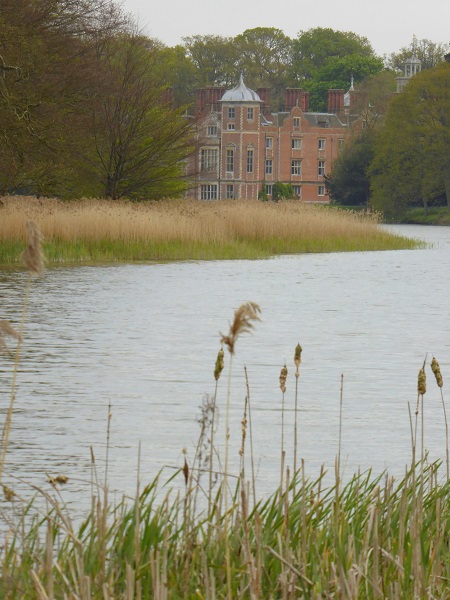
We eventually re-entered the Estate through a wood leading up to the lake.
I wonder if Henry James had this setting in mind for the outdoor scenes at 'Bly' in The Turn of the Screw. With the now-watery sun it had a faintly sinister feel
but the waterbird music kept it magical. A crested grebe was leading her brood across the water's surface.
So back to the car and the house, which I visited on a City Lit summer school many moons ago when my beloved Trude Winik was still alive (she took some very lopsided photos in the drive which I still treasure).
Sunday's excursion to see the angel roof of newly restored St Peter and St Paul's Knapton - all scaffolded up and shut down when we visited in September - and then for a fresh crab lunch at the Overstrand shack, followed by a walk along the ever-crumbling cliffs, will have to wait for another instalment. I'm getting bad at keeping my promises of second chapters here these days, but the wonders of Knapton can't be ignored.
Update (10/5) - the Europe Day concert preview had to be temporarily removed yesterday, but here it is again, with a footnote to the effect that the quality of last night's playing, singing and the music itself - including the stunning new work by Matt Kaner - went deeper and higher than I could possibly have imagined. Everyone I spoke to was profoundly moved, and absolutely everything worked. More on that anon. Now, back to the original post.
For me, the moment when a tear came to the eye: Macron took to the podium to the strains of the European anthem, Beethoven's setting of Schiller's Ode to Joy in his Ninth Symphony. Tomorrow at the Europe Day concert in St John's Smith Square, we'll be standing for it with a special emotion. Happy to repeat this rather unusual arrangement by Andrew Manze when Rachel Podger led the European Union Baroque Orchestra - leaving its UK base thanks to Brexit - at last year's concert.
And I think the programme will please: on a theme of islands, since Malta holds the presidency at the moment. As well as a movement from the Malta Suite of Charles Camilleri, we'll be hearing island music from Mendelssohn (Overture The Hebrides), Mozart (two arias from Idomeneo), Nielsen (two songs from Springtime on Funen), Sibelius (five pieces from his incidental music to The Tempest), Bizet (the Act 2 Love Duet from The Pearl Fishers), Martinů (the final monologue from Ariane), Respighi ('The Birth of Venus' from the Trittico Botticelliano) and a new piece by composer Matt Kaner for violin and orchestra, Stranded. A truly European menu.
There are four splendid soloists - soprano Jennifer Davis and tenor Thomas Atkins from the Royal Opera's Jette Parker Young Artists Programme, Maltese soprano Nicola Said to reprise the Callas-alike Ariane she sang at the Guildhall last year (pictured above with Josep-Ramon Olivé as Thesée by Clive Barda) and the supremely cultured violinist Benjamin Baker. Jonathan Bloxham, currently assistant to Mirga Gražinytė-Tyla at the City of Birmingham Symphony Orchestra, conducts his Northern Chords Festival Orchestra. What can I add except to say that I'm very excited at the prospect. And in the meanwhile, it's Springtime for France (and thankfully not for Hitler, though Madame will still be causing trouble in the years to come). How better to mark it than with the beautiful paulownia tree outside La Cité metro a couple of weeks back?
Meanwhile the stranded monsters gaping lie, but still capable of great harm. Their provenance is wittily suggested by this juxtaposition - by whom, I know not, but it attracted quite a bit of attention when I put it up on LinkedIn. Well done, whoever.
I was delighted to be asked back to serve on the jury of this annual Dutch school orchestras festival - only nominally a competition - and as chairman, no less. Slightly overparted, I feel, as my colleagues this year were not only, once again, the brilliant violinist Jeroen de Groot - how brilliant has become clearer in the interim from hearing his Bach CDs - but also two other high-level instrumentalists: international cellist Larissa Groeneveld, whose disc of Zemlinsky, von Brucken Fock (no, me neither) and Dohnányi with pianist Frank van de Laar I look forward to hearing, and Royal Concertgebouw trombonist Nico Schippers, who also rewarded me with two splendid discs featuring the orchestra's brass ensemble.
We were very happy to be joined in our backstage discussions by the genial and obviously very hard-working Gerda Hoekstra, director of the Stichting het Zelfstandig Gymnasium. The title should explain that though the Netherlands is without what we'd call public or private schools, in national terms at any rate, the participants drawn from the 40 top schools tend to be among the high achievers. The mix consequently isn't that representative of multi-kulti Holland. Well, that's the way it is, being under such auspices at any rate. The musical standard, even so, varies, as do the types of ensembles featured. I set most of this up in last year's account, so, with a preliminary shot of myself with (left to right) Gerda, Larissa, Nico and Jeroen,
let's follow the same format I used in 2016 and give what I hope will be helpful notes about each of the orchestras. We actually did this between the three of us in the summing-up speeches up, but as that was divided, these are my personal opinions - though we were mostly in agreement. Not least about the clear winner, which has to come first -
Aulos, Praedinius Gymnasium, Groningen And what a difference a year makes. In 2016 they were, to be honest, the least inspired of the bunch - though the most charming afterwards, when they asked me about their Handel 'if we had let off real fireworks, would we have got more points?' To which I answered with that assumed sagacity of someone appointed judge, 'the point is to put more fireworks in your playing'. Last year's messages about communication - with the proviso I made this year, that I know it's difficult to show you're enjoying yourselves if you have to concentrate on playing the notes - seem to have paid off. Aulos's programme was perfect. It started with an ideal novelty act, Leroy Anderson's The Typewriter (why aren't more of this witty tunesmith's pieces played by youth orchestras?) A boy who was clearly a born actor operated an invention which neither he nor any of his contemporaries are likely to have used before (I stopped using my electric typewriter in 1986). Another rang the bell. The cross rhythms and hiccoughs aren't easy, but they all did it perfectly. Then there was a really lovely piece composed by the horn-player, Daniël Apol, who I snapped in the finale (that's him on the left below).
Not only was Apol's Romance a gem, but we also suddenly heard real phrasing - not common in Orkestival. Full marks to the music teacher/conductor, Jorien Elout. She also had the inspired idea of bringing in players from the other orchestra in that segment of the day, Mercator et Musica from the splendid town of 's-Hertogenbosch - more on them below - in a wittily compiled fantasia on Bizet's Carmen by Eijk Suzuki: unexpected, concise and taking a leaf out of Shchedrin's Carmen ballet in its use of tuned percussion. So all told, a winning formula: wit, lyricism, originality, panache and collegiality.
Taking the rest chronologically, let's go back to the beginning with Group 1, kicking off with Coornhert Gymnasium, Gouda. The teacher needed to conduct with a bit more spirit, and it was a shame the lively percussion used in an Abba medley weren't engaged for the Radetzky March. The revelation here was 17-year-old soprano Annecke de Hoop singing Pamina's 'Ach,ich fühl's' from Die Zauberflöte. A polished technique already, though the pace should have been set faster for her and while I know the conductor had to keep his eye on his players, once he realised his singer was likely to come in early or late, he needed to cue here. But no doubt about it, she was the individual standout of the day. Unfortunately Coornhert outstayed their time and welcome - should have dropped the Grease selection; 'Dancing Queen' had already left us happy enough.
Murmellius Gymnasium, Alkmaar made a mistake by starting with Fauré's Pavane, and those loud string passages in the middle are really tricky. Again it was the teacher's job to set it flowing, and to hell with the wrong notes. Can't say I remember much about the other two pieces. They seem to have lost the inspirational music master who helped them to win the 'promising' category last year with a clapping piece.
Vossius Gymnasium, Amsterdam always has the biggest advantage in terms of size and training; they gave the strongest purely classical programme last year and had won several times before that. Coen Stuit got a terrific performance from them, overall the most polished, of songs and dances (not the symphonic ones) from Bernstein's West Side Story. Quite an impressive string sound here, I think you'll agree, since Vossius has been quick off the mark to put up a film on YouTube (not in the same league as the professional one excerpted for the Ode to Joy below, which I think covered everything, but this will do).
Less good was Haydn's Overture to Lo Speziale: much too heavy for an curtainraiser to an opera buffa. But still, an ambitious choice. And wonderful to watch the enthusiasm not just in performing but also in reacting when he wasn't playing of timpanist Omar Beganovic - I think I've got the right name there, but in summing up I simple called him 'cool dude'. That's him on the drumkit for the Bernstein.
Group 2Aulos followed Mercator et Musica, Stedelijk Gymnasium, 's-Hertogenbosch. They could have done with more contrast, and the repetitive theme of Jacob de Haan's Concerto d'amore was really rather boring. There were some fine solos in Alexis Ciesla's Balkan Groove, though, even if not enough was made of the groove itself. M&M can also share part of the prize, too, for fielding soloists in Aulos's Carmen selection.
A quick lunch in the Concertgebouw canteen, staffed by extremely pleasant people - as is the entire hall.
Group 3 Euterpe, Stedelijk Gymnasium, Arnhem fielded a star treble last year, and a good one this year, giving us the novelty of a boy as Mozart's Cherubino with 'Voi che sapete' from Le nozze di Figaro. Sang it accurately but - big ask - needed to express something of what it was about. Otherwise, a very impressive programme began superbly with Corelli's Concerto Grosso Op. 6 No. 8. The first violinist had professional poise, and there was a real surprise when we heard the solo tone of the young lad sitting next to her: beautiful (if I'm not mistaken this is the same who sang so amazingly as last year's star soloist, Casper Jeukendrup). Quite enjoyed Tijuana Taxi but the awkwardly filleted Capriccio Espagnol didn't have a hint of elan. In the only slight lack of agreement between us jury members, the decision was taken to give the runner-up prize to Euterpe, but as I understood it was really supposed to be for the group who showed the biggest promise, I would have unhesitatingly have given it to
Panta Musica, Johan de Wit Gymnasium, Dordrecht Last year they began virtually from scratch with a charming, oddball ensemble. How it had grown this time, enough for them to begin with a clever guide to the orchestral departments in carefully chosen snippets. And what I loved best about their engaging Dudamelesque mentor-conductor Saul de Caluwé was that he went not for a David Stone-style 'classics for schools' arrangement but the WHOLE of Saint-Saëns's Danse Macabre which, even if it was almost beyond their abilities, the group got through intact.Always happy to hear any version of Piazzolla's Libertango too.
Gymnasium Haganum, The Hague had another would-be charmer in charge, but I never quite worked out what Piet Raphael was playing at, gurning occasionally when he would have done better to keep his eye on the ball. The teacher should never become the centre of attention. And they deserved better. But we all enjoyed a 'Hey Jude' singalong at the end.
The poster, by the way, is also the result of a competition - the winning entry is by Eva Versteeg from Gymnasium Haganum. The theme - maybe it was made clear by presenters Adda van Zanden and Rikkert van Huisstede, but my Dutch isn't up to it - was 'Met een Twist', 'With a Twist', that apparently also having the connotation in the language of strife or conflict. Which some orchestras carried through, others seemingly didn't.
Group 4 Gymnasium Celeanum, Zwolle introduced a novelty in the form of bagpiper Cees Scholten, but as he wasn't one of the kids, the effect was slightly marred (and the orchestra only got to join in briefly). Good to see that the dayglo pitched thwackies known as 'boomwhackers' made a special appearance for a more aptly novel treatment of the James Bond theme. Personally I rather liked the Muppet Show tune to end, though my colleagues were a bit sniffier about it.
Big Band Stedelijk Gymnasium, Nijmegen still needed a bit more swing, as we noted last year. There was a rather interesting kid who made impressive sound effects, but the amplification went awry again for the talented vocalists. The mikes need testing, if it's possible, so that they don't scupper good intentions.
Last but certainly not least, last year's winners Christelijk Gymnasium Beyers Naudé, Leeuwarden. Even if Aulos hadn't come up with such a brilliant trio of entertainments our champions wouldn't have cut it this year simply because their programme was lacking in variety. But now that the red-headed violinist who made such an impression last year has moved on, all eyes were on Jorn Stavenga, the trumpeter who was the true leader, capping a brass sound that's absolutely gorgeous to hear (trombones shone at one point). For that we have the brass band tradition in Friesland - where nearly everyone, it seems, is blond - to thank. She spoke to me afterwards to thank me for last year, I returned the compliment for this one. Very focused, is going on to study conducting, and I'm sure she'll do well.
Final break, quick summing-up backstage and then on for the grand finale. First came the results of inspirational Mirjam van Dam's group voice coaching. They'd only allocated half an hour for the whole thing, but I still insisted that we all got to speak to give encouragement to each group. Got applause for starting with a bit of Dutch, but it all went a bit quiet when I said how good it was to be back just after the Dutch people had made the right choice in the election. Maybe you don't raise politics, but there was an important link to be made between Coen's choice of the Ode to Joy aka the European Anthem - we will be standing for it at the Europe Day concert on 9 May - and the pride we feel in being united in Europe against populist bigots like Wilders.
From then on it all went swimmingly, until I was so flustered by being pinched - I kid you not - to get on with it (I wasn't rambling, but I was determined to make the points I'd intended) that at first I announced the wrong winner. Pure Oscars moment; I think it was taken in the right spirit. Confusion absolved, there were more speeches, and then Coen conducted the Beethoven. Kudos to the superior film work here.
He's planning a Brexit concert with ironic takes on various pieces - The Lark Ascending is the UK flying away, though as a passionate fellow-European he certainly doesn't think that's a good thing.
We retired to the very characterful bar behind the Concertgebouw. Nico told me it's the favourite haunt of the brass and many of the older players - the younger ones tend to go round the corner. Anyway, the sun shone in the midst of a cold snap, we sat out, my hosts Machteld and Nick (centre back; sorry the sun has all but obliterated Coen's face) turned up along with Adda (second from the left), we moved into the shelter,
Rikkert and Adda's co-organiser Jitske joined us, and a select party went off for supper since this time there wasn't a concert in the evening. A happy day, fired up by youthful enthusiasm and dedication. I took away a lovely bunch of tulips, but assuming they wouldn't get through airport security the following day, left them with my hosts after our lunch at Keukenhof Manor.
Actually it was in early March when I went to Gloucester to give a talk on Rachmaninov's All-Night Vigil (better known as the Vespers), returning to the place I hadn't seen since I was a choirboy 41 years ago when I fainted in the cloisters (not, as I quipped to my audience, in excitement at the Harry Potter film location, since he wasn't born then, but from being affected by the heatwave of summer 1976).
So the reference is obviously to Mrs Mayhem, and the graffiti artist enriching one of the city's many rack-and-ruin spaces has nailed it. A man was also looking at the artwork as I snapped, and he remarked, 'what a waste of talent, eh' - I presumed he meant of potential which might have been engaged in true artistry, to which I replied that at least it was being seen, if only temporarily. Banksy would approve. The composite work has been built in collective style, and how gratifying to see the EU flags. I presume it's the same artist's rat
and this cubist fox - is it a reference to an extant work? - is really very fine.
The centre of Gloucester is mostly a planning disaster of the 60s and 70s; whole rows of medieval houses were knocked down, all too typical a response of the times (more on that anon). So I thought that on my arrival in the early afternoon I'd go and see what had been made of the docklands. One part has been conventionally swished up to provide luxury flats
and the usual shopping-and-eating zone (where I was grateful of a Carluccio's for lunch). But just beyond is unreclaimed industrial archaeology, buildings which are presumably destined for the same treatment but which have a real atmosphere at present, with buddleia sprouting everywhere and pigeons all over the place.
I headed back into town
and straight for the cathedral.
The lovely close is currently an archaeological zone and will be for some years to come; in beginning to reclaim it from the car park which it had been for decades, can you believe, excavators came across treasures in old foundations.
Heading out of the 12th century St Mary's Gate gives a good ensemble looking east
but the old church immediately beyond the cathedral close is surrounded by a council estate, and if you head up Three Cocks Lane, you're soon into this.
Waiting to catch Evensong, conducted by the distinguished musician in charge of the Gloucester Choral Society who were supporting my talk, Adrian Partington, I had some time to potter around the cloisters
which within boast some of the finest fan vaulting in the country as well as the earliest (finished in 1412).
What stained glass there is turns out to be mostly Victorian imitation of the medieval,
but well done, I think.
It's clear that the cathedral proper is a 15th century encasement and adornment of a Norman building, but since I'm more attracted to the former, sitting in the choir for Evensong - a very ascetic one - and looking up at this
was a joy (I hasten to add the picture was taken after the service, not during). A shame it was too dark to see the glory of the east window. Afterwards I managed to lift up my own stall and others to look at a few misericords - must return to see the rest of the 58. Mine showed a young fox in the huge talons of an eagle
while a neighbour was one of the liveliest, two men playing with dice or coins.
Further along a boar and sow snuffle for acorns beneath a tree with a squirrel in it
and on the other side, there are hunting/riding scenes
and a recumbent man with an arm around a donkey, possibly a reference to Balaam's ass.
Even the 'modern' additions, though obvious like this Adam and Eve, are finely wrought.
A brief chance to walk around reminded me that back when I was a chorister here, this effigy of William the Conqueror's oldest son, Robert of Normandy, was in the middle of the choir - not so now -
and of course the immense importance of Gloucester, so diminished by the decadence of the town - the posh folk all seem to live in Cheltenham now - is symbolised by the tomb of Edward II.
By the time I came out it was dark
and I went to a very friendly pub in the main drag opposite for fish and chips before arriving for the talk, which was held in the timber-framed hall with remains of old wall-paintings.
My loss that I couldn't get to hear the performance of the All-Night Vigil the following week, but we have the splendid Latvian Radio Choir performing it in a late-night Prom on 13 August. Which leads inevitably to a second plug for my afternoon talk that day, which will be different from the one I gave in Gloucester but possibly with a few overlapping excerpts.
All observations, questions and challenges are welcome: resistant to tweeting and Facebook (though long converted to LinkedIn), I still like to exchange ideas. You don't have to be signed up, and you can be anonymous, but comments are moderated.
Copyright
If you wish to use any of my own photographs featured in the blog, or any of the text, just let me know in the comments. Acknowledgment and a link are all it takes.




 Posts
Posts