Saturday, 1 January 2022

Buon anno da Venezia


How does this most chimerical cities keep its magic? A too-long absence may have a lot to do with it, but it's a truism to say there's nowhere like this. And we have been fortunate with clear mornings and misty afternoons (the caligo, they call it). Perhaps the above image, looking out to the island cemetery of San Michele from the Fondamenta Nuova, is a little ominous for 2022, but may death eventually come as serenly as this. At nightfall, the picture is even more numinous.

We are quietly and comfortably lodged in an apartment behind the Madonna dell'Orto, my favourite church and area (northern Cannaregio) in the whole of Venice. Still some roses along the wall.

The church itself, with the finest of facades,


had also lost none of its wonder. Maybe I hadn't remembered exactly what Tintoretto canvas was where, and to see so many of them again was awe-inspiring. 


The Presentation of the Virgin remains the one of his I love the most.


Tintoretto is buried here

and the house where he lived and worked has the famous statues of moors and others adjacent (hence the Campo dei Mori before you cross the canal to the church). 

They don't draw attention to the fact that the Bellini Madonna and Child of 1475 was stolen in 1993 - I saw it before then. But I've always loved the Cima opposite more


especially its owl among the ruins

and I didn't remember the charming Tobias and the Angel (aren't they all?) by Titian.

My favourite walk is from here via the Misericordia to the Gesuiti, and by extension heading south through a web of streets to the Miracoli. Happy with all this, even though the end of a cold meant I could still be liable to cough and so I reluctantly gave up my ticket for the New Year's Day Concert in La Fenice. Anyway, it's time for another big stroll, so here are two more personal images - a cow and a macaw along the Fondamenta degli Ormesini (excellent cicchetti here)

and a shop full of Befanas for the next big day (Epiphany, marked here by the witch bringing sacks of coal for naughty children).

It restores happy memories of being here with my godson Alexander and his family when he was four years old, and very much haunted by the story. We still laugh about it.

Sunday, 26 December 2021

Buon natale da Siena


To hell if it looks pretentious, and in any case we feel a bit reborn ourselves, for at least three reasons: 1) getting away from blighted Blighty, 2) doing it by train, rekindling happy memories of Interrails past, and entering France/crossing Paris on the very last day when it was possible to do so and 3) seeing Italy again, the country I love more than any other, after a painful two-year-plus absence. Thus the first glimpse of an Alpine rock-face before Chambery.

Impressions of Torino in detail must wait, but what a glorious, spacious city, and how amazing to see the Alps so clear from so many streets. This was new, and seemed miraculous to us. Then on to Firenze, and the impact of Baptistery and Duomo was so different from previous visits (not sure why).

Now we're in the bosom of friend Sophie's warm and welcoming home in Siena. With her friend Pia joining us, the Swedish tradition of a big feast on the eve was adopted, and before that I managed to slip out to an intimate service at 6pm that had taken my fancy, in the district of the Oca (goose) contrada (Palio connections to be explained some other side). 

I think I did well, because the Oratory of St Catherine which belongs to Oca isn't usually open. It's a jewel, with Neroccio di Bartolomeo's statue of the saint very much central, putti by Sodoma above and finely detailed scenes from the life around the wall. Not right to photograph during the service, so the few shots I took were on departure, but you can see how lovely it is. 

Later we strode out for Midnight Mass in the Duomo, so very different from when J and I attended 34 years ago. Then the building was packed, and Italians stood around and smoked or showed off their fur coats. This was a very sombre affair. The old ladies certainly weren't out - not the right time. But it IS so refreshing to be in a country where vaccine passes admit you to restaurants, museums, trains and places of entetainment. Masks on the streets, too. Why didn't our hapless government ever do all of this?

Wednesday, 8 December 2021

Horror and part-redemption: Ančerl and Haas


The still from an infamous film is not quite what it seems. Conductor, composer taking a bow, orchestra and smartly-dressed audience are all Jewish prisoners in Theresienstadt/Terezin. Two days later - the sickening cynicism of the Nazi propaganda machine! - they'll all be deported to Auschwitz. Few will survive. 

Conductor Karel Ančerl was one who did, though his wife and son were murdered in the gas chambers. Arriving in Auschwitz, he stood in line with his friend, said composer Pavel Haas. Mengele was ushering him on the path to extinction when Haas, weakened, coughed. 'No, that one'. And because of this obscene twist of fortune, the composer was lost to us and the conductor went on to greatness at the helm of the Czech Philharmonic. After the liberation of Auschwitz, he also found the orchestral parts - except the one for double-basses - of the work being performed in the film, Haas's Study for String Orchestra. 

Ančerl features in the film about the film, apparently not downloadable but to be found on YouTube (the title is 'The Führer gives the Jews a city' in capitals). Thankfully it is not the unadulterated propaganda exercise about happy life in Terezin. It's all in German, without subtitles, but an essential watch, if you can bear it. The great man's steely precision about the facts and circumstances is moving in itself. Needless to say several 'students' on my Zoom Czech music course were deeply involved - two had relatives who were in Terezin and/or were murdered in Auschwitz. Pictured below: members of the dressed-up Terezin audience several days before slaughter.

In every class, we've found something profoundly moving or troubling. Just think of the infant mortality and premature deaths which dogged the lives of the great Czech composers. As we moved through the decades, it became such a pattern that I felt I had to ennumerate. Smetana lost three daughters between 1854 and 1855, and his wife, who died of scarlet fever, four years later. Dvořák and his wife lost three children between 1875 and 1877. Janáček wrote in his 1924 autobiography that he would 'bind Jenůfa simply with the black ribbon of the long illness, suffering and laments of my daughter Olga and my little boy Vladimir'. No sooner had Josef Suk begun to mourn the death of Dvořák, his father-in-law, intending a five movement memorial with a triumphant conclusion, than his wife Otilie, Dvořák's daughter, also died. Thus the Asrael Symphony became a monument of almost unrelieved sadness.

Even though Bohuslav Martinů and his wife Charlotte had no children of their own, he had cause to mourn the remarkable young woman who may have been the great love of his life, conductor and composer Vítězslava Kaprálová (pictured above). Like another composer who should have gone on to greater heights, Lili Boulanger, she died at the age of 25. That was in 1940, just as the Martinůs were fleeing the Nazi occupation of Paris and marking the first stages of their difficult journey to the USA.

If, as the late, great Jiří Bělohlávek insisted, we accept Gustav Mahler as a Bohemian - he was born in Kaliště before the family moved to nearby Jihlava - then here's the most devastating chronicle of family loss of all the 'Czech' composers. Apart from the major loss of his life, the death of his four-year-old daughter Maria ('Putzi'), of the 14 children to whom his mother gave birth, six died in infancy, sister Leopoldine of a brain tumour at the age of 26, while 21-year old Otto committed suicide, and the greatest shock of all to the young Gustav, it seems, was the death of his brother Ernst of pericarditis, aged 14. On the manuscript of the work he defined as his official Opus One, the fairytale cantata Das klagende Lied, at the point where one of the two brothers in the forest lies down to rest - his sibling is about to slay him - the composer wrote 'Ernst' in the margin. Below are stanzas written out by Mahler in 1879.


Das klagende Lied got a look-in when I covered fairytales in the sixth Czech music class. Curious how events of great emotional significance have intruded on every instalment. Smetana's Má vlast, the fountainhead in so many ways, could be seen or heard in filmed or recorded concerts of special import: most recently, perhaps, when Rafael Kubelik returned to his newly-liberated country in 1990 (there are Japanese films of all the movements played by a conglomerate orchestra under him in Tyn Square, as wel as the famous sound recording of the Prague Spring Festival concert with the Czech Philharmonic). A thrilling, fast and often rough performance has been preserved from a radio broadcast of Václav Talich conducting the work under German occupation. It's so moving to hear the audience, in the midst of wild applause, break in to the Czech national anthem (which you get at the end of this excerpt - there's a complete performance on YouTube which stops before that point).


The Hussite chorale featured in Má vlast's last two symphonic poems, 'Tábor' and 'Blaník', runs through to Karel Husa's Music for Prague 1968 - I need say no more of the significance of that. Tomorrow we'll be focusing on Martinu in the 1940s but also remembering Haas and other Jewish composers who were murdered under the Nazis. I steel myself once again for a tough time and will try not to blub again. Then, in just over a week's time, it will all be over - the 10 Czech music classes as well as the 10 Opera in Depth surveys of Jenůfa and Julietta (which the students now accept as another of the 20th century's greatest operas). My thanks to visitors Nicky Spence, Mark Wigglesworth, Jana Boušková and Josef Špaček. As for the latest special guest, I can't wait to expound on the three Monday afternoon hours we spent in the company of Gerald Barry, ostensibly covering his latest operatic masterpiece, Alice's Adventures Under Ground, but roving far and wide to embrace, among other things, Miss Marple, Edward and Mrs Simpson, The Power of the Dog and linen napkins daubed with lines from Beethoven's letters. More anon.

Sunday, 31 October 2021

Damsels and dragons


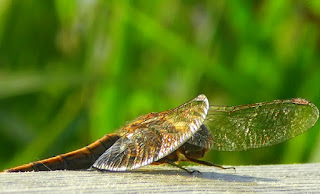
Of the -fly variety, that is. I'm far from acquiring expertise in the field of anisopterophilia (no idea if there's such a word, but I claim it using the Latin word for 'dragonfly'), but these amazing critturs, descended from bigger ones who flew around before the dinosaurs, have stolen the scene for me this summer. 

The first I espied on a plank of wood by the smaller of the ponds on Epsom Common - I've already used one shot in my post on the natural discoveries made during hospital visits, but there's no harm in putting up another since I now have reason to believe it's an Emperor dragonfly (Anax imperator), which was to be my final companion of the season back at the Wetlands Centre (zoom to the end of the piece for other images).

Then we have another damselfly to complement the one above, which takes first prize for sheer peacock beauty if not size (the Beautiful demoiselle, I think, Calopteryx virgo; more on the context soon). On the banks of the river Brue at Bruton, where we'd stopped to see the outwardly splendid church with its tall tower. Likeliest candidate here is Large red damselfly (Pyrrhosoma nymphula). 

Even when the wings are spread, you can't see the black spots which make such an impression when the creatures are whizzing about.

This was on the first day of our blissful August stay with friends Andrew and Deborah at Lacock - we'd just been to see the latest exhibitions at the amazing Hauser & Wirth Somerset, which really should have had a post of its own, had I but time. On the sunny Sunday, we walked the valley of the By Brook river via Slaughterford (beautifully situated tiny church) to lovely (deservedly touristed) Castle Combe. Flood damage had closed off what Deborah said was one of the most attractive stretches of the walk along the river beyond Slaughterford, but we rejoined it at a loop, and this is where damsel- and dragonfly activity was at its liveliest. I've never seen a dragonfly curving its back to lay eggs on vegetation and water, but that's what we got from what I'm fairly sure is a Brown hawker (Aeshna grandis).

I think you can just about see an egg being popped out into the water in this film.

It was here, too, that I saw my first Beautiful demoiselle, but there were more on the river banks by the pub where we had a drink before the last, wonderful stretch to Castle Combe.

By far our richest dragonfly time was on a magical late afternoon walk around Hickling Broad nature reserve, part of the same Norfolk day the earlier rewards of which I blogged about here. For starters, our way was guided by one particular creature always flying on ahead of us and coming to rest on the ground at times. A knowledgeable nature lover confirms that this is probably that elusive crittur the Norfolk hawker (Aeshna isosceles).

Here's a closer view of the miraculously wrought wings.

The best was yet to come - when we reached the outlook over the Broads, which Jill had promised us would be glorious, dozens of dragonflies were sunning themselves on the wood, or flying around. 

Only Common darters (Sympetrum striolatum), male and female, but in what abundance.


They ignored the ladies in our party, but seemed to like landing on us men.


More sunbathers lined the way along the path - Brown hawkers among them.

Thereafter we were rewarded with a return through a very lovely oak wood, long tailed tits the only avians to spot, but what a libellulously rich excursion. 

In mid-September dragonflies were still abundant at the London Wetland Centre - whole swarms of them one late afternoon along the east side of the sheltered lagoon. And this brings us back to the wonderful, and prolific, Emperor dragonfly, last seen there in early October.


Now it's time for the migrating birds to take over, but the dragonflies were the main event for me during August and September. You can see why.

Thursday, 21 October 2021

Harp swirls for Czech Music Zoom class 1


My Opera in Depth course this term - half devoted to Janáček's Jenůfa, the other to Martinů's Julietta - had already been under way for three weeks before I launched the Thursday class, a more general survey of a genuinely Czech music from Smetana through to Martinů, with a preludial look at 18th and early 19th century works by Bohemian composers in the European lingua franca of the time. 

The main point, though, was to reach the epic at the heart of Czech musical experience, Smetana's Má vlast, which launches every Prague Spring Festival on the exact anniversary of this founding father''s death. And I was lucky to know the Czech Philharmonic's principal harpist since 2005, the vivacious Jana Boušková, who with her colleague Barbara Pazourová usually kicks off the stirring first symphonic poem in a magnificent sequence, 'Vyšehrad', capturing the essence of the proud castle which stands above the River Vltava.

Jana accepted the invitation without hestitation. I'd become friendly with her at Paavo Järvi's Pärnu Music Festival, the best in the world for connecting with musical hearts and souls; and indeed she was invited there because she'd played in the Má vlast which Paavo conducted in the 2016 Spring Festival.

That year Jana and Barbara played the opening statements of the work's main theme, plus cadenzas, together; as it's written in the score, the second harp plays the melody and the first elaborates. Jana has actually played alongside five of her students in a Prague Conservatoire opener conducted by the late, great Jiří Bělohlávek. The one I had to hand to show the class was with a mere five harpists (students minus Jana). 

Another beauty of our introductory session was that I moved on to the most celebrated of the six symphonic poems, 'Vltava' (still better known outside Czechia as 'The Moldau' - but in the transcription made by the harpist and contemporary of Smetana Hanuš Trneček, in Jana's performance at a Czech Philharmonic fundraiser in the Rudolfinum during the first Covid spare, to help fund Prague hospitals (the number you see on the top right is the figure in Czech korunas, which shot up throughout).On the CD featured up top, Jana has referred to Trneček's work, but the transcriptions of the first three symphonic poems and of the rest of the works on a superb disc are her own.


The students warmed immediately to Jana - how could anyone not? - and there was much emotional discussion of the high level of musical education and literacy in that remarkable country. It was also vital, when Jana grew up, to have music as the world you inhabited when life under the Soviets was not so good - and to think of touring to the unimaginable rest of Europe or America as a top player, as her mother did (her father was a flautist in the Czech Philharmonic, so the couple played beautiful Mozart, inter alia, together). If you click to enlarge the image, Jana isn't difficult to spot - she has the Prague Old Town skyline behind her.

Today we move on to the Hussite chorale used in the last two symphonic poems of Má vlast, 'Tabor' and Blanik', as well as in crucial works by Dvořák (Hussite Overture), Suk (Prague) and Karel Husa (Music for Prague 1968). I'm still mapping out what the other eight classes will bring, though I'll divide fairly equally between 19th and 20th centuries, and the four greats, as depicted in this postcard of which I'm so fond, will have the lion's share.

The 10-week course on Wagner's Tristan und Isolde ended the week before we started this one. We had a virtual post-course drinks on the Friday, to which Dame Anne Evans was able to return, having been voiceless in the final class. Many laughs were had by the small but very vocal group on that evening  (Annie second from left in the bottom row).

I was also  delighted to record a Tristan chat with Robin Ticciati on the heels of his run at Glyndebourne, concluded with an orchestrally unforgettable Proms performance.


Equally thoughtful (and the other great British conductor as far as I'm concerned) was Mark Wigglesworth on Jenůfa, squeezing in the time to speak during work with the BBC Philharmonic in Salford (hence the dull hotel room background).

Just recorded another Jenůfa conversation, this time with tenor Nicky Spence, which I hope to air on Monday. Indebted to Mark for suggesting Nicky would make an excellent guest when I was running the course at the Frontline Club. As he did, and I love the generosity of all these exceptional artists, true Menschen all - that goes for Jana and Anne every inch as much as the men. Further guests, TBC, will materialise on the Czech music course anon. Not too late to join - just comment with your email here; I won't print but I promise to respond.

Saturday, 16 October 2021

Purged


It may seem melodramatic to declare it, but I knew this was coming. The previous 48 hours had seen the removal of two good colleagues on LinkedIn, Cezary Bednarski and Neil Trevitt, both passionate fighters against this misgovernment's many misdeeds, as I have tried to be alongside putting up the usual musical and cultural posts/links. So the writing was on the wall.

I wouldn't claim that LI itself is being politically selective in whom it targets; its AI is very random, a failure I've already highlighted here (when I threatened to leave and couldn't keep it up). But there has clearly been an invasion of right-wingers trying to shut down commenters they don't like. It's quite easy to do. I have in the recent past reported ad hominem attacks, and I make sure not to do them myself (there is a difference between implying that someone has made idiotic comments and saying 'you're an idiot'). But to distinguish the present government from previous Conservatives, I label them the 'Torons', which might be cause for complaint among lily-livered crypto-fascists. 

I've also been trying to wage a battle against anti-vaxxer misinformation, and one of those offenders might have taken exception to my linking to and quoting from an article on AlJazeera which calls them 'the callous cretins who kill'. I'd say that LI deals with about one in 10 clear transgressors when reported. I would have made enemies there too.

Why do this on a site which is supposedly for business contacts? Because I believe it's all connected. I do the work stuff there too, the shop-window 'look at this' links to reviews and blog posts, as well as the support for musical organisations when their posts come to my attention. And I value the exchanges I've had on LI, how much I've learned from what other people draw attention to. 

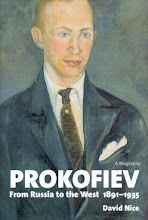
At the same time it's taking concentration away from a lot of what I should be doing (like writing Volume Two of my Prokofiev biography). I have the emails of some of the people I value on there, so we can stay in touch. Am I going to try and get back in when the LI stasi don't even give a reason for the dismissal? No. Submit passport details? Really? No thanks*.

So it's goodbye to the only form of social media I use. I find myself quite indifferent about no longer being able to access the site; but I'm furious that some political bully has forced me off. Let's see what my pals proceed to do on there - they'll let me know.

 *UPDATE (17/10) - my LI friend Willemijn Heideman suggested a simple form I could use, bypassing the document-furnishing**. And now, having been kicked off with no explanation, I've been reinstated with no explanation. As I commented below, I won't be using the site much, if at all.

**It turns out that didn't get me back on as three days later I was asked to give a screenshot of the issue. Possibly canvassing on the site linking to LI did it for me.