Monday, 2 January 2023

Norfolk Churches 245-256: Loddon to Surlingham


Apologies for the very long delay over the 2022 chronicle of our annual walk for the Norfolk Churches Trust, notching up 12 churches in 12 miles on the second Saturday in September, but I needed time as ever to do it justice, and that's been in short supply recently. This will be as lengthy as the others, and just as picture-stocked, so if you find the text too much, just whizz through the images. This might be the best place to give you the link to NCT's JustGiving page if you still have anything to give. Just note 'for J & D & friends'.

The start was the best send-off we've had: friends Katherine and Andy, whom I haven't seen since we went to a fabulous concert in their Loddon barn back in 2009, since which time all the children have grown up and none was at home this time, welcomed us with such kindness and enthusiasm, gave us all good strong coffees to kickstart the walk and wished they could join us: they will next year, I hope. This was our largest group yet, in any case: to add to the original four - Cally, Jill, Jeremy and myself - we had Kate and Fairless, who've become regulars, and another happy team member, Jane, for the first time. I won't label us all in the below line-up, except to say that Katherine is on my left (right as you look) and Andy next to her. The six walkers apart from myself are seen approaching the porch at Carleton St Peter up top.

After a Friday of storms and heavy downpours, Saturday was sunny, the horizon full of cumulo-nimbus clouds that mercifully never got closer. Holy Trinity Loddon shone in the light, albeit at a distance from the main road across the west end of its vast churchyard.

Despite Victorian restoration, it's mostly of a piece, generously endowed by the Hobart family from the late 15th century through to the early 16th. The south porch, perhaps its greatest glory, was completed in the 1530s.

The flushwork panelling is handsome, complete with battlements, and the second storey has two-light windows and what Pevsner says is a group of the Trinity, but doesn't look at all like it to me, between them.

Normally the font would be the first point of interest within the nave, but this was the weekend following the death of the Queen, so each church had its portrait (some went better still and had two or three) on a table with a condolences book.

I'd seen the first the day before taking shelter from a downpour in Norwich's St Peter Mancroft (I also spent more time than before studying the glories of the east window's glass).

The lady signing our own sheets was going to be taking part in the special peal, as her late husband had done on several occasions. Anyway, while the faces on the pulpit are defaced, it still has its signs of the Evangelists, some animals around the base and even a bit of original colouring.

The dado of the chancel screen is painted with 1530s scenes from the life of Christ, curiously cartoonish with their black outlines (Annunciation central in the first image, Adoration of the Magi in the centre of the second), and the martydom of St William of Norwich.

and one panel depicting the martyrdom of St William of Norwich. I didn't snap that, and my photos of the Hobart brasses aren't very good, but let's make do with the semi-reclining Lady Williamson, died 1684 - a benefactor of St Paul's rebuilding after the Great Fire of London, and of other City churches.

The Jacobean pulpit is also rather fine.


We also ticked off the Methodist Church, manned by friendly folk as all such institutions seem to be, a handsome mix of red brick and terracotta, of 1887-9 (the Town Hall is similar but slightly earlier).


Before we could set off on the route, cars needed to be driven and deposited in relays; we had with us two semi-invalids who were determined to walk as much as they could but needed a safety net in case they couldn't complete the route. The first stretch was tiny, merely crossing the river Chet with a view of the mill which is part of the building which Katherine and Andy occupy.

All Saints Chedgrave is a hotchpotch of different eras, from Norman to 1990,

with some pleasing headstones in the cemetery.

I was so keen to get at the glass, and the porch was so crowded, that I forgot to look at the Norman door within the porch, which you can just catch a glimpse of here.

I did snap the fine door, with 1819 in Roman numerals, the year a major restoration took place.

The east window is quite a surprise, an arrangement of mostly French glass, some of it from Rouen Cathedral, bought after the French Revolution from Norwich weaver and merchant John Christopher Hampp by Lady Beauchamp Proctor.

There was a detailed booklet about it in the church, but not for sale - frustrating as it's not online. Fortunately the excellent Norfolk Stained Glass website has similar detail. I include some of the individual panels here. God overlooks all - surely earlier than the rest?

At the centre of the first row's main lights is a later figure than the rest, but I like it.

NSG on right and left: 'a scene from The Book of Revelations where the Devil appears as a “great red dragon with seven heads.” 

'The theme is carried to the third panel which includes a banner bearing the words “macula non est” – which refers to Mary’s Immaculate Conception.'


 Other details - angels and the Virgin on a chariot.


Older, and original, is the medieval painted decoration around a tiny window in the vestry/tower.


The 15th century font, not mentioned in my Pevsner, apparently came from the church of St Julian in Norwich.

Chedgrave feels like a suburb of Loddon, but you soon walk out of it into familiar Norfolk countryside. A mostly shady lane looked across to this, enhanced by the cloudscape, on our right,

before we turned left, along an even leafier track,

to St Michael Langley, secluded in the grounds of Langley Park near the lodge which is now a private school.

Our very enthusiastic guide here, who took our signatures in front of the porch, seemed unusually well-informed, so it came as no surprise to learn that he's a master at the school.

It's a very long church, with perhaps most interest in the details of all we visited on this walk. The 14th century nave's arch-braced roof (above, looking west) is handsome, and the chancel was remodelled in 1803.

Work has begun on recovering and restoring the early neo-Gothic ceiling decoration - I wish I'd taken notes as our schoolmaster informed us about this, because I can't track down any more information on the web.

Beneath this are 18th and 19th century monuments to the Beauchamp family.

As at Chedgrave, the east window has more treasures from Hampp's hoard, also installed at the command of Lady Beauchamp.

Of the four panels, perhaps the loveliest is an Adoration of the Magi.

The nave windows are also enriched with diverse roundels/coats of arms etc, not all from the French hoard - we were to see the tortoise in a floor slab later in the walk.

Our guide pointed out another historic point of interest relating to a handsome brass of Robert Berney, who died in 1628,

namely that this dates from towards the very end of the brass tradition, so that his wife, who died 24 years later, just gets a plain slab.

The font is 'big, simple, Perp. Panelled stem, bowl with quatrefoils' (Pevsner).

The war memorial on the wall is both lovely and significant. We immediately recognised the angels on the outer panels as reproductions of figures from the marvellous - and famous - rood screen in St Michael and All Angels, Barton Turf.

Within, one notes two things - so many losses from a small parish, but how touching and heartening that the insides of the left and right panels list 'those who came back' - very much a majority.

This seems somehow of greater interest than what Pevsner notes as 'a very strange oblong recess with a C14 hood-mould on heap-stops. It is secured by an iron grille'.

It was a surprising distance to Langley Abbey, which I'd assumed would be in the vicinity. We passed a finely thatched barn,

a curiously striking specimen of nature morte,

and, along a green lane between fields, our first clusters of dragonflies which the sunny day seemed to have brought forth - you can just see a couple flying around here, though obviously the settled ones further down are more striking.

At the entrance to the abbey, across a main road, there was a big 'private - keep out' sign, but as the gate was open, we thought, hell, this is the one day in the year when you should be admitting visitors (the schoolteacher told us that the owner had been given money to open it to the public but had done nothing; it now houses a stables and an area for big wedding receptions). At least we got to see one side of the 13th century cellerarium, 

and what I think must be the north wall of the gatehouse range, very much restored to include a shelter for a vintage car collection (Fairless is peeping in thought the window).


Eventually a woman on a horse looking after the stables told us to be on our way, whch was fine, since at least we'd caught a peek which we wouldn't have done from the main entrance. 

It was lunchtime and we decided to walk across the polo field on the other side of the road, on our route, to eat our picnics in the shade.

After this, the river-valley ups and downs of the area - like that to the north of Norwich, not at all answering to the 'very flat, Norfolk' perception - made for very pleasant walking, even if the map-reading went awry for a bit, allowing for observation of dragonflies in lush foliage at the edge of a copse.


Eventually we descended via more farm buildings, having an interesting conversation with a nice old gent as we did so - I've forgotten what we talked about now, though - and watching the swallows flying in and out of this harvest-containing construction.

We were now in the secluded valley of Carleton St Peter, the church of the same name approachable either across a field or up a green lane.

The church is, apparently, always open, because there's nothing left to steal, and only a few touches of individuality, like the screen, another striking door,

a few old bench ends, a 19th century organ case with its painted angels,

and this memorial on the chancel wall to five children of the Sallett family (click to enlarge and read). 

Yet the overall ensemble is so pleasing in its simplicity

and the building seems to fit so harmoniously in its surroundings, handsome from every aspect.


We now did some looping around, following first one of many oak-fringed paths

up to Ashby St Mary and the church of St Mary the Virgin with its Perpendicular tower more recent than the rest.

The south doorway is a fairly impressive Norman specimen, with (Pevsner) 'two orders of colonettes, and in the arch zigzag, bobbins, stars, etc.'


The late afternoon light through the east window was striking.

The Swiss roundel is elegantly placed. Simon Knott in his excellent Norfolk Churches website describes it as 'a Flemish marriage glass, an angel holding shields depicting the crests of the two families and the inscription Deus Ambo 1604 ("God has joined, 1604") underneath.

Knott also neatly links this to another married couple buried side by side in the churchyard. Their headstones show different farm activities: Anne Basey is feeding the geese on the left, her husband George on the right the turkeys.

At this point the car needed to kick in to help our valiant convalescent, while the majority of us took a lovely path above the Yare valley, looking back down on Carleton St Peter (this is a zoom-in, so you don't get the sense of relative height),

before we turned to the left and saw the tower of our next church, St Andrew Claxton.


As we were heading up to it, having descended, we met a lady with a dog who'd just come from doing her stint there. This was now the time when we'd expect to find our last churches locked, but she told us it was still open - and, unique for the churches walk, so were the rest. The church looks modest from this approach


and some work was being done to it, but the charming thatched roof of the nave showed without

and looked even better within, handsomely offset by the whitewashed arches beneath on the north side.


There's a fine octagonal font with lions, shields and rosettes


a simple monument to Henry Gawdy, erected in 1637, 17 years after his death,

and a piscina from about 1300 in the 1867 chancel,

It was high time for tea, including consumption of the home-made cake which Kate valiantly carries with her every year.

Then the car and the walking party each set off for our next destination - via an especially grand and then pretty stretch of the route.


Our next destination, St John Baptist Hellington on the hill, showed its tower to us from a lovely valley,


 and revealed itself to best advantage in the late afternoon light.

The porch is a glory in itself, not just for the doorway - Norman, like the round tower -

but also rather surprising in its six Decorated openings, which looked Victorian from a distance but are the real thing (four of them featured here),


and some startling stone carving.

The building is in the tender loving care of the Churches Conservation Trust, which always means a pleasing simplicity (though Yaxton had that too).

The bench ends are handsome, though may not be that old, since I don't see them noted anywhere - but the oak leaf design here is worth showing, anyway.

The decorated east window is filled with bright Victorian glass, but these two were more striking, the roundel bottle bottoms (yes, that's what they're called) turning the outside scene upside down

and the lushness beyond so inviting through this one.

As for the tortoises in that window roundel at Langley, they would seem to belong to Sir Anthony Gaudy. Click on the first image to enlarge and read the poetic inscription.


From Hellington, a new formulation of walkers headed to Rockland St Mary, offering two approaches (glad we took another oak-lined path up and down), cloudscapes changing in the early evening light


As we passed the vicarage on the way to the church of St Mary, we heard a sweet voice singing Fauré's 'Pie Jesu'. It turned out to be the daughter of the vicar, who was in the church, preparing for a memorial service in honour of QE2. 

There wasn't a lot to see inside, other than the octagonal font, re-cut but handsome with its angels holding shields,


but the embedding of two early Victorian saints' heads in the glass was attractive.

We also managed to tick off another church, St Margaret, in reality just a few lumps of flintwork just beyond St Mary's east end with a few mushroom clumps in between.

Final destination Surlingham, which feels magically secluded but is in fact close to Norwich and the Yare. Here we should have collected another ruin, St Saviour, but in the growing darkness made do with St Mary, boasting a splendid Norman round tower with 14th century octagonal top. Curiously, the start rather than the end of our 2013 walk was at a church with a similar design, though a 15th century octagon atop a Saxon tower, that of St Mary Beechamwell.

There was more to see here than we could really make out, but glad tosee another font with lions, these ones exceptionally regal,

and the flash helped us make out one of the brasses, to John Alnwik, priest here when the church was Catholic (died 1460).

The parishioners have not been idle. This is my first taste, so to speak, of knitted cakes.

With a nod to St Saviour, and deep sunset,

we then all piled in the two cars for a well-earned supper at the Ferry House Inn by the edge of the Yare, lively with charming and brilliantly efficient service. 

A nearly full moon was there for our send-off.

The Sunday coda has become a fixture, so just a few shots: of our annual post-walk dip in the sea at Overstrand (Cally swam, I was timid of the big waves and just splashed about),

complete with the usual cormorants on the breakwaters (didn't see seals this time).

Also a fixture now is our Sunday lunch at the fabulous Suffield Arms, creative art collector and local Ivor Braxton's second venture, swish and full of energetic contemporary art but perfectly affordable. Our walking crew was joined, as last year, by local resident, conductor David Parry, always such fun.

It's been a joy to review all this in the depths of winter - promise of many outdoor jaunts and discoveries to come in 2023. Meanwhile, as usual, here are the links to all previous Norfolk Churches Walk blogs:

Wensum Valley loop, 2021

South Lopham to Roudham, 2020

Around the Bure Valley, 2019

Metton to Hanworth, 2018

Happisburgh to Winterton, 2017

Honing to North Walsham, 2016

Cromer to Southrepps, 2015  

Mileham to Bittering, 2014  

Beechamwell to Gooderstone, 2013 

Ingoldisthorpe to Thornham, 2012

East Rudham to Helhoughton, 2011

Wormegay to Castle Acre, 2010  

Walpoles to Wiggenhalls, 2009 

King's Lynn to Sandringham, 2008

Thursday, 29 December 2022

Zoom courses: from Vaughan Williams to Nielsen

What an enriching term it's been on the orchestral front (opera, too, but that's another story). The ten autumn classes on the British symphony from 1907 to 1960 had anniversary genius Vaughan Williams at the core. I came to love those of the nine symphonies I'd either had a problem with - the Third and the Fifth, so much more going beneath the surface and not at all the placidity I'd imagined - or didn't know well (above all Eight and Nine). 

The biggest revelation was how much VW can extract from a couple of chords or an enharmonic shift, often with a distinctive turn of phrase above them. You've got a colossal case right at the start of A Sea Symphony. And then I realised that the stomach-flipping sequence towards the end of Pastoral Symphony's exposition - in that case, B flat minor to G major and back - fuels more explicit conflicts in the embattled symphonies to come. Deryck Cooke made a brilliant analysis of the Sixth focused on the essential elements of musical vocabulary it exploits so originally. Even the English-idyll intervals which can sometimes get a bit repetitive (think Lark Ascending) can be transformed according to the harmonies under them - the melancholy-hallucinatory Ninth is a striking example. 


The big enigma remains about the multitudes contained within VW's outwardly lovable and wholesome personality. Whence all that violence and discontent in 4, 6 and 9 especially? He rarely discussed his music in autobiographical terms, though John Bridcut's documentary puts its finger on some of the "passions". I think second wife Ursula gets too big a role, but the frustrations he must have felt looking after the invalid first, Adeline, immobilised by arthritis. I wonder if some of the floating wastes have to do with her frozenness. Telling that after her funeral he came back and threw a chair across the room in rage. Just came across this photo I hadn't seen before of them together back in 1917 (and of course VW's service in WW1 must have been another source of anguish).

This was also a good opportunity to listen more intently to the cycles I had to hand - Boult's and Handley's. And then at a lateish stage, when I found YouTube helpful for showing the score above another performance, I discovered Bernard Haitink's recordings with the London Philharmonic: surpassing the others for the intensity and extremity of the pianissimos, the tonal beauty throughout. Haitink doesn't often do electrifying, but his Sea Symphony is just that. What a remarkable range of sympathies he had. 

A student who didn't join last term told me I needed more than 10 Thursday afternoons to accommodate other figures on the scene. But by stopping at 1960, I ruled out the later Tippett symphonie (which baffle me) and more on Malcolm Arnold. Still, while I know his Second and Fourth Symphonies well, the First came as a revelation. The first movement has great gestures, but the finale is a tour de force from start to finish. This is an electrifying performance from Rumon Gamba and the BBC Philharmonic not available on CD.

There's an even more sophisticated brilliance about Walton 2, which reveals more every time you hear it. I still don't think I've grasped the slow movement yet, but the others show this fastidious composer adding to his palette and making forms which take the art of the symphony in yet another direction. 

Let's see if enough folk are attracted to the next term, focusing on Nielsen's magnificent six, but with more than sideways glances at Berwald, Stenhammar and Langaard. Here's the flier: click to enlarge for details and let me know if you're interested. 

Tuesday, 13 December 2022

A Brno Advent dozen


On 1 December, having just returned from an exhilarating weekend seeing two productions by the opera/theatre director I consider one of the most visionary in the world, Jiří Heřman, and steeped in the spirit of a very Czech advent weekend in Brno's centre, I thought I'd mark each December day up to Christmas with an image on LinkedIn from that glorious city. Now that I've reached a dozen, I'll be reverting to London and Dublin, but I thought I might preserve the dozen here. I started above with the big wooden crib outside the New Town Hall. I'll use the original captions for the rest.

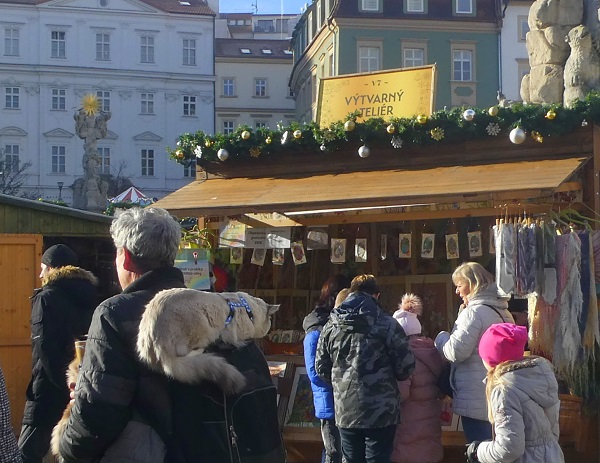
2: the people of Czechia's second biggest city love their animals. Dogs everywhere, but in the Zelný trh (which translates inelegantly as 'Vegetable Market', literally 'green', now given over to Xmas stalls) I also saw a gentleman with two cats - a Persian on his back, another in a basket. He eventually set them down to have a stroll around - the crowds parted and looked on in amusement.

This, by the way, was at the start of a very lovely Sunday spent with friend and Opera in Depth Zoom class student Barbara, who came up on the train from Bratislava. I've added one here above she took of my trying to talk to the unbiddable Persian. Another friend, Juliet, will be amused, because this cat was the spit of one looked after in Jerusalem when she and her partner Rory were there, name of Zorah, always addressed with 'so naughty!'

3:  back to the wooden-figure crib in front of the New Town Hall. Walk behind and you'll be rewarded with these splendid goats (?) and storks.


4: more hustle and bustle in
Zelný trh, and this time from cats to dogs, which the citizens walk around the centre in large numbers. Note the eyeing up of the wee black creature by the canine on the right.


5: third shot of the wooden Nativity - elephant's eye view, looking across to church of St. Michael.

6: barrel organ player in Zelný trh. I remember being struck by the quaint sounds around the streets on my previous visit - a very characterful fellow used to turn the wheel outside the Jesuit Church.

7: returning to Zelný trh after a walk with Barbara to the Augustinian abbey where Janáček received his schooling - covered in a previous post here -  and Mendel made his discoveries (and excellent duck and cabbage pancakes at Skanseen).

8: the rainbow light shimmer in front of the National (Janáček) Theatre, stunningly renovated, has been temporarily replaced by snowflakes. Walking back after Heřman's sunning production of 'From the House of the Dead/Glagolitic Mass', which I urge you to watch for free on OperaVision.


I can take another diversion from the advent 12 just to show you one stand of the exhibition in the foyer relating to both works, taking in some of the audience looks at the same time.


9:  the beautifully-proportioned Mahen Theatre = 140 years old, recently refurbished and still playing host to smaller-scale National Theatre productions - is where all Janáček's late operas were first performed. Nicky Spence's performance with Julius Drake of The Diary of One Who Disappeared was a highlight of this year's Janáček Festival.

10: expert choral sounds emerged from a small 1931 shopping precinct as I walked towards the National Theatre for a performance of Nabucco. These young people were rehearsing with their choir master - superb. Music is everywhere in Brno.

11: street cleaners taking a break in Náměstí Svobody, Freedom Place, known affectionately as Svoboďák. The Christmas tree here springs from a tradition established by the writer Rudolf Těsnohlídek, of Cunning Little Vixen fame, and a rather extraordinary story of a baby girl he found in the woods which led to the founding of a strikingy designed children's home. Full details here: https://lnkd.in/ecadynam 


I found another edition of Těsnohlídek's novelized Vixen, complete with Stanislav Lolek's charming illustrations in the original newspaper serialisation, in Brno's No. 1 bookshop, Janáček ordered up his music here.


12:  this very short tram which travels the centre is so beautifully lit up for Xmas - I'm afraid I didn't snap it twinkling in the dark, but you get the gist. Images 13-25 will first return us to London, then move on to more shining lights in Dubin. 

Previous posts on Janáček in Brno here, the city's churches here and its amazing functional 1920s and 30s architecture here. My last article on the big city festival is here on theartsdesk. Post on the latest operatic experiences due there soon.

Wednesday, 23 November 2022

On the beach at night alone*

Context is all-important, and I'd like to be honest on here: last Thursday morning I had a second biopsy under general anaesthetic at Charing Cross Hospital. There's a tumour in my bowel and my vivacious surgeon Maria needs to ascertain the type of cancer before proceeding with further treatment (probably a limited form of chemo- and/or radiotherapy to avoid a big operation). Fortunately it's not spread, so I'm at a fairly early stage, and all should be well.

As with the previous procedure, I had an afternoon nap and then went out to see a life-affirming performance: two Thursdays before this it was Gilbert and Sullivan's The Yeomen of the Guard at beleaguered English National Opera (sign the petition, please) - not the finest of productions, but with some excellent performances, and anyway I have such a soft spot for the work, even if it's not as funny as the vintage topsy-turveydom. Last Thursday it was what turned out to be a very deep and moving Vaughan Williams evening at the Royal Festival Hall, culminating in his first great masterpiece, A Sea Symphony. 


I've waxed lyrical about the profundity of the experience in my Arts Desk review, but I wanted to say a few more words here in praise of Walt Whitman, whom I scoffed at too much in my youth. The sentiments seem all the more remarkable given the times, but even the long, long lines seem to me to work now. And I appreciate all the more how Vaughan Williams set them, or parts of them, in his first great spiritual achievement. "On the beach at night alone" forms A Sea Symphony's second movement, its dual achievements the beauty and mysticism of the themes and the way the baritone is stilled towards the end so that the orchestra carries the essence alone. 

My image up top is of midnight on a solitary walk around Bergman's beloved island of Fårö - by then, the stars were not up, but it still suits my mood. Whitman's poem, 'Similitude', is worth quoting in its entirety.

On the beach at night alone,
As the old mother sways her to and fro singing her savage and husky song,
As I watch the bright stars shining, I think a thought of the clef of the universes and of the future. 

A vast similitude interlocks all,
All spheres, grown, ungrown, small, large, suns, moons, planets, comets, asteroids,
All distances of place however wide,
All distances of time - all inanimate forms,
All Souls - all living bodies though they be ever so different, or in different worlds,
All gaseous, watery, vegetable, mineral processes - the fishes, the brutes,
All nations, colours, barbarisms, civilizations, languages;,
All identities that have existed or may exist on this globe, or any globe,
All lives and deaths - all of the past, present, future;
This vast similitude spans them, and always has spanned, and shall forever span them and compactly hold them.

Time and again in A Sea Symphony, VW supports the 'all is one' philosophy with themes and colourings of surpassing beauty, reminding us how he was at best a 'Christian agnostic'. In the first movement, there's 'one flag above all the rest, a spiritual woven signal for all nations, emblem of man elate above death...A pennant universal'. And in the finale, it's the soul's sealike journey, 'fearless for unknown shores on waves of ecstasy to sail'. 

You can see why it chimed with my present thoughts on mortality and the universal. For the same reason, I'm inclined ever more to look at the beauty of the infinite - no shame in getting all purple-prosy about this - and after a splendid lunch yesterday with my new best friend Melinda at Daquise, I went back to the Natural History Museum. The late afternoon winter light made the building itself look more glorious than ever (which it is),

I'd seen a pic of the model Tyrannosaurus rex wrapped up in an 'ironic' Christmas jumper, but he was doing without on Thursday afternoon. Still, this was a good excuse to be struck afresh by how much has been dug up of dinosaur remains hundreds of millions of years old. The full frames, whether assembled from real bones or casts, are so impressive

but just look at the armour plating of this Scolosaurus, uncovered from the surrounding sandstone.

What I came for again, though, was the Mineral Gallery at the east end of the ever-amazing building, on the first floor. As it's in effect a dead end, not on the way to anywhere, unless you seek it out you may miss it, as I had done for years. Then I read Richard Fortey's Dry Store Room No. 1: The Secret Life of the Natural History Museum, and he opened my eyes as surely as Simon Winder's Germania did to the fabulously beautiful Vogelsaal of Bamberg's NHM. 

As Fortey points out, this room is rare in still housing the bulk of the collections originally intended to be housed there, and the display

has been preserved in something like its original state. The Victorian Society is delighted. It is an airy space, well lit from the generous windows, and with glass-topped cabinets running in ranks transversely across the gallery, each of which includes a fine selection of specimens. The arrangement of minerals in the cases is by natural 'families' of minerals - so the sulphides will be found together, as will the native elements like gold and copper, or the oxides, and so on.


It is a teaching collection in a way that no longer exists elsewhere in the building. An eager visitor might spend weeks in here learning, and would emerge at the other end as something of a mineralogist.

I've decided to try and do so with a combination of regular visits, and the museum's own handbook, which arrived today.

That should help me to be a bit more systematic. But I see nothing invalid in the aesthetic approach I took yesterday - simply looking more at the most beautiful things, like the opals.

And the NHM's gorgeous rooms help if you just want confirmation that nothing in art is more wonderful than nature itself. Take, too, this brain coral, which I saw en route from dinosaurs to minerals.

*Whitman's line does without the comma between 'night' and 'alone' which features in the way the poem is punctuated in the score of A Sea Symphony.

Saturday, 19 November 2022

Ireland: a lively history and a rich novel


Picked up a copy of Frank Delaney's Ireland in Hodges Figgis when I was last in Dublin, seeking to know more of my new found land in prose that was rather more eloquent than I'd found in the history books on the shelves in Fitzwilliam Street. It seemed unlikely that Delaney would make the novel wrapped around the numerous 'storytellings' work as well, but a brief flick through suggested the semi-mythic embroideries of the facts would be reward enough.

I was wrong: the journey of two souls, the Storyteller's and young Ronan O'Mara's, is no less compelling than the takes on everything from the stone-age miracle of unpromisingly-named Newgrange, via vivid lives of saints and warriors, to the Easter Rising of 1916. Delaney rings the changes on the chief narrator's word-magic by having Ronan himself try his hand in the schoolroom, and then by introducing the donnish playfulness of his tutor at Trinity College, T. Bartlett Ryle, whose didactic quality is actually useful - or at least I found it so - in reinforcing the injustice of centuries of English rule, where (thus Ryle) 

the state, that is to say the ruling body, that is to say the monarchy - and later the elected Mother of Parliaments - felt and exercised the right to interfere in people's lives in a minute, everyday way. To put it differently, it paved the way for oppression on a personal scale, because it struck at the personality of a people. And that is the hallmark of true prejudice, of true despotism.

The don returns at a later stage to reinforce what the Storyteller has had to say about Daniel O'Connell with his personal take on Charles Parnell, reinforcing the important notion that the first took as his cause the abolition of the Penal Reform laws, the second Land Reform, both acknowledging 

this pattern of failure on both sides. The English hadn't succeeded in their different eradication attempts, which ranged from assimilation to would-be genocide, because somehow the Irish clung on to who they were. And the Irish failed to throw them out because the country was simply too small to get anywhere by force of arms.


This is all very useful for a novice in Irish history like myself. But the imagination is what counts in terms of both the novel and the retelling, in many cases the mythologising, of the Irish past.
Clearly both Delaney and our Storyteller have some very fanciful chronicles of the saints to help them make the legends of Patrick and the Devil, Brendan and the New World, flavoursome. But the language is pure poetic prose, especially in the marine flavouring of Brendan's home in the west and his long odyssey. 


And the wanderer's observation of exquisite detail in nature chimes with where I am now. On, then, to the third volume of Jaan Kross's Between Three Plagues trilogy, A Book of Falsehoods. It's been a long wait for Merike Lepasaar Beecher's translation - Volume Two appeared in 2017, when I first wrote about my excited discovery of the Estonian genius - but last week the treasured tome arrived in the post from my dear friend Katharina Bielenberg of MacLehose Press. More anon.

Wednesday, 28 September 2022

Kosky's Meistersinger: falling at a late hurdle

Wednesday afternoon sees the 10th and final class in my Zoom course on Wagner's Die Meistersinger von Nürnberg, and the end should crown the work, as well as our grand finale: our special guest is Ben Heppner, who for me sings the most beautiful Prize Song of any I've heard (on the Sawallisch EMI recording: glorious sound, though my overall favourite on CD is Kubelik's. The below film is clearly from a gala, but it will certainly do). 

We've also spent a wonderful hour with Mark Wigglesworth, who conducted one of the Royal Opera revivals of Graham Vick's splendid production, and while Jane Eaglen (whom I saw as Eva at ENO, one of her first major roles for the company) had to pull out of a chat because of a crucial meeting about fundraising - she'll visit some other time - John Tomlinson will give of his time when he comes back from holiday, a very welcome postscript.

I previously covered Meistersinger when the course ran at the Frontline Club and Richard Jones's WNO production - still the best I've ever seen - was pending; he also came to talk to us. But every time it just gets richer. I don't look at previous course notes; it's important to start from scratch. This time we've been more preoccupied with the question of Wagner and antisemitism because, although I don't think it figures in this work (the comic villain Beckmesser is seen as a target, but that's been ignored by most UK directors, Jones included), Barrie Kosky, as the first Jewish director of the opera at Bayreuth, felt he had to tackle it. And I felt we had to follow some of the scenes in the DVD of his production (it's also on YouTube, by the way, but only with German subtitles). 

Felt the Wahnfried tableau restricted the scope of the Prelude, and it sets massive problems to solve: Sachs, Walther AND David among multiple Wagners; Cosima as Eva; Pogner as Liszt; Beckmesser as Hermann Levi. To his credit, Kosky makes the scenes between Beckmesser and Sachs laugh-out-loud funny. The ever- brilliant Johannes Martin Kränzle is at his most outrageous in this production. He's not at any point a Jewish stereotype, but Kosky makes the laughter freeze when the crowd turns him in to one. Personally, I'm happier with a view which treats Beckmesser as a Malvolio within a Shakespearean comedy. But I do understand why, in Bayreuth of all places, the peripheral questions need addressing. 

The point where I lose faith is when Eva enters Sachs's study - here the room in which the Nuremberg Trials were held - in Act Three. We lost the sentiment in favour of swift humour in the comparable Act 2 scene, but although I adore Anne Schwanewilms, the silly mock-girlish skipping she's asked to do defuse all the emotion in the situation. And if Michael Volle's Sachs and Klaus Florian Vogt's Walther are both aspects of Wagner, where's the crucial love triangle? I turned back to Lehnhoff's stripped-back production for Zurich Opera, and having doubted the scene's power, the tears flowed again. It was with good reason that Strauss and Hofmannsthal saw in this a blueprint for the Marschallin-Octavian-Sophie triangle in Der Rosenkavalier.

Excellent cast. Real-life couple Peter Seiffert and Petra-Maria Schnitzer keep it real, too. Some find José Van Dam's Sachs too dour, but I like the introspection, the pain is real, and he's very much an attractive older man.

Every class has brought big emotions. As Mark pointed out, every transition is a thing of wonder, and strictly speaking you could say it's ALL transition. I'm especially happy with the two hours we spent on the Act Three Prelude and the Wahnmonolog, with the help of Brian Magee's eloquent words on the Schopenhauer connection in Wagner and Philosophy to help us out. There's also another of the few really good books on Wagner which I re-read with pleasure, because all the elementary points in it are put so well - this brief but pithy journey through the opera by Catholic priest, professor and author of numerous books on literature and music M. Owen Lee. 

The art, ultimately is what matters, and among the many miracles of this great masterpiece is how it bears out all its claims with musical chapter and verse - everything is perfectly executed. Can it really be, as Mark wrote he was inclined to believe, in our initial email exchange, 'western civilization's greatest achievement'? While engaged on it, I'm inclined to believe so, Bach Passions and Mozart operas notwithstanding.

Verdi's Aida, of course, is a different case - the kind of plot all too familiar from early 19th century Italian opera, but ah, the music, the orchestration, the great string of duets! The writing is as masterly as that of its late successors Otello and Falstaff. I've had trouble persuading some students we should spend five Mondays on it, still more that G&S's The Yeomen of the Guard deserves two (I'm splitting the second half of term between that and Britten's The Rape of Lucretia. 

We start tomorrow (Monday 3 October), probably hitting 'Celeste Aida' before we get to 'Morgenlich leuchtend' on Wednesday. Full details here - click to enlarge.

Thursday's non-operatic course this term is devoted to the symphonies of Elgar, Vaughan Williams (the bulk of the classes) and Walton. I thought after the Russians, Czechs, Hungarians and Finns it was time for British - I hesitate to say Engish - music to have a look in. I wanted some words of commendation different to Sue Bullock's for the opera course - and Mark wrote what I'm sure he thinks, so proud of that. Again, click to enlarge.

Onwards! I hope a few more will be tempted to join up; good numbers for the opera course, fewer for the symphonies, but that's always been the case.