Saturday, 9 May 2020

Azure skies and inhuman horrors: Titian's Poesie


Beneath the ground-lapis blue, a man catches a goddess at her toilet and will be transformed into a stag, to be ripped apart by his own hounds, while women are penetrated by a shower of gold (some think that's lovely, I'd still call it rape), chained to a rock to be devoured by a sea-monster until a hero arrives, carried off in a 'rape' by Jupiter/Zeus in bull form.  There's still such sensuousnss and beauty in some of Titian's richest canvases for Philip II, who clearly wanted quite a lot of female flesh. The series is a counterpart to the earlier canvases Titian painted for Alfonso d'Este's Camerino. Back in 2003, we doubted if the National Gallery could ever excel itself in its reuniting of the three canvases Bacchus and Ariadne - of course one of the glories of the NG's collection - The Andrians and The Worship of Venus from the Prado; plus Giovanni Bellini's The Feast of the Gods with additions by Titian, courtesy of Washington's National Gallery of Art). But it just has, in another once-in-a-lifetime (or once-ever). All six paintings which may never have graced a single palace room of Philip's are in one splendid gallery, with the earlier masterpiece plus others visible beyond.


Actually there are seven, and I'm a bit confused as to which is the odd one out: the late Death of Actaeon with its very free brushwork, another National Gallery fixture, or Danae from Apsley House? There's also a lot of confusion around whether this is the most 'real' of the many versions, but I'll take it from my great pal Claudia Pritchard, writing in The New European with splendid reproductions gracing her article, that it is, since she's read the catalogue and I haven't. Certainly looks much better for the clean, though apparently it's not the full canvas.


My own pics will have told you that I did get to see the miracle - in fact, on the last day before the National Gallery closed indefinitely, 18 March. I cycled into town and out; J took the tube.Most rooms were empty and we weren't expecting many folk in the exhibition, but there were. Not so many as to make it impossible to avoid the two-metre distancing which we were already taking on board then. I nearly forgot in the thrill (unanticipated, because I hadn't done my homewortk) of seeing the one I'd never encountered 'live' before, The Rape of Europa (1560-2), normally to be seen in the neo-Renaissance setting of the Isabella Stewart Gardner Museum in Boston.


The eye first hits on the best azure sky of the lot - valuable crushed lapis lazuli the pigment, of course - and then to the pink drape that Europe clutches as the bull spirits her away from the shore. I didn't know this when I visited, but the painting had a major restoration in Boston; our friend Jill, picture restorer at the NG, spent three blissful days at the Museum where she was able to see work in progress (for her own most remarkable recent work, see the post on the Mantegna-Bellini exhibition). The sea-life along the bottom part of the picture is wonderful when you get up close, too. It couldn't be more of a contras to the sombre hues of The Death of Actaeon.


I like it that the picture, given one of the two widest unbroken walls to itself, is complemented by the most damaged work of the seven, the earlier (1554-60) Perseus and Andromeda, always a welcome site in the sumptuously revamped long gallery of the Wallace Collection.


We did have an earlier chance to see the two great mythologies with obvious symmetries markig them out to be hung alongside each other, Diana and Actaeon and Diana and Callisto, before they were rotated between the National Galleries of Scotland and London, but there was fresh cause to wonder here.
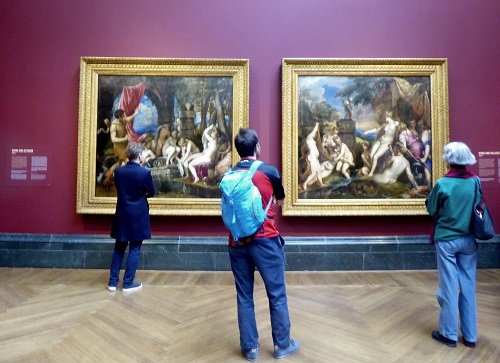

And finally, the original Venus and Adonis (on the right below and up top) is, of course, infinitely superior to the National Gallery copy, which can be seen next door.


We've seen the perspective down to the top Titians with Parmigianinos to the left; here's another great masterpiece, The Vedramin Family venerating a Relic of the True Cross (1540-5, possibly reworked in 1555), hanging on the wall the other side of the exhibition room next to the late Tribute Money.


We also wanted to pay homage to Holbein as J had read, and I had just embarked on, the final instalment of Hilary Mantel's Wolf Hall trilogy, The Mirror and the Light. In which Master Hans appears again to work on the quadruple full-length portrait mural for Whitehall Palace; destroyed, but here was half of it in cartoon form (Henrys VIII and VII), on loan from the National Portrait Gallery while it undergoes renovation.


Well, all galleries are shut now; who knows when they might reopen? But imagination and a good collection of art books at home are sustaing us now. As for Mantel's crowning glory, what a masterpiece, and praise be to this period for the time to take over savouring it. I'm glad The Arts Desk was patient with my slow reading of it; this is the result.

Outside the Gallery, central London felt all wrong. Some have rejoiced in the empty spaces, and Trafalgar Square as a landscape with few figures is certainly unusual,


but the West End is made to teem with life; never again will I curse those crowded narrow pavements of St Martin's Lane and Charing Cross Road. There were still a few tourists about - the Chinese were the first we saw to wear facemasks -


and 'pavement artists' had chalked in expectation of offerings - not great art, of course, yet topical - but were nowhere to be seen.


We quickly gave up; I had a coffee and a bun in Ole & Steen - handwash at the door and on the counters, all cakes carefully covered - and then cycled home. Haven't been into the centre of town since then, and not been on anything more than two wheels for seven weeks. Oddly, I don't mind for now. And the distancing must be maintained for a good while yet, though our disastrous government has once sent out weak signals which will up the death count again.

Wednesday, 6 May 2020

Zooming the symphony, from Haydn to Adams


A colleague once said he used his blog as a kind of shop window for his work. Although it's absolutely not my aim here - there are no barriers, I write about what I want to and see it more as a kind of public diary - this is one of those shop-window posts. Certainly not born out of need to try and hook more punters to a course which already has so many signed up - the response from my regular list of students was very surprising, since it's usually easier to 'sell' opera than orchestral music - but out of a genuine sense of excitement about where the 11 classes might take us.

Mastering Zoom is easy - even my senior students, up to the age of 95, can manage it - but there was quite a bit of stress before I settled in the second of my Opera in Depth classes the Monday before last. First, not being able to find the camera on my computer, which took five hours of collaborative searching here at home - even my techno-wizz spouse was foxed - before it appeared after a re-start. Then the awful quality of the sound clips, which could have been solved if my two tech-savviest students had joined the test class. They showed me what to do et voilà - state-of-the-art sound for all, best using headphones.


So two out of the three (out of five) OiD classes on Strauss's Elektra so far have gone like a dream - beyond my wildest expectations in one sense, since Susan Bullock - a top Elektra all round the world, and now singing the other most challenging role, Klytemnestra - was there for most of the second class and the whole of the third, bringing extraordinary insights to every scene (for the above photo, I return to Frontline Club days, when she and Anne Evans - on the left - came to talk Isolde). The students thought our double act went very well. She'll be back, and for Madama Butterfly in the second batch of five classes. I've also just heard that Ermonela Jaho, the heartbreaker of the Royal Opera production who should have been reprising the role this summer (pictured below by Bill Cooper), will also be joining us.


Having established the special guests there, I thought I could also call upon conductors I know and respect. So delighted to say that Mark Wigglesworth, who's just conducted a Beethoven cycle in Adelaide, chose to make his appearance in the 'Eroica' class. Again I return to Frontline days and a visit which was photographed by professional (and, briefly, student) Frances Marshall.


Three other stars are expected, but not confirmed yet, so I won't pre-empt. STOP PRESS: Ian Page, who's recording a Sturm und Drang series with his Mozartists orchestra, will be with us tomorrow. ADDITIONAL STOP PRESS: so is Jonathan Bloxham, inspirational founder of the Northern Chords Festival and its superb young professional orchestra who conducted our last three Europe Day Concerts (read all about the 2019 one here).

Below are the plans for all 11 classes, just so that I have them in something I can link to rather than just on an attachment. Message me if you'd like to join for all or some: it's a bargain (I halved the usual fees because I don't have room hire expenses and Zoom is, after all, not live with great equipment to hand, so it's £10 a class, ie £5 an hour. We meet on Thursdays as from tomorrow, 3.30-5.50pm. and if anyone misses a class or has connection/sound issues their end, I can send on a recording of the whole thing. Send me a message with your email and I won't publish it, but I'll be sure to get back to you.

This list has now been updated in the light of how we progressed, and who came to visit.

1: Sonata form and instrumental novelty   7 May
Selected movements/snippets from Haydn symphonies - 22,  31, 45, 70, 83 and 101; Mozart 41, 'Jupiter' (1788) Special guests: Jonathan Bloxham and Ian Page.

2: A new and noble scale  14 May
Beethoven's Third Symphony, 'Eroica' (1803-4). Special guests: Mark Wigglesworth and Jonathan Bloxham.


3: Follow that! Scaling up and down after Beethoven  21 May
Berlioz's Symphonie fantastique (1829-30) and Schumann's Second (1845-6). Special guest: Nicholas Collon.

4: Songs for Clara  28 May UPDATED
Schumann's Second (continued) and Brahms's First Symphony (1875-6). Special guest: Catherine Larsen-Maguire.

5: New/old approaches to the finale  4 June UPDATED
Brahms's Fourth (1885) andTchaikovsky's Sixth Symphony, 'Pathétique' (1893). Special guest: Vladimir Jurowski.

6: The world in a symphony   11 June
Mahler's Third Symphony (1895-6). Special guest: Paavo Järvi.

7: Imagining cataclysms   18 June
Mahler's Ninth Symphony (1909-10) and Elgar's Second (1911). Special guest: Vasily Petrenko.


8: Mosaic tiles from heaven   25 June
Sibelius's Fifth Symphony in its original (1914-15) and final (1919) versions. Special guests: Kristiina Poska and Andres Kaljuste.

9: The finale question: 1920s, 1940s  2 July
Nielsen's Fifth Symphony (1921-2); Martinů's Third Symphony (1944-5), Vaughan Williams's Sixth (1944-7) and Prokofiev's Sixth (1947). Special guest: Sir Mark Elder.

10: Endgame   9 July
Shostakovich's Fifteenth Symphony (1971). Special guests: Elizabeth Wilson and Peter Manning.

11 Symphonies in all but name   16 July
John Adams's Harmonielehre (1985) and Naive and Sentimental Music (1999). Special guest: Catherine Larsen-Maguire.

Wednesday, 29 April 2020

Raising a mug to Prokofiev on his birthday


Serendipity has been at work. Last Wednesday I had the loveliest email imaginable from a lady I'd never met or corresponded with before, Jennifer B Lee, Curator of the Performing Arts Collections in the Rare Book and Manuscripts Library of Columbia University. She'd got my email from a mutual friend, the pianist Barbara Nissman (pictured in the top right hand corner above). Trying to avoid humblebrag, in short Jenny wrote so many kind and positive things about my Prokofiev biog Vol. 1 that it was enough to fire me up to get on with the many-years-delayed Vol. 2 (really, I am). The point, though, is the connection with the Prokofiev Archive, and her delight that I had worked my way through the 40 boxes of papers in the Archive when it was based at Goldsmiths College in London.

The tale of how the Archive went to New York is, in my opinion, a sorry one, and I wanted nothing to do with it for years. That, it seems, is all in the past now, and now the Project Archivist for the Prokofiev Archive, Natalia Ermolaev(a), seems like a splendid person. Jenny told me that Natasha was co-ordinating a Zoom birthday greeting to Prokofiev to make up for the cancellation of a conference at which many of the participants would have been speaking.

They included members of the Prokofiev family - Frances, widow of the composer's much-missed younger son Oleg, now living in Norfolk with her partner Graham (that's them in the lead pic, top left), and three of the grandchildren - Beatrice, Cordelia and Gabriel, who of course has forged a big reputation as composer himself; he was sitting in a garden with wisteria behind and birdsong adding to the soundscape. Assorted babies and small children enhanced the picture. Serge Jr., son of Oleg's brother Sviatoslav (also much missed), sent apologies that he couldn't attend, and I had been so hoping to see one of my favourite Prokofiev people, Natasha Savkina, from Moscow, but she couldn't 'come' either. I won't list the scholars from all over the world - you can see them on the screen - and would just add that I asked a New Best Friend,  pianist Yulia Chaplina, to join from London. Natasha E invited us all to speak in turn, and at the end we raised whatever we had to hand (in my case an empty coffee mug) and I attempted to sing 'mnogaya lyeta' as we always used to intone it in the Kalina Choir (see below), but it needs harmonies underneath... That, as it happens, is Bortnyansky's version


But Prokofiev also provided another one for Eisenstein in the film music for Ivan the Terrible.


The most serendipitous aspect of this all - and here, though rationally I don't believe in such things, there's a small part of me willing to leave the door open to the unexplained - is that without the prompting I would have probably forgotten Prokofiev's official birthday (27 April is the other candidate, owing to clash of statement with birth certificate). And when I remember it, I call to mind more vividly that my beloved Noëlle Mann, the driving force behind the Prokofiev Archive, with whom I collaborated over quite a few precious years, died on the same day. So I was able to go back to my blog posts marking the sad time - which turned into an unexpected kind of visitors' book for tributes to her in the messages - and the wonderful memorial concert, and honour her by talking about her with the group (many of whom never met her). It turns out to have been exactly ten years since she died.


Above is the photo I used at the head of one of those pieces, of Noëlle and her splendid husband Chris (whom I was in touch with briefly last week) at the time of my last visit to her a few weeks before she died, when she was tired but full of plans for the larger future of SSP and encouragement as usual. I think I probably remark on the post about how I admired an old oak at the top of Greenwich Park on my way back, and how I saw another in leaf on the other side at the time of her funeral: not only did the connection with Prince Andrei and the oak in War and Peace seem curious, but Chris told me that the former tree was her favourite, and I couldn't have known that. Here she is celebrating a happier anniversary, 25 years of the Prokofiev Foundation, with Serge Jr. at the Barbican premiere of Prokofiev's original Romeo and Juliet score from the Mark Morris Dance Company.


So many friends and great names have been lost since it all began - as well as Noëlle, Sviatoslav and Oleg, also Christopher Palmer, Alexander Ivashkin (who was heartbroken over the removal of the Archive), Viktor Varunts, Ted and Joan Downes, Rupert Prokofiev and my Russian teacher Joan Pemberton Smith (best known as a translator of Russian opera librettos and songs. She also sang, as I did, in the Kalina Choir conducted by Noëlle, and left an amount to help me get on with Volume Two - I need above all to honour my pledge to her and Noëlle). I'm sure I've omitted a significant name or two, so forgive or prompt me if you're reading this. I also hadn't heard until Frances told me about the death from C-19 of Dmitri Smirnov, married to fellow composer Elena Firsova and father of a wonderful person who's since become a friend, Elena Firsova, another composer and a spellbinding pianist.


This is all three of them at a stupendous Festival Hall concert in which Michail Jurowski, father of Vladimir and another great Prokofiev champion, conducted Schnittke's vast First Symphony. It was my first experience of it live, and predictably it blew me away as Vladimir's performance of the Third had some years earlier; but Dmitri and Elena had been present at the 1974 premiere in Gorky (now Nizhni Novgorod), which caused such a scandal that it was banned in the Soviet Union. Not only were these two fascinating in their insights, but I warmed to them immediately and wish I could have spent more time in Dmitri's company. Hoping to see Alissa and catch her in action when all this is over. 

Saturday, 18 April 2020

To those who still buy CDs...


...you could support our stalled, languishing and penniless (though still ever creative) musicians at this time. Remember that all the from-home concerts they do are for the love of it, to feel that they're still performing and reaching out even if that 'magic triangle' of live music as defined by Britten - composer, performer(s), audience - has temporarily vanished.


This ties in well enough with some of the discs I've been listening to over the past weeks. Perhaps it shouldn't come as a surprise that Bach, being both of the essence and worth hearing over long sequences, has been top of the list, and the absolute highlight I wrote about yesterday on The Arts Desk - 90 glorious minutes of Jeremy Denk taking us through the workings of five Preludes and Fugures from The Well-Tempered Clavier. I didn't know about it when I worked my way through the five CDs of the two books just released on the Orchid label by a pianist I hadn't heard of before, George Lepauw.

These are very personal readings, full of rubato and the kind of tense-and-release which won't please those who like their Bach crisp and even. But somehow with this composer you always know when his interpreters are in a deeper zone. I've said it before, but much as I like Vikingur Ólafsson's intelligent programming on his Bach disc, I wouldn't have given it the kind of awards it garnered. At the time I went straight across to hear young Martin James Bartlett and grand maître (no need to call her maitresse) Idil Biret, and there was the thing-in-itself, the very essence, reached as in the best of transcendental meditations. Denk is there, too; I've written more than I should about his inspiring masterclass, so just go over to The Arts Desk, read if you like and if you don't, just click on the link. As I also wrote there, I suspect that were Denk to record all 48, that would probably push aside all the other Well-Tempered Claviers I have, just as his Goldberg Variations did - until Beatrice Rana came along. There are, in any case, infinite varieties of interpretation in this endlessly re-discoverable music; it just depends on which appeals most to your temperament. And Lepauw was also filmed in Weimar's Jakobskirche; I've yet to see the online documentary/performances.


Orchid, the CD label which took on this project, seems to hit the nail on the head every time. I have friendly email exchanges with its main man, the excellent violinist Matthew Trusler, and so I'm maybe partisan; but every CD that comes along strikes a chord, makes me sit up and listen even if I'm dipping in casually. When Matthew told me that fellow violinist Jack Liebeck's Brahms was exceptional, I listened - and I agree (I haven't plucked up the courage to listen to the companion Schoenberg Concerto yet; I need time and a score). Such perfect intonation, just the right degree of fantasy. And the oboe playing of Alison Teale in the slow movement - the players of the BBC Symphony Orchestra under Andrew Gourlay are all credited in the booklet - is superlative, and it all sounds so good (no surprise when it turns out the producer was Andrew Keener). The cover photo, by the way, and the ones of JL in the booklet, are by my good friend Kaupo Kikkas, inspired as usual, in this case to include Jack's adorable dog.


It was a coup for Orchid to 'get' Gabriela Montero, possibly because it agreed to her own Piano Concerto No. 1, 'Latin', appearing on the disc alongside Ravel's G major - and whilst the latter is impeccably detailed and alive, rich and full, the Montero work is also beguiling, immediately communicative. I like the programming of Yu Kosuge, too; she's halfway through her 'Four Elements' series with 'Fire', taking us from hearthside meditations by Tchaikovsky and Reger to the more dangerous flames of Liszt, Scriabin, Falla and Stravinsky; there were some real rarities on the 'Water' disc too.


Trusler buys into the quirky: Kottos is a quartet of accordion (Bjarke Mogensen, whose duet arrangement with Rasmus Schjærff Kjølle of Stravinsky's Petrushka on the same label is a firm favourite), recorder (Pernille Petersen), cello (Josefine Opsahl) and bouzouki (Christos Farmakis), in beguiling arrangements of Skalkottas, Lyadov (quirky choice, the Eight Russian Folksongs), Grieg, Bartók and Vaughan Williams, inter alia. It works!


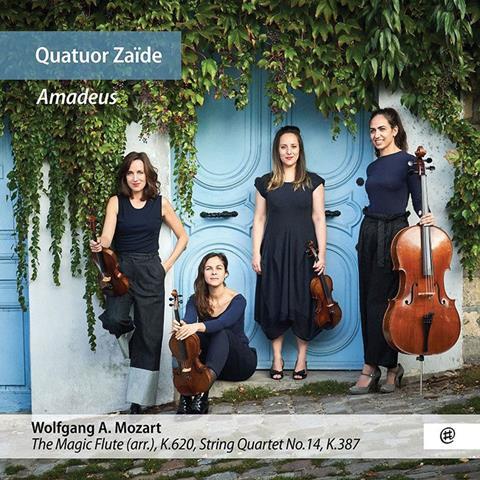
But enough spotlight on Orchid. Another CD of a transcription that works superbly was given to me at the end of Quatuor Zaïde's wonderful concert with Fiachra Garvey in the small but perfectly-formed first Vauxhall Festival. They featured a 1792 quartet arrangement of the Queen of the Night's second aria in their Mozart first half, and it turns out it's one of 19 movements selected from The Magic Flute, featured on a disc which also has the nuance-perfect interpretation of the bold G major Quartet, K387 I heard in the concert. If this clip doesn't sell the Flute idea to you, nothing will.


The Zaïdes make the G major masterpiece sound incredibly modern, but what they do is nearly all in the score. I look forward to their next CD, which will follow a similar format with a Beethoven quartet (one of the first, Op. 18 set, I think) followed by the stunningly effective string quintet arrangement of the 'Kreutzer' Sonata I heard played by Sheku Kanneh-Mason and friends at the Highgate Festival. Sheku, by the way, is still staying loyal to the groups he played with before he became really famous: he'll be trying out the Dvořák Cello Concerto for the first time in October with the Fantasia Orchestra conducted by Tom Fetherstonhaugh, with whom I heard him play the Haydn C major.


Sticking with quartets - of which I've played a lot in lockdown, trying to stick to quieter music out of consideration for my neighbours (though there's no placating the passive-aggressive lady downstairs, who goes to the council and the estate office before she speaks to me) - there's a mellow beauty from the Stamic Quartet, showing what a superb craftsman and original melodist was Karel Kovařovic in his three works for that format (he's usually only known as the conductor who initially failed to recognise Janáček's genius). Easy listening, in a sense, but none the worse for that. My thanks to an incredibly generous Czech friend, who deserves a medal for his services to Czech music as he sends me and The Arts Desk's Saturday classical CDs columnist all the latest (I've also been spellbound by a disc of Janáček piano works from Jan Bartoš, and Martinů's "Incantation" Concerto from Ivo Kahánek with the Bamberg Symphony Orchestra under peerless Jakub Hrůša ).

Symphonic music has been in abeyance, for neighbourly reasons given above, other than the discs I've been reviewing for the BBC Music Magazine and a chance to correct the unpleasant flavour left by Maxim Emelyanychev's over-speedy-to-breathlessness performances of Beethoven Five and Seven with the Scottish Chamber Orchestra (my last excursion, to Edinburgh in early March). The players clearly love ME, and their recording together of Schubert's Great C major Symphony helped me to understand why.


It's full of personality, but (unlike the Beethovens) never too wayward. So I'd better give the team another chance. Ticciati he is not, but he's clearly a force to be reckoned with - though in the hit-and-miss Currentzis league. To watch both in action is almost unbearable. Meanwhile, I hope the rather better all-rounders among young conductors I know will be able to pick up where they left off, along with all other musicians and performers in general. This is a very hard time for them and I suggest you donate if you can to a relevant set-up of your choice; my favoured targets so far have been the City Music Foundation and the National Youth Orchestra. Meanwhile I leave you with an earworm from a disc I've played two and a half times in recent weeks: from Shai Wosner's marvellously programmed 'Impromptu' CD, Gershwin's Impromptu in Two Keys. It's accompanied here by a neat little film which has a special poignancy now that stricken New York is in lockdown. Those streets were made for walking...


Tuesday, 14 April 2020

Virtual timetravel: the glory of Palma


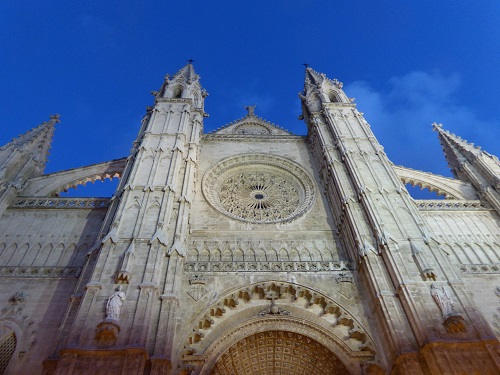
It was just before the last big religious/seasonal festival that I first encountered one of the wonders of the architectural world, and at a time when one could still go inside one (remember?) This is Palma Cathedral, according to legend-gilded history the offering of Jaume I, caught with his fleet in a gale off Mallorca in 1229 before victory over the Moors. Salvation resulted in a very grand project, known by its Catalan name of La Seu. Built on the site of the citadel's Great Mosque - little remains of the Moorish years in Palma's Old Town apart from two sets of Arab baths - it took 500 years to complete. Yet the Gothic essence of what we see, begun in 1300 by Jaume II seems very much of a piece, thanks also to an early 20th century restoration overseen between 1904 and 1914 by the great Catalan architect Antoni Gaudí, and its buttressed sandstone walls glow at sunset.


The above wasn't how I saw it until near the end of our 10-day idyll, returning from Deià in time to catch the honey-coloured vision. We approached it on our first early evening excursion into Palma's old town via the west-end Portal Major (Great Door), described in my Rough Guide as 'a neo-Gothic disaster', but its rose window (one of seven) and the bits of old statuary applied to it don't seem that bad to me. The necessary effect of grandeur is certainly still achieved.


Later in the week, on one of the few days when the weather threatened to be less than clement (and turned out to be nothing of the sort), we dedicated a full morning to the interior, essential even if you begrudge paying 8 euros (I certainly didn't). You enter via the Vermells Sacristy, one of the 21 side chapels, and that's a grand enough first impression of the nave with this Renaissance arch (detail online has not been of much help here).


The slender beauty of the 14 pillars, rising to 21 metres, came as a surprise.


The palm-like effect at the top is trumped by the perfection of the 15th century former exchange, the Sa Llotja, which I must attempt to do some justice in a future post, but there's no harm in putting in a photo for comparison now.


To take it all, you must do the usual thing in cathedrals and stand at the west end looking towards the high altar.


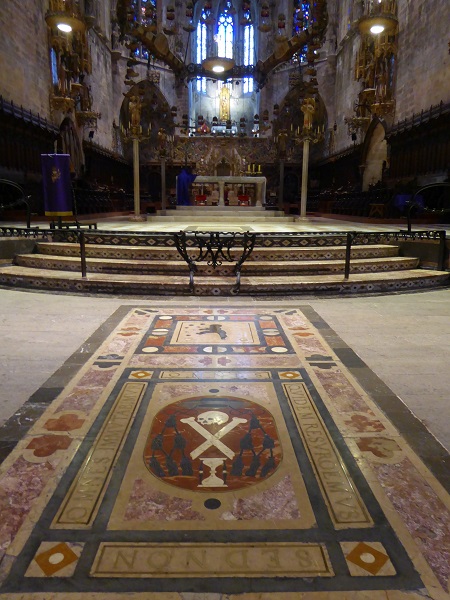
Before the steps into the chancel a fine pavement prepares the way (I also lack more detail here).


The baldachin is quite a pretty thing with its twinkling lights, a sparkly crown of thorns begun by Gaudí but not quite executed as he would have wished.


Gaudí also moved the stone pulpit of 1531, 'supported' by telamons (male caryatids) to the left of the entrance to the sanctuary.


Maybe it was a Christmastime seduction by all things gaudy, but the blend of new(ish) with old seemed succesful, a lightening of potential Gothic gloom. Oddest is the plasterand ceramic decoration by Miquel Barceló (b. 1957) of the Chapel of the Blessed Sacrament to the right of the high altar. The fishes go with the loaves as signs of Christ and of multiplying abundance.


The 16th century Chapel of Corpus Christi on the other side is more what you might expect from a grand east end, with a three-layered altarpiece.


The Last Supper at the bottom is remarkable, while above it are the Presentation in the Temple and the Temptation of St Anthony.


My inadequate guide is sniffy about the other chapels - 'dull affairs for the most part' - but most had something of interest. The Chapel of St Jerome has another fine altarpiece


with an especially fine statue of the saint and his lion at the centre


and I love these life-sized angels in the Chapel of Our Lady of the Crown.


The route out takes you into the Gothic chapter house, a gallery-room with works by the Mallorcan primitives, including here on the left the life of Catalan St Eulalia by the Master of the Privileges


and another fine doorway


leads into the Baroque chapter house, with more treasures; but the eye is drawn upwards.


The surroundings of the cathedral are especially attractive given the amount of money spent on the city in recent years. The park around the water basin is airy and spacious - this from a day when a storm was bowling in -


and of course the best views are from the other side, taking in the Almudaina Palace.


In the next post on this wonderful city, I need to do justice to the rest of the old town within the walls. There was infinitely more to see and explore than I could ever have imagined, and this is a lived-in place, full of character - though I guess we were lucky to see it with a dearth of tourists around.