Tuesday, 20 September 2016

Our anti-Polish deplorables


So my best barometer of what's happening to anyone who’s come to live, work and pay taxes here in the UK is my friend Magda, who also happens to be our hard-working and superbly well-organised cleaner.I ask her every Monday if she's had anything adverse happen to her or to anyone she knows.

The pressure is clearly mounting. At first she only recorded two official problems. Her niece, recently arrived from Poland, was turned down for working at Pret a Manger because they said they were uncertain about the situation post-Brexit. She actually got a job at Wetherspoons (ironically, since the owner was/is fiercely pro-Brexit. Yet the company has explicitly stated that it will carry on employing Eastern Europeans). To get her National Insurance number she went to the local Job Centre. The woman there was hostile and sarcastically incredulous – ‘you’ve only been here ten days yet you have somewhere to live and a job?’ – and didn’t put down on the form that she had a job but that she was applying for one.


Today's news was worse. The 8-year-old daughter of one of Magda’s friends has been traumatised by an incident on the 41 bus from Tottenham Hale to Archway. She was travelling to a Polish Saturday School with her parents, three friends of the same age and her three-year-old brother. She speaks English with her schoolfriends but her brother is too young to communicate other than in Polish. So they were speaking their own language as they went to get off the bus at Crouch End when a couple in their sixties said 'why are you still here? Go home! Fuck off back to Poland.' The rest of the people on the bus did/said nothing. Olivia wants to know ‘why do these people hate us?’ and is sufficiently upset not to want to go back to Saturday School.

Magda says that about 20 per cent of her friends have gone back to Poland, including a friend who ran a hairdresser's but has closed down business. They are afraid not so much for themselves but for the kind of hostility their children face at school.


I wanted to believe these incidents were isolated, but when they're directly reflected in the lives of the Poles I know, I fear it has to be commonplace. So I'm disgusted and feeling helpless. But I've reported the incident - three hours later the police arrived to take details, and the rest will be up to Magda's friend - and the more people do so, the more we stand a chance of stamping out the apparent licence to abuse which Brexit - with the help of the right-wing press, shame on them - has unequivocally encouraged. If people only do what they did before, think vile things but keep them to themselves and their circle, less people will be hurt or, worse, murdered. It's a minority, but it's enough to drive these admirable folk away.

An afterthought - I'd forgotten about this one: how about something from the Ukippers' misplaced idol Elgar? His Polonia of 1915, a perfectly fine occasional piece composed to support Polish refugees... And it will teach you the Polish national anthem into the bargain. Sad to report that beleaguered country as a good deal worse than us on its current record for taking in refugees. None of the leaderships of the so-called Visegrád Group within the EU is good, and Hungary's is marginally worse than Poland's, but that's not saying much.


Invitations to comment are usually met with a blank, but if you know of anyone - Polish or other - who's been affected like Magda's friend, do write about it below. It's important to have these things documented.

Monday, 19 September 2016

Coming soon: two mythic giants


Which is a way of advertising six classes of the new Opera in Depth season on Mozart's Don Giovanni and my forthcoming BBC Radio 3 Building a Library on Elgar's Falstaff (broadcast date 8 October). Let's get the basic info down for the first, since it starts on Monday 26 September. Runs for ten weeks, Mondays 2.30-4.30pm, at the wonderful Frontline Club in Paddington. We devote the first five weeks to Don G before moving on to Shostakovich's The Nose (covering two or three weeks) and Ligeti's Le Grand Macabre (one or two). Mark Wigglesworth is down to return on 14 November, having by then moved on to Berg's Lulu at ENO. If you're interested in joining, try this email: david.nice@theartsdesk.com

While it's hard to love the Don Juan of Tirso de Molina and the Don Giovanni of Mozart, who could not have more complex feelings about Shakespeare's greatest (semi)comic creation? Elgar understood his dualities and wrote the most perceptive 'analytical essay' for the Musical Times of September 1913. Novello helpfully reprinted it as a little booklet, which I treasure.


As this most magnificent of tone-poems illustrates, Elgar had no time for what he saw as the 'caricature' of The Merry Wives of Windsor but couldn't praise too highly the creation of Henry IV Parts One and Two, whose death is described so vividly by Mistress Quickly in Henry V. Thus part of Elgar's second paragraph, using Professor Dowden and Maurice Morgann to speak for him:

The real 'Sir John Falstaff is a conception hardly less wonderful than that of Hamlet.' This complexity has been summed up by Morgann as follows: 'He is a character made up by Shakespeare wholly of incongruities; - a man at once young and old, enterprizing [sic] and fat [not sure what the duality is there, mind you], a dupe and a wit, harmless and wicked, weak in principle and resolute by constitution, cowardly by appearance and brave in reality; a knave without malice, a lyar without deceit; and a knight, a gentleman and a soldier, without either dignity, decency, or honour.'

Dare I say the opposing qualities would have appealed to a typical Geminian like Elgar? They account for why in part Falstaff is also a self-portrait (cue this surprising photo which Graham Rickson sent me today).


Everything is in perfect balance - the humour and extroversion versus the introspection of the dreamer, darkness and light, programme music and pure symphonism. The climaxes of the Gadshill exploit, battle and aggressive coronation march sit well around and between the heartbreaking dream interludes - and if those don't have the right degree of inwardness, any recording is going to fail. That helped me to make distinctions and to jettison half-good performances at key points. But more I cannot say, of course, until the programme's aired.


Some years ago I was asked to give a talk comparing Falstaff with Strauss's Don Quixote. There are so many points of correspondence between the man Strauss hailed as 'the first English progressivist' and the Bavarian tragicomedian (another Gemini, of course). I had a wonderful time on Wednesday evening hearing the English Concert in two Quixote-related works; should have got to know Telemann's Le Burlesque de Quichotte long ago, but what a light-footed charmer it is, made all the richer by Danann McAleer's reading of what turned out to be the poetically archaic Victorian translation of Cervantes by John Ormsby. Maybe that's the version I should turn to next - for like War and Peace, Don Quixote should be revisited at least every 10 years.


It's in fact been nine years since I last covered Mozart's Don Giovanni in what was then my Opera in Focus class. Now we coincide with the first and last fling of what ought to be a perfect partnership, Mark Wigglesworth conducting and Richard Jones directing a new production at English National Opera (oh, what wouldn't we all have given for the original plan that the duo should share The Gondoliers, a work Carlos Kleiber in all seriousness would have conducted at ENO if they'd taken him at his word). I look forward to all the film references Richard revealed in a special-preview ENO talk with Christine Rice and myself, bearing in mind that he had given each of the cast members a special DVD. Clive Bayley, the Leporello, got The King of Comedy.


Which made me buy a copy and watch it for the first time. What a masterpiece of discomfiture and a prophecy of the insane pitch celebrity culture has already reached. Astonishing performances from De Niro as the man who won't let go, Jerry Lewis as the man without humour - and Sandra Bernhard as the fan from hell, getting her big break from Scorsese.


Hoping that Richard will come along again to the Opera in Depth course. Looks likely, but he's usually elusive until closer to the time, and of course totally preoccupied with Don G at the moment.

Friday, 16 September 2016

Preface to the Norfolk Churches chronicle


You'll have to wait a while to go into the woods - with the Wodewose of the North Walsham misericord pictured above -  of my annual Norfolk churches walk write-up. It always takes me some time to get the pictures and the text ready so that we can further request donations for the Norfolk Churches Trust. Suffice to say we did it, though in a rather unorthodox time-scheme which I'll mention in the chronicle. Anyway, 12 churches and 12 miles is good enough, if slightly less than usual, so if you want to give to an historically vital cause, here's the link - third time lucky, and higher up the blog entry this time - to J's JustGiving page.

I thought I'd use the opportunity to sweep up some long-withheld impressions of major churches in Devizes, Salzburg and Tallinn from earlier in the year. The first visit was on a chill, intermittently wet Easter Sunday weekend based in Lacock after warmer-weather walking. Devizes has a rather run-down feel to it, not really on the way to anywhere, though it was prosperous once. We did enjoy our lunch at a rather unusual greasy spoon, though; that's stuck in the memory.


As has major Norman masterwork St John, set in an extensive churchyard with some fine buildings around the fringe. It is, as Pevsner puts it, 'dominated by a mighty crossing tower with round stair-turret higher than the tower'.


The east end immediately catches the eye on walking in to the centre of the interior. The crossing and chancel are both unusually rich expressions of Norman style


with the east bay of the chancel interesting Pevsner with its 'wild blank arcading of intersected arches with zigzag'.


This is all the doing of Bishop Roger of Sarum, who also rebuilt the castle constructed by his predecessor as Devizes' initial raison d'etre. There are three green men among the grimacing capitals; as they're not vastly different, one will do.


To the south is the Beauchamp Chapel, immediately recognisable without and within as a cousin of the splendid Beauchamp and Tocotes Chapel at Bromham, so of the same date (1490s).


Especially interesting is how the Norman corbel table of the chancel appears as part of the chapel.


The North or Lamb Chapel is Perpendicular, but here too Normanness in the shape of massy columns appears on one side (these columns actually appear to the south of the crossing, but they're the same in design).


The 14th century nave is plain by comparison, much restored by the Victorians, and there are few other of the individual treasures which make less grand churches so memorable. Pevsner, oddly, doesn't mention these brasses (they can't be of 1788, surely?)


But there's enough in the east and in the churchyard to make this a major building. The other main church in Devizes, St Mary's, also boasts a Norman chancel but was firmly locked (we had difficulty enough getting summoning one of St John's wardens, but he came eventually).

I think of Salzburg as a city of Baroque and rococo, epitomised by the large complex of the Peterskirche


which includes what's advertised as 'the oldest eatery in Europe' - I had a good lunch there with ever-entertaining polymath Nicholas Berwin, who had also come to be impressed by The Exterminating Angel and disappointed by Die Liebe der Danae - and a churchyard beneath the castle rock. So it was a surprise to come across the Franziskanerkirche, a Gothic masterpiece remodelling a Romanesque original and then overlaid with 18th century work. The only way to get a good look at the building as a whole, since Italian-style it's hemmed in by attractive narrow streets with high buildings on every side, is to climb the Kapuzinerberg (the tower to the left is that of the Peterskirche, which shows their close proximity).


The glory here is the Gothic choir, remodelled between 1408 and 1450 and reminiscent of some of the treasures of Toulouse's Church of the Jacobins we saw at the start of the year.


The altar is Baroque, part of Johann Bernhard Fischer von Erlach's makeover. But at its centre is a Madonna of 1495-8 by that Tyrolean master Michael Pacher, whose St Wolfgang masterpiece we'd admired on our Hallstatt holiday some years back.


Dig the angels of Ottavio Mosto guarding the Franziskuskapelle, first on the right of the 'rosary' of chapels.


Probably the earliest treasure is the 12th century marble lion at the foot of the pulpit


with a man clearly struggling beneath him to plunge a sword in.


The Gothic tower was taken down a notch because it was impiously higher than that of the Cathedral. The Baroque version is nicely in tune with the rest, though,


and peers down on various alleys around the edifice.


Last but not least, the most charming interior I've seen in Tallinn, that of the medieval Lutheran Church of the Holy Spirit. Tourists all see the outside with the famous clock, which I never photographed because it always seemed to be in shadow. you'll have to make do with a shot of the octagonal tower with crow-stepped gables leading up to it, actually rebuilt after the second of two serious fires in 2002.


I was glad I paid the modest entrance fee and had the interior to myself. Its fittings date from various eras, but seem all of a piece.


The galleries with paintings by different artists and musicianly angels punctuating the scenes are 17th century


and I like the extra angel-capped posts lined up in display on the west wall.


Oddly, the choir is situated in what would normally be the Lady Chapel, and it isn't facing east since clearly the church had to be squeezed in to Tallinn's already labyrinthine medieval design. Its treasure is the altarpiece of 1483 by Bernt Notke with the Miracle of Pentecost as its centrepiece.


I have a fold-out card showing all the panels sitting in front of me as I write.

Here's a fine gryphon bench-end.


and it seems appropriate to end with a view up into the gallery where the organ's situated; the plant, I think, was part of the eco-greening theme of the Estonian Music Days festival I so enjoyed in the spring.


So, next stop Norfolk churches 167-179. If you're interested in doing some background work before this year's Norfolk selection, I'll put up again the list of previous chronicles:

Cromer to Southrepps 2015
Mileham to Bittering, 2014
Beechamwell to Gooderstone, 2013
Ingoldisthorpe to Thornham, 2012
East Rudham to Helhoughton, 2011
Wormegay to Castle Acre, 2010
Walpoles to Wiggenhalls, 2009
King's Lynn to Sandringham, 2008

Earlier walks back to 2002 BB (Before Blog).

Friday, 9 September 2016

Proms Last Night 'a celebration of Britishness'?


Certainly not that, or rather not just that. The ghastly Bill Cash just reveals his ignorance by saying so. First, the Last Night is a celebratory party for everything that's gone before, all 74 Proms in the Albert Hall. Which began with Russians (Tchaikovsky and Prokofiev) and an international British master (Elgar) between them and has seen the visits of three outstanding German orchestras in the past week (below, Thielemann and the Staatskapelle Dresden - the image, ahem, is by Thielemann's approved photographer, Oliver Killig; thanks as ever to the wonderful Chris Christodoulou for the rest). It also includes French and Italian music in the finale, sung by a Peruvian tenor and conducted by a Finn.


Indeed, Sakari Oramo (pictured up top) donned a Union Jack waistcoat for the second half of a previous Last Night, and has championed British music, G&S included. But he's as splendid an example of international versatility as anyone who's appeared at this year's Proms.

Crowdfunding supporters have raised enough money for 500 EU flags to be distributed tomorrow night. Of course the disgusting, immigrant-persecuting Daily Mail and Express howl that it's a Corbynist conspiracy - unlikely given his own disappointing if not entirely unpredictable take on the EU - and the Brexiteers wail foul play. But it's our turn now after years of attack from the lunatic fringe.


I won't be there - as on every occasion for the past 10 or more years, we'll be walking for the Norfolk Churches Trust. I'm privileged enough to be admitted to a final rehearsal of the Verdi Requiem before we catch the train tonight; had to hear something of the great Tamara Wilson. If I have to pick my favourite Proms of the ones I've managed to attend, the internationalism speaks for itself: London-based Russian Pavel Kolesnikov with the National Youth Orchestra of Scotland conducted by Israeli Ilan Volkov in Tchaikovsky's Second Piano Concerto (pictured above), a Finnish diva (Karita Mattila) and a Czech conductor (Jiří Bělohlávek) leading a stupendous performance of Janáček's The Makropulos Case


and the Berlin Philharmonic conducted by 'our own' Simon Rattle in Mahler's Seventh Symphony. Oh, and if you want more Britishness, there was Mark Wigglesworth conducting Welsh forces (and American Wilson superb alongside UK soloists, having made her first partial and compelling test of the role of Brünnhilde) in Tippett's A Child of Our Time. No doubt which kind of flag Sir Michael would be waving tomorrow night.

Thursday, 8 September 2016

Summer bees


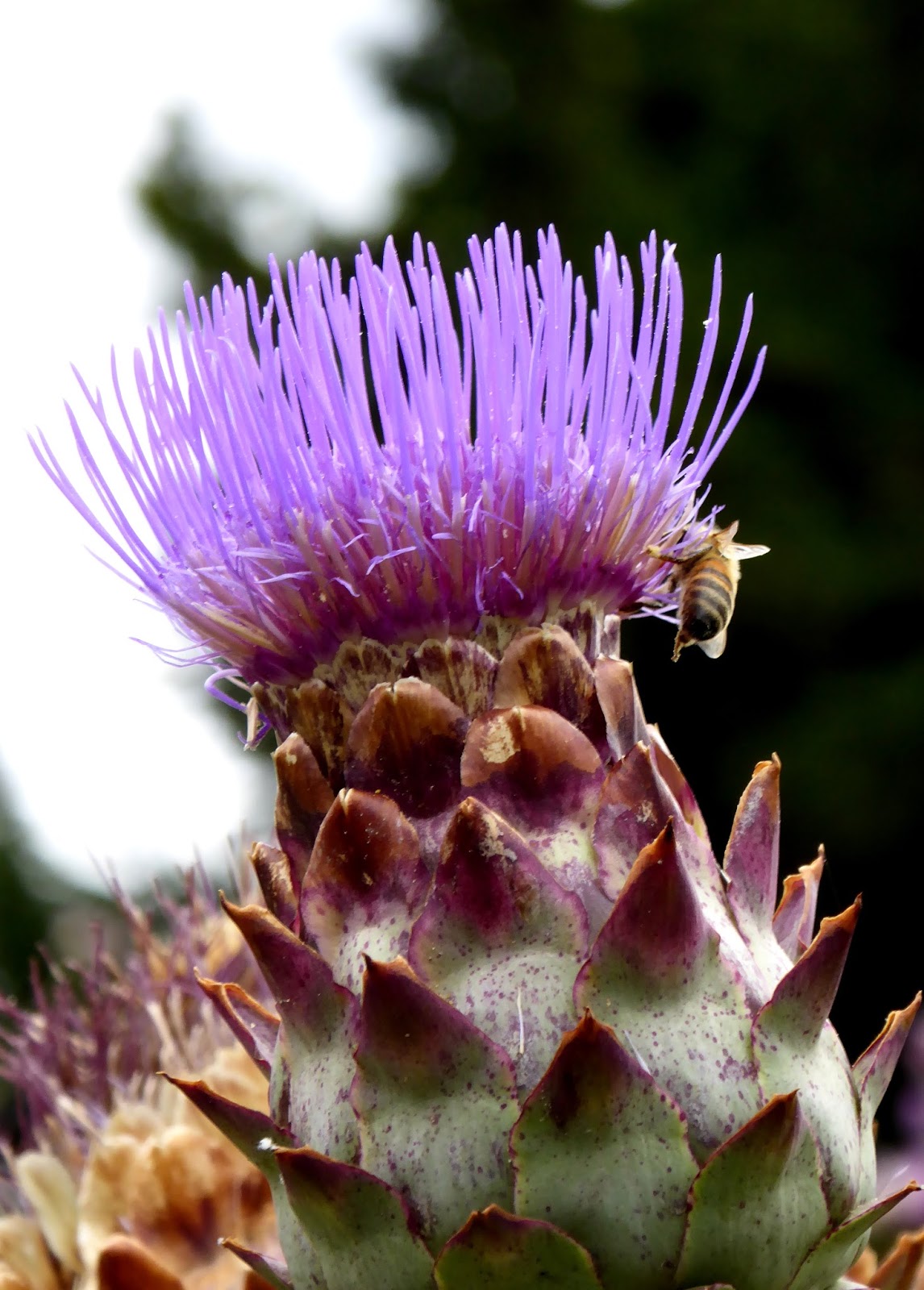
Kew Gardens had laid out a vast herbaceous border with 27,000 mostly bee-friendly plants, and there was plenty of apine activity among the agapanthus planted around the Palm House


while two strips of the order beds in the Chelsea Physic Garden - on the Dicotyledon side - were humming


and in our friends the Van der Beeks' garden in Lacock, Eryngia were among the preferred sources of nectar.


Perhaps this is the unexpected one, though the Mayfield lavender fields are on the tourist map now: a big tourist attraction opposite my childhood haunt of Oaks Park near home 'village' Banstead.


The big one this summer has been Kew, with its extraordinary new structure the Hive.17 metres tall, made out of 169.300 mostly aluminium components and first seen as part of the UK Pavilion at Milan Expo 2015, where the theme was Feeding the Planet, Energy for Life. Nottingham artist Wolfgang Buttress reacted accordingly and consulted a researcher at Nottingham Trent University who studies how bees communicate. It's now found its natural home surrounded by a meadow of 34 native wildflower species, 19 outsiders and three grasses, edged with a hedge of six other species.


The idea of accelerometers in a hive measuring the bees' activity from vibrations has been translated into 900 pulsing LED lights which react to behavioural vibrations. I imagine this would be more spectacular at night, but you can still spot the light-ups, rather bee-like in themselves


and there is sound, too. A drone bass relayed from a nearby hive of 40,000 bees (literally, what Buttress calls a 'deep visceral hum') activates musical phrases 'in C', which are triggered by the various vibrational messages. There are two levels. On the ground you can apply a lolly-stick to a panel to hear the vibrations more immediately. And you can see people above in the central panel; these kids knew it and were playing to the parterre.


I sat against the ?plexiglass? walls on the upper level for much longer than I'd intended, fascinated by the bonding experience which brought all ages together to respond to the magic.


A small Chinese boy really got it, lying on the floor contentedly for long periods looking up at the sky through the opening in the top of the Hive.


It was a good connection to be able to walk straight to the herbaceous border - gone now, I fear, , the fiery pokers of Kniphofia triangularia -


 and see the bees in action on scabious and the like.


Kew's other August stunner is the Waterlily House, where Victoria amazonica, grown from seed every spring, waxes most impressive


and all shapes, colours and sizes of nympheas put on a display.


Around the fringes loofahs (strictly soeaking, Luffas)


grow so big they have to be supported before they fall.


Next port of call, reading-wise, after my Pamuk binge is very definitely Dave Goulson's A Sting in the Tail, about the life and variety of bumblebees, warmly recommended to me by a beekeeping lady as I browsed in the Chelsea Physic Garden shop yesterday. It was a humid, grey Tuesday, nothing like the high days of summer when the bees were in full swing (though they;re still doing their stuff, albeit not so prolifically). Oh, the profusion of pollen and nectar then.


As at Kew, cardoons were a firm favourite


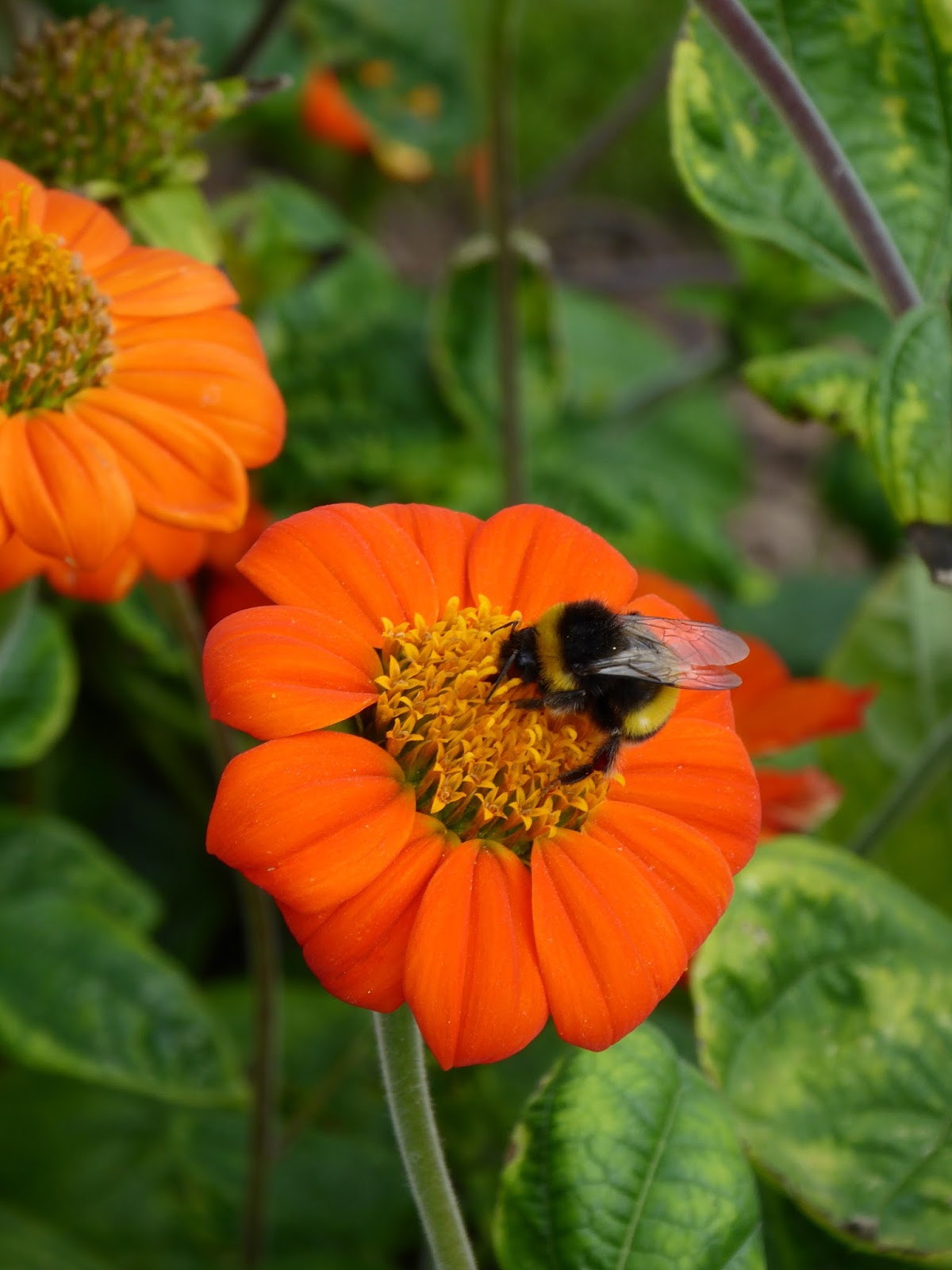
along with this extraordinary variety of dahlia, still going strong.


Two more, the second one another type of Eryngia, I think.


Pitcher plants, drosera and Venus fly traps in the little greenhouse by the Tangerine Dream Cafe were all in their creepy prime, too.


As for the wonders of Cantax House, Lacock, I start from the particular, as up top,


and move to the general. The garden is looking very inviting from the wall and pavement outside


though Deborah's fecund topiaried goddess was in need of a haircut, and was about to get one:


I realise I've over-extended myself here and have to postpone the wonders of Iford Manor, a performance of The Magic Flute in the cloister of which was the focus of our visit. But I can't ignore the miraculous orchid field Deborah led us to, a walk down into a beautiful valley from the village of  Biddestone. Why should all species gather in this one field, I wonder? So many names for so many similar-looking varieties - Deborah may be able to help here - but surely the Common Marsh Orchid (addendum: see DvdB's comment below) and the Common Spotted Orchid are among the range:


No mistaking this one, though, the Bee Orchid. I gnash my teeth because Deborah had promised an abundance, but they were at the end of their season. I'd all but given up when she headed south and found this representative - and I wasn't with her, but I'm grateful for the image.


Last but not least, an ordered profusion of purple at the Mayfield lavender fields. I've been here before, but they seem to have extended their territory, just as well because in mid-August the lower slopes were losing their strength. But up over the hill, there was a profusion


which also meant an abundance of bees.


It was good for me to stand in the upper lanes with apines buzzing past me and occasionally hitting me: I had to remember, you're not near a hive, it's unlikely you'll get stung. And I conquered my fear, which in any case is of wasps rather than bees, very quickly.


Couldn't begrudge the international tourists either as they were all having such a good time. Chinese especially seemed to have found their way to Woodmansterne in small groups; many were waiting by the nearest bus stop as we left. I was photographed with two Philippino women and I loved seeing the pleasure kids got out of running up and down the lanes


as well as being photographed by the phone box, another new feature to please the visitors.


A final reminder, in case I don't get round to posting more before the event, that we'll be out in nature on Saturday*, making our annual pilgrimage to 13 or so places of worship covering about 17 miles on the Norfolk Churches Walk. Raising money, as before, for the Norfolk Churches Trust: all donations welcome.

*Or Sunday - Saturday is the one day surrounded by a sea of sunshine for which torrential all-day rain is forecast. So Jill, our leader, suggests we tour the churches by car getting signatures on Saturday and do the walk on Sunday. INNOVATION: you can give via one of 'my dear walking companions' (what he said) here.