Saturday, 14 July 2018

Carnival of resistance


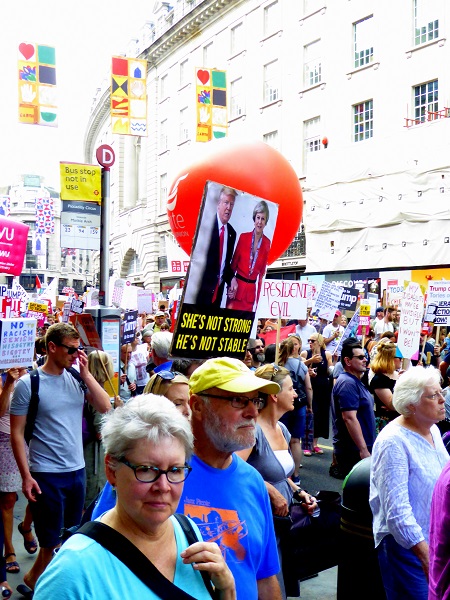
'I hate Trump even more than I hate crowds,' as one of hundreds of ingenious placards and banners read, so there I was among peaceful thousands for the fourth time in a month, following the People's Vote March and the Latvian song and dance celebrations. Never, surely, has there been a funnier or, weirdly, more joyous demo. It was indeed, as many banners declared, a 'carnival of resistance,' and I laughed and smiled my way from Langham Place to Trafalgar Square. This was a reminder, too, of all the vital causes the Horror Clown has been besieging, resulting in a rainbow coalition of protesters.

Worried that I might be a bit late - 2pm was the start, and I had to tidy up Glinka notes for the Proms, just past the mid-day deadline, before cycling off. I came at it all from Wigmore Street, and first joined what I was told was the back of the procession in Chandos Street, complete with Handmaids (later I saw a witty banner, 'The Handmaid's Tale is not an instruction manual').


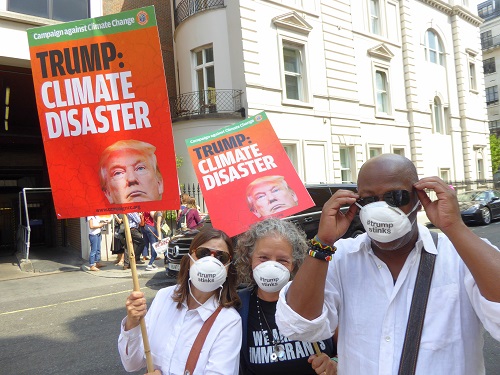
The first three people I encountered were all sporting - albeit not wearing, in high temperatures - the 'Trump stinks' face masks I'd seen the sublime Janey Godley and friends display online, so I asked them to don the masks for a photo-op, in which they were happy to oblige.

Here, too, were an American father with his infant


and a group with the first of many dogs I saw.


This one is cutely adorned with 'Dump Trump,' and didn't seem to mind too much.


But behind us another procession was moving towards Langham Place, so we quickly joined that and found it to consist mostly of pro-Palestinian Muslims, including headscarved women


and this genial gentleman.


Behind them came orange people, in solidarity with Guantanamo inmates.


Let's feature some of the ingenious slogans and pics now. One of my favourites came from this lady


who had an equally ingenious inscription on the reverse.


This one was more earnest.


and later on, the reverse of a 'F*** Trump' spread had serious messages, too.


Demi-dragged Donald


soon joined forces with Trumpelstiltskin and 'Muggy May' (not sure I got that one)


though it was only at the end that I spied a couple of the drag-queen group sashaying away.


Americans warned to stay away by their loathsome administration were not taking any notice


and this one represented overseas voters who need to help make a difference in the mid-terms.


Humbler hand-made efforts still got their point across amusingly.


I assume this one is on the right side of humorous.


Found myself hailed by a familiar voice - that of good friend Christine, closely followed by husband Duncan, who was promming later in the day (he's a season ticket holder).


We were touched by an Indonesian gentleman who wanted to photograph my 'No man is an island, no country by itself' t-shirt, earnestly saying that we are all human beings who must join together.

The priestly community was out in force. Not sure what the lying threesome was proclaiming - couldn't read the message,


Of this genial group, the best banner - 'My boss told me to come' - isn't quite visible.


It took much longer than I expected to reach Oxford Circus, after which things moved more rapidly down Lower Regent Street. Here I caught the ingenuity of the best 'models'.


I had a nice chat with the ever-beaming lady on the left about the humour factor of it all. More mixed responses from the huge numbers of police when I remarked to the effect that it didn't look like trouble, did it? A smiling black policewoman said 'absolutely not';  a grimmer plod replied 'not yet'. Not at all, as it turned out.


Anti-fracking sideshow:


The chap just visible on the left below had a job to do, and he was getting on with it, though smiling all the while. Note ' Christian? Like Martin Luther King?'


More good signs. 'Nightmare on Any Street' was Amnesty's contribution.


EU flags still part of the picture (I now have a sticker with not only 'Bollocks to Brexit' but also 'Bollocks to Trump').


And so I took a slight detour at Piccadilly Circus, to rejoin the march at the Theatre Royal Haymarket, where the handmaids were in full spate


And on to Trafalgar Square, where I filled in a pro-EU postcard to my MP (not that Andy Slaughter needs any prompting) and the good banners kept on coming.


Poor Madge. But did she have to smile? And did Mrs Mayhem have to take the Horror Clown's hand again? Well, their charade was going on while we were part of the Real Thing. Here's a glimpse of the alternative - the Blump flew in the morning, though not very high - courtesy of Ileana Antinori, a LinkedIn connection.


Monday, 9 July 2018

Latvian song and dance 2: the grand finale


Another quick post from the eye of the peaceful storm (now, on an official public holiday, the calm aftermath). The gathering of the 16,500 choral singers last night, to an audience of 70,000 in the grand pine-tree-surrounded stadium of Riga's forest park, was quite a sequel to the dizzying dances extravaganza of the previous evening (see previous post). Rich a cappella classics dating back as far, in some cases, as the first festival of 1873, led by a host of conductors including many women,


were interlaced, over a period of four and a half hours (no interval!), with poppier numbers that clearly had great emotional significance for all Latvians (lots of iPhone waving to this one).


Mixed feelings, then, but we did it! And proud that our young friends Artis and Kristaps participated for the first time, and loved it.


They went on singing until 4 in the morning. Post vivem in town shortly...

Sunday, 8 July 2018

43,290 sing and dance in Riga


Just a quick post, with jaw still open, to show the grand finale of  the Latvian Dance Featival last night. Patriotism (as opposed to nationalism) can be a glorious thing. This is the only point at which there was no space to whirl after two and a half astonishing hours. 18,174 dancers from 739 dance groups from within Latvia and from the world diaspora, having rehearsed for the past five years, performing to an audience of a a mere 5,000. Over in the woodland stadium, 16,500 singers from 427 choirs were holding their dress rehearsal to an audience of 60,000 - another of that number are the lucky ticket holders for tonight (ourselves very honoured to be included - demand was ten times the supply, and tickets sold out within hours on the day of release). Our friends Kristaps and Artis will be participating. No wonder this is listed by UNESCO as a 'masterpiece of humanity'.


More in due course - too much to see and do right now.

Sunday, 24 June 2018

Marching with Wolfgang Tillmans


Here we went again, this time on the People's Vote march (well reported, for once, on the BBC news), in the warmth of a beautiful June day. It wasn't as long a march as the one in March - only from the end of Pall Mall to Parliament Square, rather than starting at Hyde Park Corner - but the numbers seem to have been an estimated 100,000. What made my day was that as we were standing around waiting for the start (it took an hour), J spotted that celebrated artist and passionate Europhile Wolfgang Tillmans. And as I was wearing my T-shirt with his design ('No man is an island, no country by itself'), I wanted to point it out to him. Little thinking that he would snap and instagram me. This ain't flattering, but hey, it's a Tillmans.


We met up with friends Susannah and Jamie at the park cafe where in fact they were married on the roof (I served as celebrant). Cycling in from the west, it was good to see so many small groups assembling to head to Pall Mall, and in the park there was a heartening flag on the bridge.


The standing about was not without the pleasure of reading signs


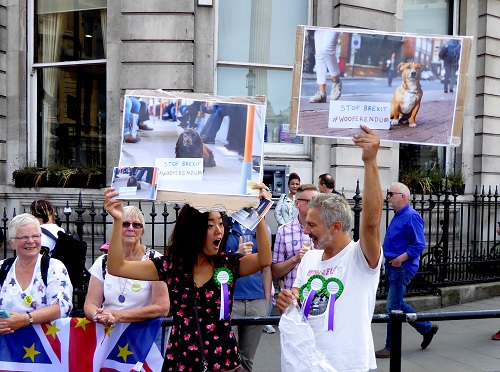
and conversing with sundry canines.


There's actually going to be a convergence of the 'Wooferendum' to 'hound' Mrs Mayhem in Downing Street, as this jolly couple advertised.


Here's a better shot of the very dapper and handsome Herr Tillmans in conversation.


And we're off. The organised signs behind us


and a specially splendid one in front.


Quickly arriving at Trafalgar Square, which yields similar shots to last time from the west side


and the south


and then down Whitehall.


I had to leave the others at Horse Guards Parade as I was off to catch an early evening and late night concert at the wonderful Peasmarsh Festival (Arts Desk review imminent), and returned on Sunday morning to a blooming Chelsea Physic Garden. Should just sign off this quick one with celebration of a true European, our very dear friend Edward Mendelsohn, a fixture here since he arrived on the last Kindertransport from Vienna. We were honoured to be at a small dinner party to celebrate his 90th birthday. Needless to say he is, touch wood, in excellent physical and mental health, and you'd probably knock 20 years off his age looking at this photo.


Herzlichen Glückwunsch, lieber Edward!

Mesnwhile, Tillmans' pre-Referendum campaign posters remain as relevant as ever:

Sunday, 17 June 2018

Ever upwards with Bach and Dante


You can see I'm in danger of being left behind on terra firma in both my big pursuits of the year, with four out of seven Bach cantatas to catch up on here - I'll deal with the other three alongside next today's in a future post - and four Dante lectures to comment upon, of which I missed one. Nevertheless I'll make some effort to be light and airy like the masters.

It seems I was premature in leaving Purgatorio behind in my previous Dante/Bach post: there turned out to be one more Warburg Institute class on the middle cantica. The most treasurable utterance, of many, that I took away from Professor Took, of many, was a very helpful summary of the Dantean essence in response to one of the questions in the discussion: 'Peope's lives are mixed, ambiguous in the extreme, simultaneously in hell, purgatory and paradise. In order to explore [the issue], he divides it out. The moment of truth lies somewhere in the unutterable complexity of the here and now'.


Even so, Dr Scafi prepared us for 'a difficult and allegorical Canto' (33, the last, of Purgatorio) in the shape of the final processional which represents the triumph of the church (sketched above by Botticelli, no less), complete with the four cardinal virtues, three theological virtues and Beast of the Apocalypse. The difficulties pale into insignificance once we reach Paradiso. Dante warns the slackers among us - and there must be many more now than in that religiously obsessive age - at the beginning of Canto 2 (with acknowledgment to Robert W Durling's literal translation):

   O voi chi siete in piccioletta barca,
desiderosi d'ascoltar, seguiti
dietro al mio legno, ché cantando varca:
   tornate a riveder li vostri liti,
non vi mettete in pelago, che forse,
perdendo me, rimarreste smarriti;
   l'acqua ch'io prendo già mai non si corse;
Minerva spira, e conducemi Appollo,
e nove Muse mi dimostran l'Orse.

O you who in little barks, desirous of listening, have followed after my ship that sails onward singing, turn back to see your shores again, do not put out on the deep sea, for perhaps, losing me, you would be lost; the waters that I enter have never before been crossed; Minerva inspires and Apollo leads me, and nine Muses point out to me the Bears.

Despite the comfort of mythological and classical signposts, the Christian theology, albeit that Dante has such a singular take on much of it, is what makes so many of Beatrice's homilies rather hard for the contemporary reader. So is the assurance of a now outdated cosmology; it can't all be taken as poetic metaphor, after all. Nevertheless, the guidance of our Warburg Dante and Virgil (who has long disappeared from the scene in the Divina Commedia, of course), and the thoroughness of the notes to the Durling edition (of which the Paradiso volume runs to 873 pages) make the most difficult journey worthwhile.


The best of our two most recent classes, for me, has been in the discussions. I'm getting antsy: why should Piccarda Donati and the empress Constanza be in the lowest sphere, the moon, in Canto 3 (pictured above), simply because men snatched them out of their nunneries and forced them into unspeakable wedlock? And why does the narrative of Dante's Thomas Aquinas about St Francis seem so hard and charmless to us, expecting at least something of the goodly saint's conversation with nature?

Dante's Beatrice provides part of the answer when it comes to the two paradisical ladies in Canto 4: they merely appear in the moon, and actually adorn the first sphere, the Empyrean. It's a matter of conscience. Well, that's half satisfactory. And Prof. Took thinks that the narrator Dante is playing the serpent when he asks them if they don't desire a higher place. Smiling and joyful Piccarda replies that 'it is constitutive of this blessed to stay within God's will, and thus .our very wills become one' ('Anzi e formale ad esto beato esse/tenersi dentro a la divina voglia/per ch'una fansi nostre voglie stesse', 3.79-81).


As for Francis, the harshness is to do, as Prof. Took put it, with Dante's 'stringent selectivity' - he has an axe to grind with the Dominicans and their tendency towards luxury in opposition to the Franciscans, led by a man who took Poverty as his Bride. He's 'too angry', has 'too much of an agenda' to spend time on the birds and the beasts.

Bach doesn't always do the expected thing, either, though his line of communication is always direct thanks to the expressive power of music. His first Ascension cantata for Leipzig, 'Wer da gläubert und getauft wird' comes not with trumpets and drums but an exquisite halo of two oboi d'amore, a short if uplifting opening chorus and an affirmative tenor aria with ardent violin obbligato. Loveliest is the chorale for soprano and mezzo in imitation with dancing continuo support, as Brides of Christ complete with joyous 'eia's- irresistible when Rilling's soloists here are Arleen Auger and Carolyn Watkinson.


That fine alto distinguishes BWV 44, 'Sie werden euch in den Bann tun', with a superb aria alongside oboe and bassoon. The opening is surprising: two parts of the text run respectively as a duet for tenor and bass and a harmonically wayward chorus in faster tempo. The chorale for tenor here has a distinctly weird, chromatic accompaniment from bassoon, there are fabulous adventures from the bass line in the virtuoso soprano aria, verging on the Handelian, and the closing chorale is familiar from its similar setting in the Matthew Passion.

BWV 172, 'Erschallet, ihr Lieder, erklinget, ihr Saiten!' for Whitsunday, is much more what one might expect for Ascension. It comes as no surprise to learn that its three celebratory trumpets, which go virtuoso-crazy in the bass aria (a good, if short alternative to Handel's 'The Trumpet Shall Sound'), were originally meant for a secular celebration, but they suit the celestial setting of the Weimar chapel (pictured below, no longer extant, alas) for which they were destined in 1714. The tenor aria offers some room for reflection, and a presumably deliberate harping on minor seconds in the 'weh' of 'wehet'.


Intimacy is apt for the Whitsun Monday and Tuesday cantatas, both of which begin with charming recitatives. BWV 173, 'Erhöhtes Fleisch und Blut", is another cantata adapted from a profane congratulatory set. It haas a radiant beginning (plus a non-chorale final number, unusual but not unique among the cantatas) and a lilting 6/8 tenor aria (beautifully sung on the Rilling set by his regular, Adalbert Kraus) with flute doubling first violin line to strong effect. The most original number, in which each of three verses, first for bass, then soprano, then the two together, is treated with increasing elaboration, is ruined by the only inadequate soprano I've heard on the Rilling set so far; let's hope she's a one-off.


BWV 175, 'Er rufet seinen Schafen mit Namen' captures the good-shepherd pastoral aspect with three recorders - and we're back to excellent soloists - Watkinson, Schreier, Huttenlocher - exchanged for two very florid trumpets before the finale choral reverts to the original colouring. Last night, in the only one of the three Gardiner cantata sequences I was able to catch over the Bach weekend at the Barbican, there was equal rustic beauty in the perfect correspondence between countertenor Reginald Mobley and Rachel Beckett and Christine Garratt on two transverse flautes for the aria 'Wohl euch, ihr auserwählten Seelen' in BWV 20. But I feel that's all I can write on the evening's cornucopia of riches for now, lest you feel drowned in BWV numbers. More anon.

Tuesday, 12 June 2018

Talks with two great artists


I'm not overstating the case, even if I do regard both as friends.


Dame Anne Evans was the Brünnhilde I saw in what remains by all accounts the last great Ring seen at Bayreuth to date, Harry Kupfer's, with Barenboim conducting and John Tomlinson as Wotan. She was also a superb Isolde with Mackerras. But her career embraced many surprises, as we heard at the Wagner Society. Everything there beautifully organised - for the first time in my experience of composer societies - by Henry Kennedy*, down to photographs taken by Ben Tomlin.


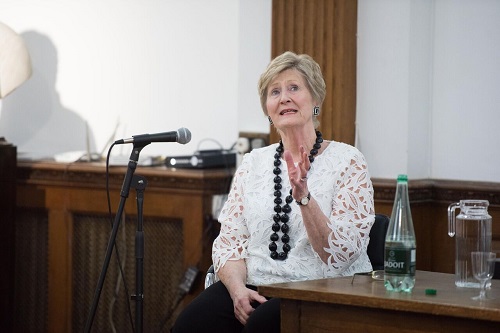
Kaupo Kikkas I first spotted moving very silently around the concert hall in Pärnu, with a muffler on his camera's click button. He took superb photographs of the Järvis and the Estonian (formerly Pärnu) Festival Orchestra, and continues to be the best musical portraitist, in my opinion. But he also surprised me when he sent a file of his 'Treescape' project, definitively answering the question 'is photography art?' with a resounding 'yes'. I was very honoured when he asked if I'd be the 'moderator' in an event to mark the end of his exhibition at the Estonian Embassy, about which I'd earlier written here. The above photo was taken by Roger Way; the other two of the talk below and lower down by Helen Mäerand.


In order of appearance, then, Ann(i)e first. I interviewed her about Wagner in the 1990s, but I first started to get to know her when she came to my Opera in Depth class with Susan Bullock. And to prepare for the talk, I paid a visit on a sunny afternoon to her, delightful husband John Lucas (biographer of Klemperer and Goodall, inter alia), and adorable one-eyed dog Izzie - as in Isolde, though a sex-change to Wotan would be even more apt - at their Islington home. We decided on the examples we'd play from an impressive archive which went back as far as her first Wagner in December 1967 - a snippet of her Wellgunde in Das Rheingold. As John remarked, and I sincerely agreed, you could tell the voice immediately; her sound has always been warm and distinctive**. She was then a student in Geneva, and she and two colleagues (one was Katherine Pring) got to sing Rhinemaidens, Valkyries and Norns in a professional staging.


Verdi and Mozart were more often on the cards in those days. We heard a very Italianate portion of the 'Libera me' from Verdi's Requiem conducted by John Barbirolli in the Royal Albert Hall on 3 March 1969 - another collaboration with students - and a stunning Traviata 'Sempre libera' with Mackerras at the Coli in the autumn of 1973. Because of CM, no high E flat just before the end, but the rest proves she could have done it. Lovely ornamentations in the da capo of 'Dove sono,' also under Mackerras's guidance.

And then, of course, Brünnhilde, with snippets from the film of Kupfer's Ring. Much discussion of the 'coming on running' instruction from Kupfer, how a dancer told Anne to hold the breath so that she could release it on arrival. And of how for the awakening scene in Siegfried, he wanted her to imagine a butterfly released from its chrysalis. Jerusalem was as much of a great colleague as John Tom, she says.


Our grand finale moved everyone, I think. If I were to go for an Immolation Scene on CD, it would be Flagstad's with Furtwängler in Rome, 1950 (Michael Tanner played it in his contribution to the German Romantic Opera study day I curated in Birmingham). On DVD, it would be not from a production, but this - Anne with the stunningly good National Youth Orchestra of the Netherlands conducted by a hirsute younger Mark Wigglesworth in a hot open-air summer concert in Nijmegen on the banks of the Rhine. 14 July 1995. The second half of the concert was excerpts from Götterdämmerung, all worth watching; for the Immolation, go to 19'35.


Next talk at the Wagner Society is with Peter Conrad, always a thought-provoking speaker and writer, on Wagner and Shakespeare on 12 July; I look forward to being enlightened...

As I was by humble Mensch Kaupo a couple of weeks after the Wagner Soc event. I was delighted to receive a Treescape photo in a thick glass block - namely this one -


and a copy of the book based on his latest project, Saja Lugu, a centenary project to photograph 100 Estonians of all ages and from all walks of life. It had its origins in a similar venture Kaupo worked on in Tyneside with our mutual friend Jonathan Bloxham at his Northern Chords Festival. If only every town and every country had the resources to honour its people like this.


After spending two hours in his subjects' company, he took two photos - one a close-up portrait in black and white,


the other a colour image of the person in a setting dear to him or her.  There is no better way to connect with that wonderful country as it is today.


I marvel at the candour with which the folk engage with Kaupo. There isn't so much the culture of smiling inanely at the camera which makes so many photos here unnatural, as if everyone is always having a jolly time. You can see the history in the older folk, the openness of the young.

Kaupo's natural curiosity and lack of arrogance ensure all his portrait subjects are themselves, in a true dialogue with the photographer. He is especially proud of his many photographs of Arvo Pärt,


and in addition we discussed his several stays with the Matsés tribe down the Amazon; he won't do it again, he says, because the relationship between the gringo and the native is too precarious not to damage something. He pointed out that while the tribespeople do follow their traditions in certain rituals - the older women still sport decorative whiskers in homage to the jaguar -


they more often dress in t-shirts and baseball caps. But their cooking and essential ways of life remain the same as they always have been.


I should add that Kaupo trained at first as a musician at the Tallinn Music School and the Estonian Academy of Music before going on to study photography in Helsinki. Typical of his multifacetedness is that here in London he was guiding fellow Estonians around his own 'secret' places along with the familiar - many of this haunts I don't know myself, so I must take them up.


By way of footnote, I should mention one more Embassy event - this time at the Czechs' handsomely renovated Brutalist building in Notting Hill. It was a chance to hear the first-rate Pražák Quartet, who've recently taken on a new first violinist, Jana Vonášková. Her great artistry shone especially in the improvisatory feel to her solos in Dvořák's 'American' Quartet.


Their all-Czech programme was generous, but the revelation for me, because I hadn't heard it before and fell instantly in love, was Josef Suk's Quartet No. 1 in  B flat, full of personal touches both harmonic and melodic, rarely predictable.


While I do find the Asrael Symphony rather long in getting to its devastating payoff, I'd count this relatively early work as a masterpiece. There's even a recording - trust YouTube, at least for the first movement - with Suk himself playing it as second violinist of the Czech Quartet in 1928.


*Young and very enterprising conductor and clarinettist who's just completed his studies at the Royal Academy of Music. He's put together a concert in aid of Parkinsons' UK at St John's Smith Square this Friday (15 June), with fellow students playing and a senior Beethoven Piano Society of Europe prizewinner, Andrei Iliushkin, in Beethoven's Third Piano Concerto, followed by Bruckner's Third Symphony. Book here.

**And now she may have an Irish successor. As one of the Royal Opera's Jette Parker Young Artists, Jennifer Davis sang Mozart, Nielsen and Bizet, very meaningfully, at our 2017 Europe Day Concert (pictured here with Jonathan Bloxham by Jamie Smith)


and took over the role of Elsa in Wagner's Lohengrin at the Royal Opera from Kristine Opolais. Total, if unflashy, triumph, winning the loudest applause, cheers and footstamping of the first night. Rupert Christiansen, in the Torygraph, went for the 'star is born' line in the opening paragraph. I felt I ought to keep perspective in my Arts Desk review since we regard her as 'our Jenn', but there was no denying the evenness throughout the range, the brilliant top - in marked and not inappropriate contrast to Christine Goerke's Ortrud - or the authority of goodness she brought to bear against her hater in Act Two. Here she is in Act Three as the wedding night starts to unravel, photo by Clive Barda.