Tuesday, 14 September 2010

Striding the Nar


So we did it - our longest churches walk with the fewest gems, perhaps, but some of the loveliest and most varied west-to-central Norfolk landscapes in between: 18 and a half miles, 14 churches by virtue of including numerous ruined priories along the way.

Why so many? Because the river Nar clearly watered and powered the communities - and very rich most must have been, to judge from edifices like the Pentney gatehouse seen in the distance across the Nar in the second picture up top. My fellow walkers are mere dots in that shot, already across the bridge and heading across the field, so I'm permitted to feature them at slightly closer quarters about to enter the most substantial and airiest church we encountered, All Saints Narborough, before a familiar end reaching Castle Acre at sunset.

So - lots of pictures, hope the details will keep you occupied and help the cash to flow (cheques payable to the Norfolk Churches Trust, please, if you feel inclined to pop anything in the post). We started off in humid, low-cloud weather with a taxi ride to Wormegay, where St Michael is eventually to be found up a long track - and closed. Nothing to detain us about the late-Victorian rebuilding of the nave, so we moved on with initial vigour through Shouldham Warren, where the sandy soil and birches of central Norfolk meet the black soil of the fens, to All Saints Shouldham.


Lovely situation, this, looking down the gentle slope to the handsome if over-restored Abbey Farm. And we were able to see more here than Simon Knott, in his wonderfully eloquent survey of 848 churches to date, since we were greeted by an unoccupied table with barley water on it and an unlocked door.


The interior's rather uncared for and dark, with a Victorian chancel, but it does boast a splendid medieval hammerbeam roof with angels extending - what, tongues, trumpets? (Why does Pevsner so rarely mention the angels?)


On, then, past rich pickings of blackberries and an intriguing farm with old walls and a moat, to Marham. Thumbs down to the Anglicans, who kept us from seeing Holy Trinity's monuments by locking it and passing the buck to the Methodists down the road. Full marks to the latter, though, for serving us tea and coffee in a room cheerfully muralled by local children.We entered the chapel to find our hostess strumming on the harmonium, 'for my sins', as she put it.


We could have clocked up three more churches on the RAF base up the gentle hill, but that would have meant a detour of a mile and a half, so on we struck out along the Hogg's Drove, a reminder of last year's open fens and big skies.


And there, beginning to shimmer in a slowly-emerging sun, was the Nar, and opposite, its top just visible above treetops, the gateway of Pentney's Augustinian priory, founded before 1135. Would it be worth the detour along the river in the opposite direction to cross a bridge and see it at close quarters? I thought so. And heaven indeed it turned out to be, seeing the gate emerge alongside its adjacent farm


just before we came to a bend in the river, approached and found ourselves fixed by the gimlet eye of a lady on a lawnmower. There were various keep-out signs by the gateway entrance proper, but nothing to stop us staring at close quarters, which we did for about ten minutes


before retracing our steps and finding the perfect place for a picnic. The next stretch was the longest between buildings, but surely the most beautiful, as the open river scene


became more enclosed and the waters began to race, accounting for the disused waterwheel.


Past a copse which seemed to have been ripped up by a mini-tornado, we arrived sweating a bit at Narborough, where we were rewarded at All Saints by a human being at last and the now-necessary liquids. And the best monuments. Catching the late afternoon light opposite the porch was the first of several monuments to the local worthies. This one's for Sir John Spelman who died in 1662.


The others are in the chancel. Sir Clement Spelman and his wife recline in an alabaster monument, above them a kneeling daughter and a baby in a cot.


The baby turns out to be the younger Clement, whom we find opposite in all his worldly grandeur as Recorder of Nottingham sculpted by C J Cibber, c. 1672 - how far removed it seems from the milieu of his parents.


He should have merited an elaborate niche, and his coffin in what was originally an eight foot pedestal should have been left in peace. But in transporting the statue from a central place in the chancel to the south wall, the pedestal was cut down, the coffin chucked out and presumably Clement the Younger left to receive the trampling feet of the living over him he'd tried so ingeniously to avoid.

Narborough's medieval gem is its group of 15th century angels in the tracery of the north chancel window. Simon Knott has more information on them than any other guide I've got, including the flimsy church leaflet, so let's quote him on the orders. They are 'Thrones, a small angel in white; Powers, a blond angel vigorously birching a devil, his scroll reading Potestates presut demones ("powers put down demons"); Virtues, an angel in purple; Angels, an angel in gold; and my favourite, Cherubim, an angel in white protecting earthly citizens.' Don't know how well you can see them all here, but you can always click to enlarge.


Two cyclists who were zipping between churches told us we shouldn't miss nearby Narford Church, which we hadn't been sure would be open - but apparently it was, until 5, so briskly we crossed the busy main Lynn-Norwich road and soon found ourselves in another world. The sparsely-pined heath is part of the Narford Hall estate


and the church of St Mary now stands in the grounds with the Hall's lake just beyond. No doubt the villagers were removed by the lord of the manor, because of the original 200 houses none remains. But the situation is beautiful.


Yet despite some financial help with the roof in 2000, the church interior is in a sorry state. This is exactly the sort of building we're walking to save. Damp assails the walls, mocking the lofty coats of arms with the three jolly little elephant heads on them


and it seems surprising in such a declining interior to find a bust of proud Sir Andrew Fountaine by Roubiliac.


No refreshments here, so waxing weary now we rejoined the Nar Valley Way and headed for West Acre. The church was closed, but the sight of it standing alongside another priory gateway meant it wasn't a wasted visit.


And there are some interesting features on the exterior - a porch with a skull above it approached by a dark yew avenue, two gravestones side by side bearing the names 'Softly' and 'Everard' and the clock with its twelve-letter invocation


by which you will see it was nearly 6pm and our final destination beckoned. What a long two miles it seemed to Castle Acre, even if we approached it via further glimpses of the Nar, a shady oak wood


and water meadows nearing sunset with the church tower beckoning elusively in the far distance.


The approach took me by surprise. First the tower re-emerged at closer quarters


and then the famous priory where I'd left my camera at the start of the 2006 walk (some of you might have wished the same had happened last weekend).


An awe-inspiring walk along the fringes, and past the big barn there we were in the centre of Castle Acre, without the thronging tourists because it was already 7pm. Yet the church, amazingly, was still open, and so I went in with Cally, who hadn't seen it. A grand interior, but not anything like as pleasing as Narborough or indeed St Nicholas in King's Lynn. The angels are in the detail, three misericords including this one


a pulpit dating from 1400 with fine paintings of the four Latin fathers of the church (two featured here)


and a rood screen probably by the same artist, this time featuring the twelve apostles (again, two in the picture).


So you see that, weary though we were by then, my touristic obsession hadn't deserted me. This was because drinks and a fish supper awaited us in the classy pub by the green, The Ostrich, and after that a conveniently located car to take us back to Lynn. Relishing the prospect of both, we hobbled away from the church in the sunset.


From the length of which you may detect that I've been shirking some rather unpleasant work. One act still to hear of Michael Berkeley's turgid opera To You, with an equally stodgy libretto by Ian McEwan. Now it has to be faced. I hope I live to tell the tale.

Monday, 13 September 2010

It is now


All over, the Proms, that is. Except for Radio 3 repeat broadcasts and iPlayer remains, which give you three days to hear Noseda's shatteringly beautiful, fleet-footed Mozart 40th and the singular Dorothea Roschmann in Robin Holloway's Schumann/Mary Stuart treatment (not going to give its full name here). Above are soprano, composer and conductor in the nearest I got to a big farewell. Chris Christodoulou took the picture, and I'm so pleased he came up with a gallery of the season's wackiest conductor shots for The Arts Desk. No-one catches the moment better than this. And the piece is cross-referenced to list all our reviews of the top Proms.

Highlights out of the 16 I attended? Well, there were good things even in the most familiar places. Number One remains the Dausgaard Danish Prom with the Langgaard Music of the Spheres centrepiece. I enjoyed Ashley Wass in the Foulds Dynamic Triptych, and his conductor Donald Runnicles' ineffable way with the slow movement of a curious Elgar One; Julia Fischer, peerless in the Shostakovich First Violin Concerto with Jurowski and the LPO; the revelation of Stravinsky's Threni under Atherton; bits of the Sondheim evening, though not the whole; the moving-to-tears semi-staged Hansel and Gretel under Ticciati; and all of last Monday night, from Deneve and Lewis to Spinosi, Jaroussky and Lemieux (that late nighter gets my special rosette for most unexpected gem of the season, maybe the entire year, let's see). Only saw the Meistersinger on the box, owing to a Saturday of afternoon parties, but of course I'd been there in Cardiff and Bryn should be showered with awards for performance of the year, whatever else happens between now and Christmas.


Heard odds and sods of the Last Night on the car radio driving back to King's Lynn from Castle Acre, our final destination after what turned out to be 18 and a half miles and 14 churches on our annual walk. Full report with pics to follow. The Onegin Polonaise didn't sound good enough for Belohlavek, and it turned out to be from the Ulster Orchestra in Belfast. There was a soporific guitar piece, a very classy Thais Meditation solo from the leader of the BBC Philharmonic, and Dame Kiri sounding sluggish but still rather youthful singing 'O mio babbino caro' in the park. We only caught the Chabrier Marche Joyeuse from the second half as the car pulled in to old Lynn, but how I love that piece (especially in Ansermet's recording).

And the Prommers - don't moan about them, please. They raised what now stands at an unfinalised total of £90,400 for musical charities - the Musicians' Benevolent Fund, the CLIC Sargent charity which helps to provide music therapy for children with cancer and the Otakar Kraus Music Trust which does the same for children with special needs and their families. Do you know, some joyless bastard on the Radio 3 messageboards complained about the 'self satisfied' chant the Arena crew gave out every night to keep the audience informed. And was duly rebuked by a regular telling him that it was a legal requirement by the hall and the BBC. Bravo, anyway.

Talking of legal requirements, blogger Intermezzo seems to have received an apology from the Royal Opera over its litigious objections to her using production shots. I came up against the same barrier last year, when I wanted pics of Lulu, only to be told they didn't allow bloggers to use the press images. But they thought they might make an exception if I sent them the copy. I did; they never responded. Later I used a Rosenkavalier image and was told by the press office to remove it immediately. It all seems so foolish as this is free publicity, surely; and no other arts institution I've encountered has ever raised the slightest objection. Mind you, I can see there's a grey area about curtain-call photos, and anyway I find them deeply boring. Unless, of course, they're taken by the consummate Mr. Christodoulou.

Thursday, 9 September 2010

The show's not over...


etc. And even then, I've still one more Prom to go tonight. Would have been quite happy, though, to take my leave with the quite unexpected fireworks of Monday's late-nighter featuring the ravishing-toned Philippe Jaroussky and irrepressible true contralto Marie-Nicole Lemieux (pictured above for the Proms by Chris Christodoulou, who also took the below shots and whose copyright they all are. We hope he'll be featuring in an Arts Desk Proms photo retrospective on Saturday).

You can read what I thought about it here. And it seems like an appropriate place to thank the Arts Desk for pushing me in unpredictable directions, since a baroque late-nighter of Vivaldi, Telemann, Handel and Porpora isn't something I'd have chosen to go to myself. Especially after a Prom I truly did want to hear, the RSNO concert of Berlioz, Beethoven, MacMillan and Respighi, because I knew what to expect from the wonderful Stephan Deneve. I stayed on to hear fiery Corsican Jean-Christophe Spinosi and his Ensemble Matheus only because colleague Alexandra had to call off due to the tube strike. And like most, though not all, of the audience, I found Spinosi's febrile intensity irresistible, especially in the final stamping, hollering tziganery of the Corelli Concerto for recorder and flute. Here he is sparring - as I gather he does to the point of fisticuffs - with his players


and with his delightful soloists after an anything-you-can-do adaptation of a Vivaldi aria for rival divo/a/s. One BBC Messageboard contributor even thought that Jaroussky and Lemieux were giving us a Kenneth and Hattie after all that refinement and passion.


Anyway, the Proms are nearly over for the year but the Arts Desk has barely begun. That I hope nourishing source of thought and feeling, which has given me free rein to dip into theatre, ballet, cinema and TV as well as my familiar stamping grounds, celebrates its first birthday today. I'm a little younger than that in TAD terms, but I feel old in contributions. Here's to hoping it continues to take off and finally earn us a crust or two as well as the sheer, sometimes indulgent pleasure of culture-vulturing at length.


Oh - and happy Rosh Hashanah, too!

Wednesday, 8 September 2010

Fixing to stride


'Ride and stride' is what the Churches Conservation Trust helpfully dubs this coming Saturday's mix of cycling and hiking to fundraise. When we started walking for Norfolk Churches back in 2002, pedestrians were very much in a minority and I see the form still has the 'Sponsored Bike Ride' logo.

Anyway, we're still at it and any donations will be gratefully received. This time we should pass the 100 churches mark, and I only hope it's as beautiful a September day as it was last year when we strode across the Fens from Walpole St Andrew to Wiggenhall St Mary Magdalene (along the Great Ouse to the ruined Wiggenhall St Peter pictured above).

I was hoping for more Fentrudging this year, but team leader Jill has worked out what sounds like a fair 16-mile route from Wormegay along the river Nar to familiar territory, the resplendent Castle Acre.

As a rather opulent token of what we're striding to preserve, a return to St Margaret, Cley-next-the-Sea won't do any harm. We covered it on our second walk in 2003 but as it was the end of the day we didn't have much time to look around, so we went back when we were staying with Susie Self and Michael Christie this Easter.


Now landlocked, St Margaret once stood proud above a busy river. Its proportions are odd: a great west window, a squat tower, a huge nave and a disproportionately humble chancel. But it does have many treasures, starting with the early 15th century south porch. Guides make much of the shields, but are curiously wary of mentioning this sinner whose bare bum is being tanned by devils.


The corbels above the pillars in the nave are tamer, but even more splendid as many have their original colouring. Here are a strolling player striking his tabor


and a lion with a bone in his mouth


Other features are shared with the best of Norfolk's countless churches. They include one of two prayer boards


a fair amount of medieval stained glass


and some splendid brasses, including this group of six sons looking up at their dad from c.1450.


This is what we're trudging to save. Gi's a penny or two (preferably a cheque, made payable to the Norfolk Churches Trust). Or just wish us fair weather and none of the incidentals - pouring rain, wasp stings, step-tripping, speeding fine on the return journey to King's Lynn - which bedevilled our only disastrous walk of the seven we've done so far.Anyway, I promise, or threaten, a report of Saturday's progress in due course.

Tuesday, 7 September 2010

Property race


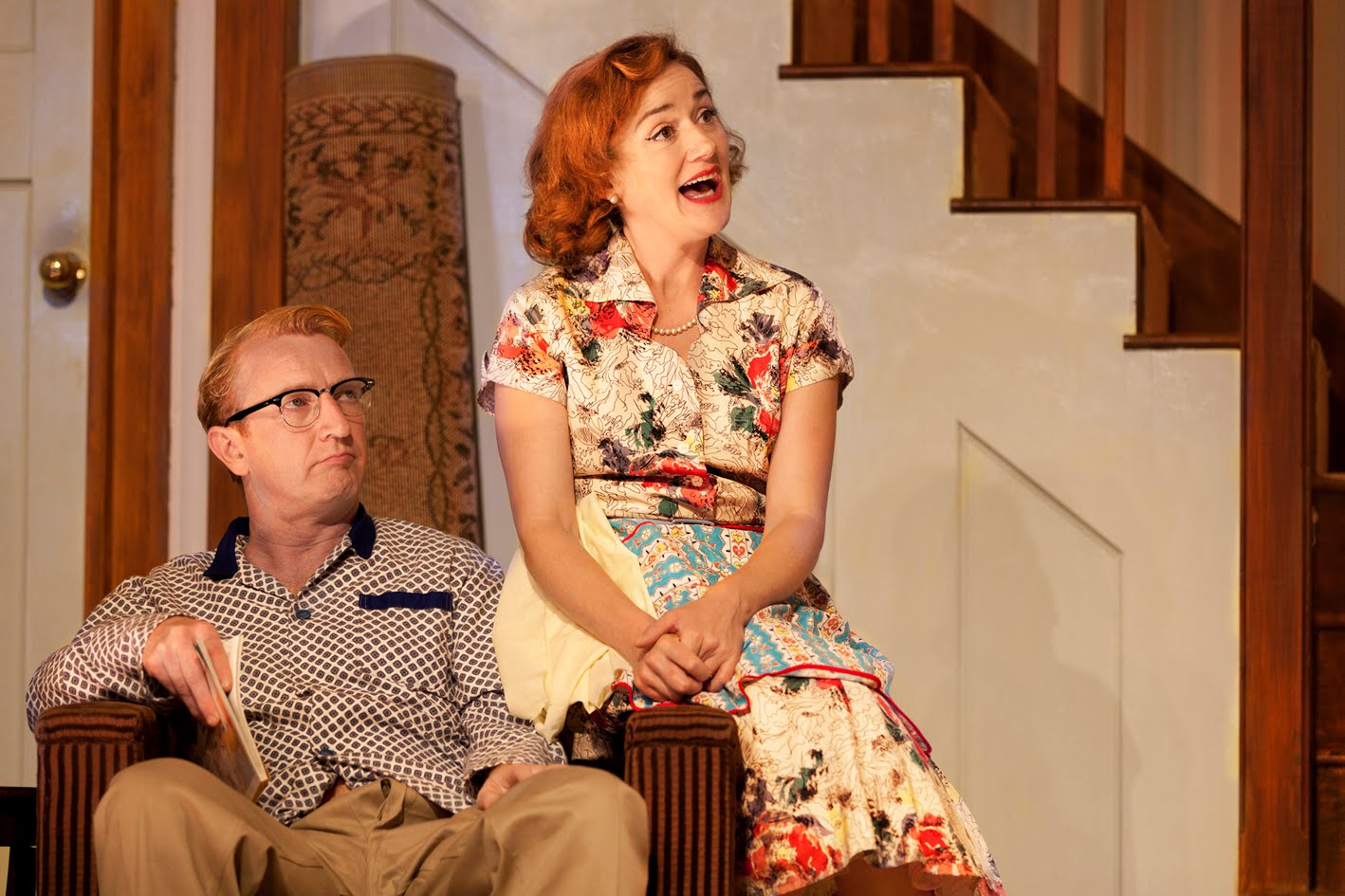
As word-rich as Jez Butterworth's Jerusalem it isn't, but Bruce Norris's Clybourne Park has enough thoughtful entertainment value to transfer from the Royal Court and earn a respectable West End run. It's a true ensemble piece, a bit like a more conservative, realistic version of Caryl Churchill's Cloud Nine inasmuch as the seven actors from the late-fifties first act turn up in different roles half a century later in Act Two.

Did you recognise The Office's Martin Freeman up top? Not many in the audience did at first, as he preaches a barely covert form of neighbourhood racism while home help Francine (Lorna Brown) and her husband Albert (Lucien Msamati, fresh from his touching role in the Almeida's Ruined) look on. The production photos featured here are by Johan Persson.


Bev and Russ, the central figures of Act One, are a suburban couple recently bereaved by the suicide of a son who's done unseemly war things to civilians in Korea. The husband (Steffan Rhodri) isn't prepared to hide his depression and anger; Sophie Thompson as the wife overdoes the false brightness at first, but is immensely touching towards the end of the act as she tries vainly to communicate with a flabbergasted Albert: 'Maybe we should learn what the other person eats. Maybe that would be the solution to some of the - If someday we could all sit down together, at one big table, and, and, and, and...'

Act Two shows us that in 2009 everybody is tasting everybody else's food: the black couple have been to Prague too. But nobody is really sitting down at one big table, even if they've come together to discuss a white couple's plans to pull down the same old house and infiltrate what has now become a predominantly black middle-class neighbourhood.


This is where the dialogue truly crackles, culminating in an outrageous stream of racist jokes from both sides. It's a participatory experience - you can hear the audience gasp, tut and finally collapse in helpless laughter (well, you could on Thursday night when I went).

I'm not sure about the point of the quiet coda, nor quite how much this play will stay with me in the long term, but it's beautifully designed (by Robert Innes Hopkins), hauntingly lit (by Paule Constable) and incisively projected by a fine team of actors.

Monday, 6 September 2010

Father, son and English scenes


Having pompously thought of myself as 'citoyen du monde', I realised how through this blog Englishness seems to have become a recurrent theme in my middle years; English churches, music, paintings, books keep popping up in the cosmopolitan mix like an inescapable rondo theme. I hope I'm no would-be ruralist reactionary, but I'm not ashamed to declare how passionately fond I've become of the works of Eric Ravilious - through that superlative Imperial War Museum exhibition 'Imagined Realities' - and Edward Bawden.

Their sons have followed the tradition in their own different ways, too. We made sure to catch the last day of the 'Familiar Visions' exhibition featuring the works of Eric and James Ravilious in the father's old stamping ground of Eastbourne, where the new Towner Art Gallery tucked away unsigned alongside the Congress Theatre houses quite a collection. And while I marvelled again at Eric's sometimes disconcerting mix of straight lines and curves, the human and the natural, in those now-familiar watercolours, it was the photographs of his son, born only a few years before his untimely death in the Second World War, which brought tears to my eyes.

Almost immediately, in fact, with a vast 'View towards Iddesleigh and Dartmoor, Devon, leading you into infinity down a lane between frost- and sheep-covered fields. I don't know why, but I felt I knew and loved this scene at first sight (in a sense, I do). But James wasn't just a poetic black-and-white snapper of landscapes. He got to know and be trusted by the local community, and took about 80,000 images recording a vanishing way of life for Devon's Beaford Archive. He never posed his subjects but caught them in action - stooksetting, muckspreading, lambing, shearing, orchard-shaking. His favourite subject, old farmer Archie Parkhouse, must (I'm crudely guessing) have been something of a surrogate father figure - Archie, James and his idol Cartier-Bresson all shared the same birthday. Here's Archie taking ivy for his sheep on the cover of an indispensible book:


Apart from the fact that I can't seem to contact the Towner for copyright permissions, I don't think that otherwise reproducing some of the photos here would do them much justice. You can, though, see the entire half-hour documentary narrated by Alan Bennett on YouTube. As usual, I recommend clicking on the picture once you've started to get the fullscreen version over on the site proper.


James comes across as such a sincere, gentle man. He certainly wasn't trading on the 'Ravilious': when he went to St Martin's College of Art, he took another name. And you never get the feeling that the Devonians felt some toff was intruding on their turf.

I should finally point out that the exhibition - finished now, alas - covers much more than just photos and watercolours. There's also a wonderful room half-filled with Eric's woodcuts, which I heard some of the many visitors declaring they liked best. And it's quite a size too - four sizeable galleries, all well themed and, in the case of Eric's work at least, complemented by eloquent if slightly over-interpreted commentaries. It makes the South Downs exhibition on the first floor seem rather tame by comparison.

Sunday, 5 September 2010

Julia at midnight


I'm obsessed. By the master's infernal, internal rhymes; by the little bean-cells that sprout tunes; by the whole intricate fairytale-meets-human-dilemma machinery of Sondheim's Into the Woods. Having seen that far from perfect Regent's Park production, I ordered up the original London cast recording to take me back to the palmy days of Richard Jones's show (I went twice, and the second time I took my pal Stephen Johnson to convince him this was up there with the greats. He agreed).

Well, further examination leads me to an outlandish claim: this stands in the same relation to Sweeney Todd as Britten's Turn of the Screw does to Peter Grimes or Billy Budd. It has something like the same thematic rigour, the same symmetries, and even some equal felicities of chamber scoring from Sondheim's inimitable house orchestrator Jonathan Tunick.

Most of it doesn't work out of context. But the track I've been playing over and over again is Julia McKenzie's Witch delivering the apocalypse-now of 'The Last Midnight'. It's the apogee of what I'm guessing is Sondheim's (and Tunick's) obsession with Ravel's scarier waltzes. Especially the burbling clarinet against my favourite lines (witch to world: 'You're just nice. You're not good, you're not bad, you're just nice. I'm not nice, I'm not good, I'm just right.')

Alas, it's not on YouTube; you'll have to get hold of the recording for yourselves. But what I did find was sublime Julia performing Sondheim's wicked Astrud Gilberto spoof 'The boy from...' She does it deadpan, and savours the place-names like no-one I've heard. All as a riposte, I'm guessing, to Kit and the Widow's famous parody 'People who like Sondheim'.


As for 'The Last Midnight', the best I can do is a piano-accompanied version by the Witch of the Regent's Park production, Hannah Waddingham. It will give you some idea of the number's insidious genius.


The Guardian's Martin Kettle claimed that instead of concentrating on his interview with Tony Blair last week, he was plagued by the 'earworm' of Mahler's First Symphony. But I came away from the beautifully played, more questionably interpreted Berlin Phil/Rattle Prom featuring that wonderful work and found myself earwormed by 'The Last Midnight'.

Friday, 3 September 2010

Protestant Zurich, Catholic Lucerne


The Swiss, don't you know (I didn't until recently), are a lot more interesting than The Third Man's cuckoo-clock jibe would have us believe. As Jan Morris, whose Europe: An Intimate Journey accompanied me along with Ulysses on our little rest-cure, puts it, his fellow officers in 1945 would have welcomed the comment. It came, of course, four years later. For them, though, it would have expressed perfectly 'the sour judgment of a battle-scarred, impoverished imperial kingdom of epic suffering and performance upon an comfortable, well-heeled, chocolatey republic which hadn't done a damned thing to save civilization as we know it.'

Morris's own view doesn't stretch to the more recently uncovered extent of Switzerland's compromises in the First and Second World Wars, compromises which seem to have sprung all too easily from the ambiguous nature of its safe-haven status. The recent minaret debacle has done nothing to endear Switzerland to the rest of Europe. But in the long term, I think I share Morris's fundamental stance:

The Swiss are the one people who have given dignity to the idea of the Nation-State by turning it into a State of Nations, to my mind a model for us all. They have not compromised either their Statehood or their nationhoods. Their four languages [French, German-ish, Italian, Romansh] remain more or less unviolate, but in all their autonomous cantons the Swiss are the Swiss.

Having spent time in the Valais and central Switzerland in close succession this summer, I can appreciate a few of the differences (though we still need to go walking in the Romansh valleys further south-east). I also find it intriguing that after quite a few nasty conflicts, the more powerful Protestant cities established a modus vivendi with the Catholics, holding the fragile Nation-State together. After 1874, in fact, it was race rather than religion which threatened to tear things apart.

The gulf hadn't occurred to me until I spent more time in several different churches in democratic Zurich and patrician (but Habsburg-resistant) Lucerne. St Peter's (first picture up top) dates from the 13th century and its 16th century clock face is the largest in Europe, overlooking a very pretty square


but the greater part of the interior was remodelled in 1705. You can just about see the Hebrew lettering above the gospel text, 'legacy of the Reformers' desire to reclaim the fundamental sources of Christianity' as my guidebook says.And the plasterwork is very lovely. Then you find yourself in a Romanesque choir with some rather attractive wall painting.


Along with the equally light and airy Predigerkirche, it's my favourite of the Zurich churches. The Grossmunster and Fraumunster have distinctive towers/spires to grace the wonderful skyline, and famous glass (I prefer the Giacomettis to the Chagalls, at least closer to) but rather gloomy interiors.

Lucerne's three big churches all have their glories. You may remember from an earlier entry that I visited the Hofkirche just before Easter. This time I managed to catch up with the other two. The Jesuit effect (second picture up top, 1673) could be predicted from the big 'uns in Rome and a regular haunt in Vienna. That extravagance lines the Reuss


and its neighbour is very different, the Italianate Renaissance Rittersche Palace, still the seat of the cantonal government


while the bigger and older number, the Franziskanerkirche, has its own grounds - formerly those of a large 13th century monastery - tucked away behind the Jesuitenkirche. It's much more of a jumble of styles, all intriguing.


Flags were painted on the nave walls in 1625 after the original battle-snatched standards had been removed. The painted images were twice restored, at the ends of the 19th and 20th centuries.


The outlandish mannerist pulpit is by Niklaus Geisler of Schweinfurt and dates from 1628.


A final flourish comes from the late 17th century plasterwork angels of the north chapels.


It was an exhilarating if exhausting afternoon, temperatures rising fast: the grey, humid pall hanging over the start of the holiday had lifted by noon as the four-day heatwave began. So we found it a bit of a sweat doing the circuit of the town walls


but worth it for the views over city (including the KKL, home to our stupendous Lucerne Festival Orchestra/Abbado experiences) and lake from the top of the Schirmerturm.


Wednesday, 1 September 2010

Careful the things you do...


...children will see and learn. Yes, I know, Sondheim gets preachy here, and preachier still in the climactic 'No-one is alone' as Into the Woods goes all gooey, though I swallow even the latter from direct performers like Jenna Russell in Regent's Park or Jacqueline Dankworth on the London cast recording, which I finally bought off Amazon in an attempt to relive two happy performances. It was that production's director Richard Jones, by the way, who told me in an interview that he parted company from Sondheim in the last stages - 'because it's just not true that "no-one is alone" ').

But it's a sound enough message when linked in - as everything in that uniquely planned, symmetrical score is - with an earlier passage (the Witch's 'Children won't listen'). And it seems to be the message of an almost unequivocally dark masterpiece, Michael Haneke's The White Ribbon, which we finally saw at the weekend. The setting is rural Germany on the eve of the First World War. The first thing to say is that subject and cinematography are one: the dazzling, digitally-enhanced whites of summer party and harvesting scenes, the near-black interiors. Good may flourish in the dark, when for instance the teacher-hero plays the harmonium by gaslight to soothe the distress of his just-dismissed governess girlfriend, and white can be bad, like the painted door behind which the pastor punishes his dysfunctional children.


It's a bit like Bergman, but with less humanity (only the honest narrator and his slightly freaky-weird love fumble towards honest living, though you feel the powerless women of the various households want to help). Indeed, the scene where the doctor tells the midwife he's been sleeping with of his disgust for her smacks of the hapless uncle and his wife in Fanny and Alexander. But there you get to understand why Carl's become the way he has. The parents in Haneke's world are just symbols, it seems, of a decadent old-world, sado-masochistic discipline and carefully concealed abuse that the anarch-children serve to mimic or to challenge. For the whole drama to remain shrouded in mystery, it depends on the victimised children not to identify their attackers, and maybe I found that a bit hard to buy.

Yet the atmosphere of unease is compulsively suggested from the start, and there's something in common with James's The Turn of the Screw, about which the wisest comment I read was that the Governess wants the children to be too good, and the 'ghosts' want them to be too bad. And the performances in The White Ribbon, from the kids especially, are haunting and real. There's a clip on YouTube of the unforgettable scene in which the doctor's young son questions his sister about death.


Taken in the round, it's a masterpiece, and I can understand why Abbado was so impressed that he wanted Haneke to direct a new production of Berg's Wozzeck.

The debate about how much children will listen, see and learn has been a bit stoked up by sundry productions of Humperdinck's Hansel and Gretel. Laurent Pelly's reasonably light-of-touch Glyndebourne take on consumerist wastefulness came to the Proms last night, all its messages intact in the semi-staging and all involved glistening and shining under the silky baton of Robin Ticciati.


Needless to say Wolfgang Ablinger-Sperrhacke's bald, hairy-bellied fright of a Witch (pictured above with the definitive Hansel of Alice Coote by Chris Christodoulou for the Proms) set some chins wagging, and one old bloke accosted us at the end to tell us he'd walked out in disgust. But children can take it. And of course we all oohed and aahed at the semi-staging's solution to the vast supermarket-sweep 'house' of the original production: a mini Albert Hall. But of course! Yet who'd have thought it - and I wonder what Sir Henry would have made of Rosina Leckermaul sticking her pink wig on his bust. Had a good laugh like the rest of us, I hope.